Starting and Ending a Floor Routine: Poses, Transitions and Timing
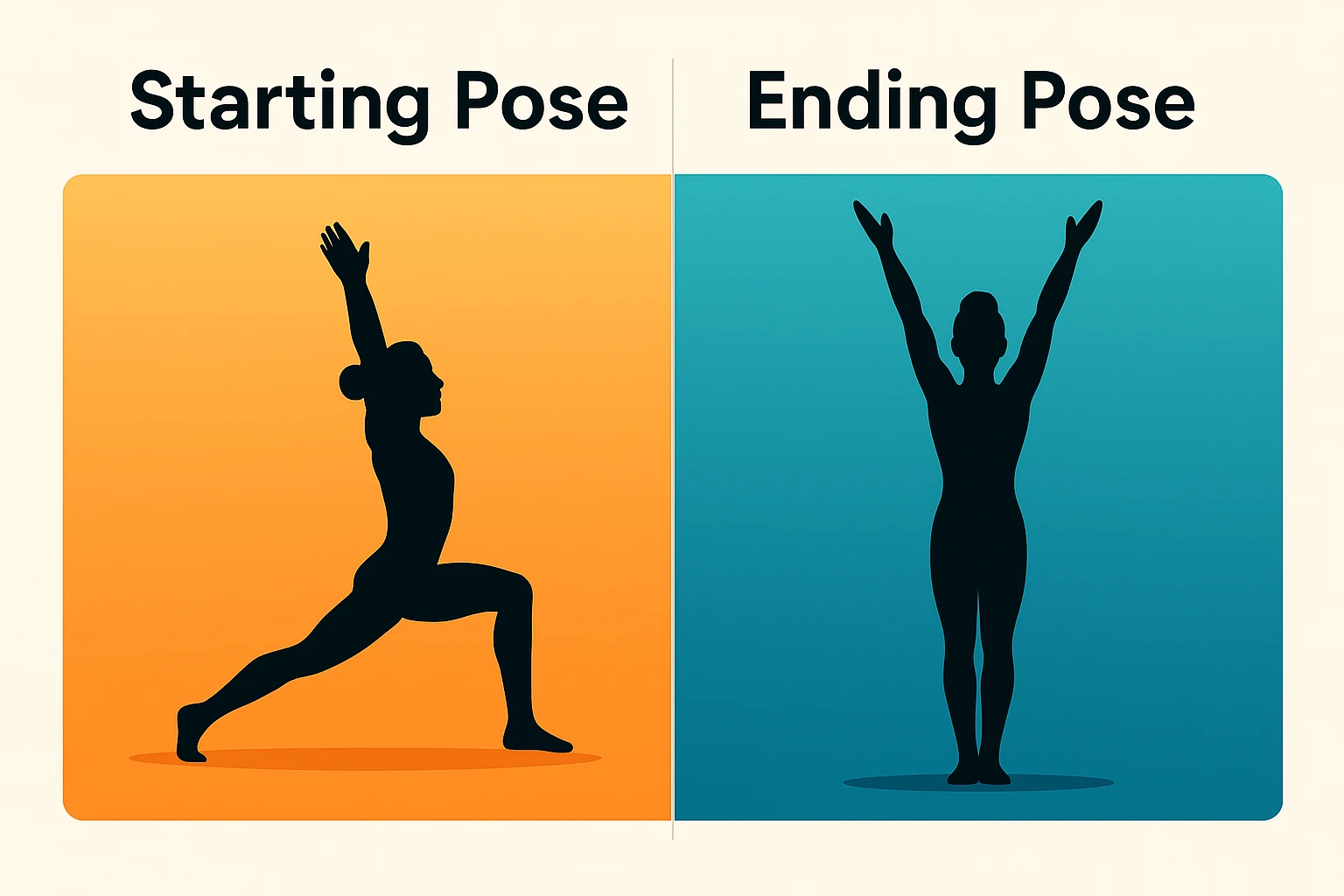
A useful starting pose leads naturally into the first movement of a floor routine. A useful ending pose grows out of the final sequence and makes the finish clear. Neither needs extreme flexibility or a dramatic expression to work well: the shape needs to suit the gymnast, the music and the choreography around it.
Contents
- The Pose and the Transition Belong Together
- Understand What Starts and Stops the Clock
- Choose an Opening the Gymnast Can Perform Clearly
- Plan the Ending From the Preceding Sequence
- Compare Ideas With the Same Questions
- Expression Comes From the Whole Body
- Rehearse More Than the Frozen Position
- Keep the Choice Personal and Practical
This guide concerns women’s artistic floor routines with individually chosen choreography. A USAG compulsory gymnast learns the prescribed exercise rather than replacing its opening and ending with personal choices. Men’s international floor has a different structure and is performed without music.
The Pose and the Transition Belong Together
A photograph shows the position; a routine shows how the gymnast enters and leaves it. An opening that looks impressive in a still image can be awkward if the first movement requires a hurried change of direction. An ending can look equally disconnected if the gymnast has to rush across the floor to reach it.
Start by considering the neighboring movement. Does the opening lead into a rise, a turn, traveling choreography or preparation for tumbling? Does the ending follow floorwork, dance or movement away from the last acrobatic line? The answer helps the choreographer select a workable shape.
For example, a low opening may allow a gradual unfolding movement, while an upright opening may lead directly into travel. Those are creative possibilities, not rules assigning every musical style to one pose.
Understand What Starts and Stops the Clock
Under the FIG women’s Code, Section 13, floor timing starts with the gymnast’s first movement and stops at the final position. The exercise must finish with the music. The audio file’s displayed length and the officially timed movement are therefore related but distinct.
A long introduction does not automatically count as movement time while the gymnast remains still. Once the gymnast begins moving, however, introductory gestures are part of the exercise even before the first named skill. “The tumbling has not started” does not mean the timer is still waiting.
No rule says a one-second pose protects a gymnast from deductions. A coach may teach a clear hold as a cue, but it isn’t a competition rule. The floor timing guide compares program limits.
Choose an Opening the Gymnast Can Perform Clearly
Begin with a small range of comfortable shapes: standing, a manageable lunge, kneeling or a floor-based position. The choice should let the gymnast show the intended character without spending the opening moment struggling to balance or arrange the limbs.
Next, try the first few movements with the music. A pose may feel suitable in silence but create a difficult transition when the musical phrase begins. Adjusting an arm pathway, facing or starting level can solve the problem without replacing the whole opening.
Ask the gymnast what they hear. A sustained note, a short accent and a gradual build can invite different responses. There is no need to make every upbeat track begin with the same sharp stance or every lyrical track begin on the floor.
Plan the Ending From the Preceding Sequence
The final shape needs enough space and a workable route into it. Mark the location after the preceding movement, then consider how the gymnast will reach the finish. A pose that repeatedly requires an extra hurried step may be revealing a problem earlier in the choreography.
Work with the musical ending as well. A decisive accent may suit a clear arrival; a gentler ending may suit a movement that settles gradually. The goal is a readable relationship between sound and movement, not a rule that every routine must stop on a loud drumbeat.
Keep the salute separate in the planning. Presenting to the judges and completing the choreographed final position have related performance roles, but they are not interchangeable movements. Ask the coach how the routine should finish under the applicable program’s rules.
Compare Ideas With the Same Questions
| Question | What to look for |
|---|---|
| Can the gymnast control the shape? | A position that can be reached and left deliberately. |
| Does the adjacent movement fit? | A clear route into or out of the pose. |
| Does it relate to the music? | A connection to the phrase, character or accent. |
| Is the location workable? | Enough room for the movement and the finish. |
| Does the gymnast understand its purpose? | A repeatable movement idea, not only a copied photograph. |
A more demanding balance is not automatically the stronger choice. Compare how the complete opening or ending works, including the transition. A simple position performed with clarity can serve the routine better than a complex shape that repeatedly interrupts it.
Expression Comes From the Whole Body
Facial expression is one part of presentation. The head, shoulders, arms, trunk and timing also communicate the routine’s character. Asking for a bigger smile does not resolve an unclear movement or a transition that loses the musical phrase.
For example, a movement can feel deliberate because the direction of the gaze follows the body and the gesture finishes clearly. Another can feel uncertain because the gymnast is still arranging the arms after the rest of the pose has stopped. These are practical observations to discuss with the choreographer, not a spectator’s deduction chart.
The artistry explanation puts presentation in its scoring context. An opening pose does not have a separate universal “impression score,” and a fixed list of deductions should not be invented for every possible shape.
Rehearse More Than the Frozen Position
Practise the opening together with its next movements, and the ending together with the sequence that leads into it. That reveals problems a static hold cannot show. The coach can decide how to rehearse these sections within the gymnast’s training plan.
When using video, include the whole body and the surrounding floor. A close-up can hide a late step or a cramped route. Review the clip at normal speed before using slow motion, because the relationship to the music happens in real time.
If the audio edit changes, recheck both ends. Removing a few seconds near the start can shift later cues, and replacing the final phrase can change the available transition. The music-timeline guide explains how to record those relationships.
Keep the Choice Personal and Practical
Bring two or three workable ideas to the coach or choreographer, then compare them in motion. Explain what feels comfortable and which musical moment the gymnast wants to express. That gives the discussion a useful starting point without assuming a famous gymnast’s pose will fit another routine.
Once the choice is settled, record the approved version and its transitions. A clear, repeatable opening and ending give the gymnast a defined way into and out of the performance while leaving the full routine’s tumbling, dance and musical interpretation at the center.