Parents, coaches, and young athletes often ask:
“Which sport is the toughest for girls?”
- 1. Gymnastics — The Ultimate All-Around Challenge
- 2. Ballet — Discipline, Perfection, and Physical Strain (Often Underrated)
- 3. Swimming — Endurance, Repetition, and Mental Grit
- 4. Figure Skating — Power, Balance, and High Pressure
- 5. Soccer — Speed, Strength, and High Injury Risk
- 6. Competitive Cheer — Strength, Stunts, and Zero Margin for Error
- 7. Track & Field — Pain Tolerance and Mental Drive
The truth is that “toughest” doesn’t have just one definition. Girls face unique challenges in sports depending on their age, body type, mental makeup, and the demands of the sport itself. Some sports require extreme strength. Others demand endurance. Some carry high injury risk. Others impose intense emotional or aesthetic pressure.
To fairly compare sports, we evaluate them across five core dimensions:
- Physical Demand – strength, flexibility, endurance, agility, speed
- Skill Complexity – technical difficulty, precision, coordination
- Mental & Emotional Pressure – fear, perfectionism, performance anxiety
- Injury Risk – strain, overuse, impact, and long-term health effects
- Training Intensity – hours per week, early specialization, repetition
Girls and young women often face unique physical and social challenges in sports. Studies in sports medicine show that these factors can make certain sports especially demanding for female athletes.
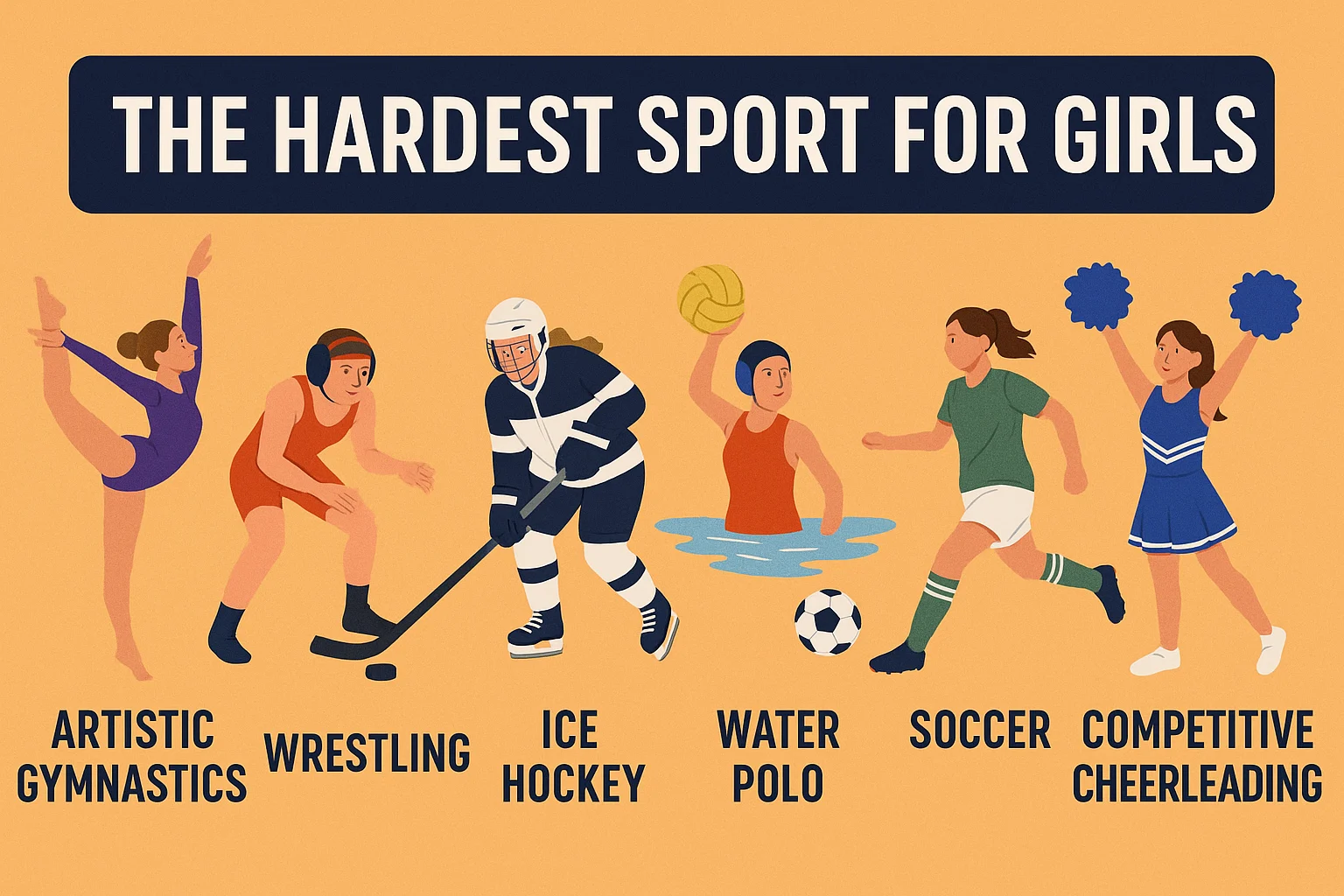
Below is a clear, easy-to-understand ranking of the 7 hardest sports for girls, along with why each one is so challenging.
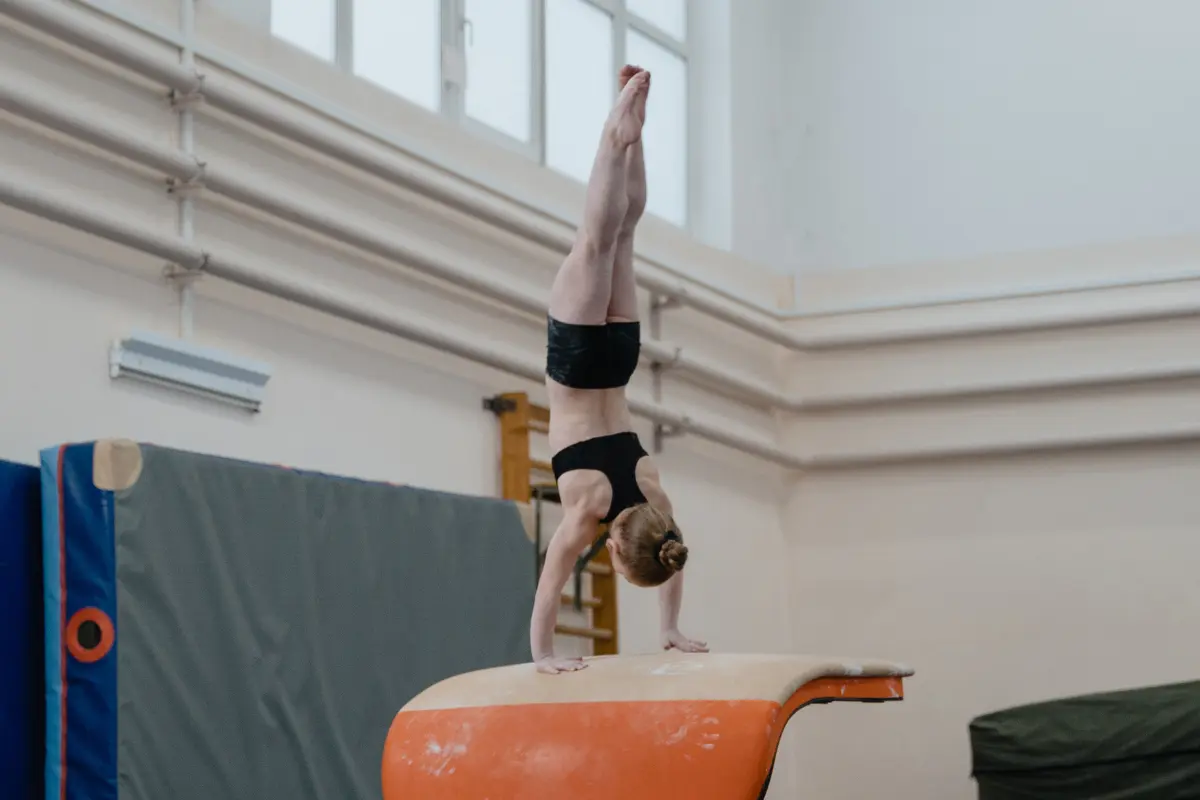
1. Gymnastics — The Ultimate All-Around Challenge
If you ask almost any expert, from athletic trainers to pro athletes in other sports, the answer is consistently the same:
⭐⭐⭐ Gymnastics is the toughest sport for girls. ⭐⭐⭐
Why It’s the Hardest
Gymnastics demands an unmatched combination of:
- Extreme strength for flips, holds, tumbling, and bar swings
- Elite flexibility for splits, leaps, bridge work, and beam skills
- Precision and coordination at a level few sports require
- Courage to flip backward, release bars, or balance on a 4-inch beam
- Mental resilience to handle fear, pressure, and perfection expectations
- Early specialization, often starting around age 4–6
- Long training hours (10–20+ hours weekly in competitive programs)
- High injury risk (wrists, ankles, backs, knees, and growth plates)
Gymnastics challenges every part of a girl’s body and mind. The mix of fear, physical strain, and relentless practice is unlike almost any other sport.
Toughness Level: ★★★★★
What It Builds: Confidence, courage, power, resilience
2. Ballet — Discipline, Perfection, and Physical Strain (Often Underrated)
Ballet may look graceful, but make no mistake: it is brutally difficult when done seriously.
Why Ballet Is So Tough
- Technique must be perfect — down to the angle of a toe
- Requires flexibility, turnout, strength, posture, and balance
- Pointe work is extremely demanding on feet, ankles, and calves
- Classes involve hours of repetition and correction
- Emotional pressures around appearance, weight, and “ideal” lines
- Overuse injuries are very common
Ballet blends athleticism with artistry — but the pressure to be flawless makes it mentally and physically exhausting.
Toughness Level: ★★★★☆
What It Builds: Discipline, artistry, body awareness
3. Swimming — Endurance, Repetition, and Mental Grit
Swimming challenges girls in a completely different way. Instead of high-impact skills or artistic expectations, swimmers battle endurance, repetition, and intense conditioning.
Why Swimming Is Hard
- Practices often start before sunrise
- Training happens 5–6 days per week
- Uses nearly every major muscle group
- Requires perfect technique for each stroke
- Progress is slow — shaving off fractions of a second takes months
- Long sets build mental toughness, not just physical strength
Swimming produces incredible endurance athletes, but the monotony and the grind can be draining.
Toughness Level: ★★★★☆
What It Builds: Stamina, discipline, mental toughness
4. Figure Skating — Power, Balance, and High Pressure
Figure skating is elegance on the outside — but power, pain, and pressure underneath.
Why Figure Skating Is Tough
- Jumps require explosive power from the legs and core
- Falls on ice are harsh and frequent
- Athletes must skate with both endurance and grace
- Programs demand perfect timing and expression
- Training hours are long and extremely technical
Figure skaters balance artistry with physical difficulty — all while performing on a slippery surface.
Toughness Level: ★★★★☆
5. Soccer — Speed, Strength, and High Injury Risk
Girls’ soccer is fast, physical, and tactically demanding.
Why Soccer Is Hard
- Players run miles every game
- Constant sprinting, cutting, and fast changes of direction
- High physical contact and collisions
- ACL injuries are especially common in girls’ soccer
- Requires teamwork, strategy, and split-second decision-making
Soccer challenges conditioning and mental focus — with injury risk always present.
Toughness Level: ★★★☆☆
6. Competitive Cheer — Strength, Stunts, and Zero Margin for Error
Competitive cheer combines tumbling, stunting, dancing, and performance — all in a fast-paced 2-minute routine.
Why Cheer Is Tough
- Stunting requires trust, timing, and serious upper-body strength
- High risk of falls, concussions, and shoulder injuries
- Tumbling can be as demanding as lower-level gymnastics
- Routines must be perfectly synchronized
- One mistake can ruin the entire team’s score
Cheerleading demands boldness, timing, and teamwork under pressure.
Toughness Level: ★★★☆☆
7. Track & Field — Pain Tolerance and Mental Drive
Some track events — especially the 400m, 800m, hurdles, and sprints — are known for being brutally painful and mentally demanding.
Why Track Is Hard
- The 400m and 800m are considered two of the most painful races in sports
- Hurdles require both courage and precision
- Frequent repetitive strain injuries (shins, hamstrings, ankles)
- Races are decided by fractions of a second, adding pressure
Track builds determination like few other sports.
Toughness Level: ★★★☆☆
| Sport | Physical Demand | Technical Difficulty | Injury Risk | Mental/Emotional Pressure | Training Hours | Overall Toughness |
|---|---|---|---|---|---|---|
| Gymnastics | ★★★★★ | ★★★★★ | ★★★★★ | ★★★★★ | ★★★★★ | ⭐ #1 Toughest |
| Ballet | ★★★★☆ | ★★★★★ | ★★★★☆ | ★★★★☆ | ★★★★☆ | ⭐ #2 |
| Swimming | ★★★★☆ | ★★★★☆ | ★★★☆☆ | ★★★★☆ | ★★★★☆ | ⭐ #3 |
| Figure Skating | ★★★★☆ | ★★★★☆ | ★★★★☆ | ★★★★☆ | ★★★★☆ | ⭐ #4 |
| Soccer | ★★★★☆ | ★★★☆☆ | ★★★★☆ | ★★★☆☆ | ★★★☆☆ | ⭐ #5 |
| Competitive Cheer | ★★★★☆ | ★★★☆☆ | ★★★★☆ | ★★★☆☆ | ★★★☆☆ | ⭐ #6 |
| Track & Field | ★★★★☆ | ★★★☆☆ | ★★★☆☆ | ★★★★☆ | ★★★☆☆ | ⭐ #7 |
Why Gymnastics is Ranked #1
Gymnastics earns the highest score in every major difficulty category, including:
- strength
- flexibility
- technical skill
- fear management
- precision
- discipline
- injury risk
Very few sports challenge girls physically, mentally, and emotionally as completely as gymnastics.