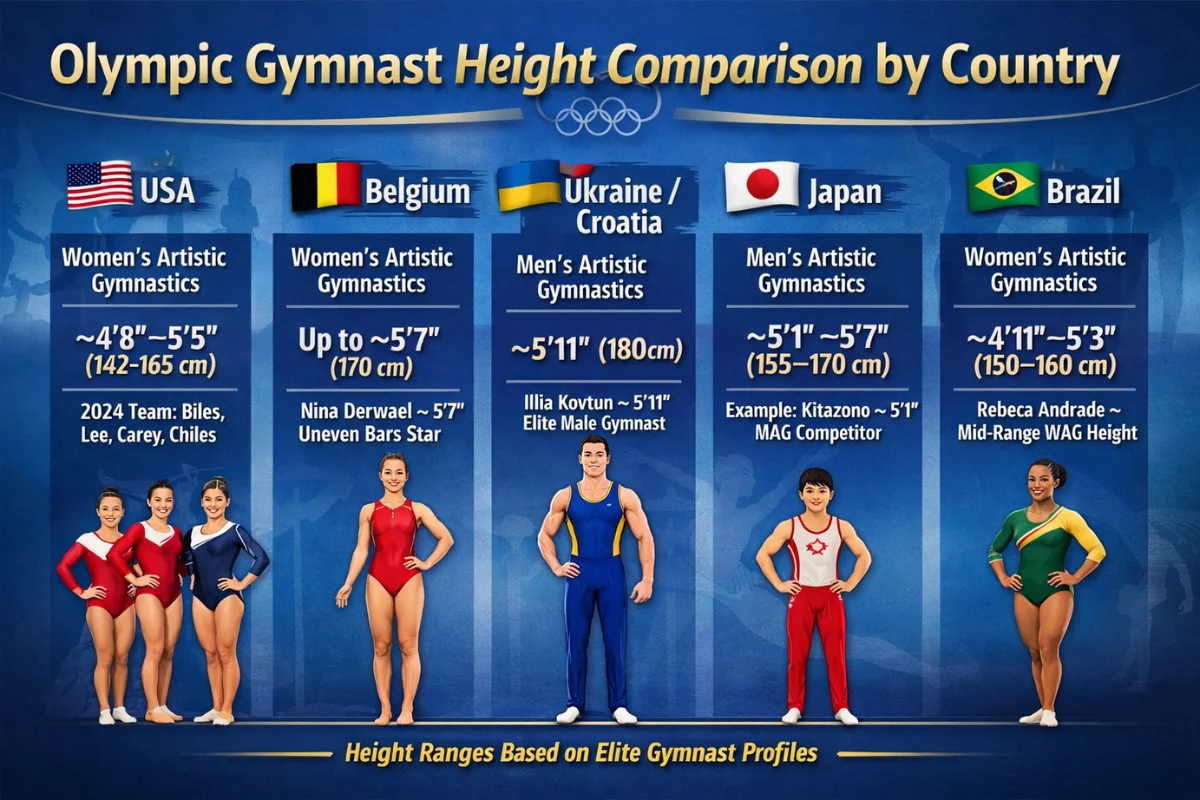
Olympic artistic gymnasts do not have one fixed average height. The answer depends on the Olympic year, whether the group is women or men, and which athletes have usable measurements. A published study of the 1996–2016 Games gives a more reliable historical comparison than a collection of unsourced celebrity profiles.
- Olympic height averages from 1996 to 2016
- How tall is that in feet and inches?
- What does the mean tell a reader?
- Did Olympic gymnasts get taller?
- Why not publish a country-by-country ranking?
- Why Olympic averages do not define the ideal gymnast
- Does the research show that gymnastics limits growth?
- Use the right reference for the question
The table below summarizes height data from that study. It describes those Olympic fields; it is not a current world ranking, a Paris 2024 estimate or a height requirement for entering gymnastics.
Olympic height averages from 1996 to 2016
Almir Atikovic’s 2020 study of Olympic artistic gymnasts used archived Sports Reference and official Rio 2016 information. The values below come from its height table. WAG means women’s artistic gymnastics; MAG means men’s artistic gymnastics. Counts indicate available height records.
| Games | WAG mean, cm | Records | MAG mean, cm | Records |
|---|---|---|---|---|
| 1996 | 151.76 | 94 | 166.36 | 93 |
| 2000 | 153.03 | 94 | 166.67 | 97 |
| 2004 | 153.24 | 97 | 166.79 | 98 |
| 2008 | 153.85 | 98 | 166.56 | 97 |
| 2012 | 155.39 | 96 | 167.04 | 97 |
| 2016 | 154.64 | 97 | 167.07 | 94 |
These are historical profile-based averages, not measurements newly collected from every athlete by the researcher. Values retain the table’s two decimal places so readers can identify the reported results; that precision does not establish equally precise original profiles.
How tall is that in feet and inches?
For an accessible reference, the 2016 women’s mean converts to approximately 5′0.9″, and the men’s mean to about 5′5.8″. These are rounded conversions using 2.54 centimeters per inch.
Feet-and-inches notation is different from decimal feet. A height written as 5′6″ means five feet plus six inches, not 5.6 feet. When comparing a metric research table with an athlete biography, convert the complete measurement before rounding.
Rounding is useful for conversation, but it can hide a small difference between years. Use the centimeter table for historical comparisons and the rounded imperial equivalents for a rough sense of scale.
What does the mean tell a reader?
The mean is the total of the recorded heights divided by the number of recorded athletes. It is one summary of a group, not the height shared by most of its members. OpenStax’s explanation of averages also distinguishes the mean from the median, which is the middle value in an ordered dataset.
Consider a fictional five-athlete example with heights of 148, 152, 154, 158 and 163 cm. The total is 775 cm and the mean is 155 cm, although none of the five is exactly 155 cm tall. This example explains the arithmetic; it is not a real team.
A single average also hides the spread. Two teams can share a mean while having very different shortest and tallest members. Without individual records or additional measures of variation, it is inappropriate to turn a mean into a complete description of everyone in the group.
Did Olympic gymnasts get taller?
Within the table, the women’s 2016 mean is 2.88 cm above the 1996 value. The increase is not uninterrupted: the 2012 mean is higher than the 2016 mean. The men’s endpoints differ by 0.71 cm.
Those calculations describe differences between Olympic groups. They do not show individual athletes growing by those amounts. A different set of competitors can change an average even if no returning athlete’s height changes.
Nor can six historical observations establish what happened after 2016. A line extended toward a later Olympics would be a projection, not a measurement. A current comparison needs data from the later field, with the same care over missing entries and units.
Why not publish a country-by-country ranking?
A country average requires a defined roster and sourced measurements for its members. An international overall mean cannot be divided into national figures without the underlying country data. Guessing which countries “usually have shorter gymnasts” is not an acceptable substitute.
The roster definition matters too. A competition team, a group of individual qualifiers and a list including replacement athletes may contain different people. Before calculating an average, decide which group answers the question and state that choice.
A ranking can also exaggerate tiny differences when a team contains only a few athletes. One changed selection may move the mean noticeably. Report the group and its size alongside any calculation rather than presenting the number as a permanent national characteristic.
Why Olympic averages do not define the ideal gymnast
Olympians are a highly selected group. They have already passed through training, competition and selection processes. Their average describes athletes who reached that field; it does not test which beginners could enjoy gymnastics or improve with good instruction.
Height is also only one body dimension. Arm length, leg length, strength, coordination and skill technique are not contained in a standing-height value. A taller gymnast cannot be assigned an event, or ruled out of one, from this table alone.
Our guide to gymnastics body-type research explores that distinction. Observing a characteristic in elite performers is different from proving that everyone needs it to learn the sport.
Does the research show that gymnastics limits growth?
No. A comparison of Olympic profiles is not a study following children’s growth with and without gymnastics. It cannot separate inherited stature, maturation, selection and training effects by itself.
The dedicated gymnastics and growth guide examines that separate evidence. Parents concerned about a child’s growth should discuss the child’s own growth history with a healthcare professional, rather than compare the child with an adult Olympic mean.
Another distinction is participation versus winning. An average for athletes in an Olympic field is not automatically the average for all-around finalists or medalists. Those are smaller groups selected by competition outcomes. A claim about medal-winning height would require its own identified set of athletes and measurements; it cannot be read directly from the overall table.
Use the right reference for the question
For individual measurements, consult the sourced women’s height chart. For the broader question of how researchers measure and compare athletes, see our height and weight research guide.
The historical table is most useful when its boundaries remain visible: artistic gymnastics, a specified Olympic year, a defined group and documented records. Those details turn an attractive statistic into information a reader can actually interpret.