Planche Progression: From Planche Lean to Full Planche
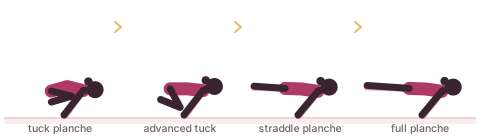
A planche is a hold on straight arms with the whole body level with the floor, face down, and nothing touching the ground but the hands. Nobody learns it in that shape. The planche progression starts with a shorter body, knees tucked to the chest, and lengthens it one step at a time: lean, tuck, advanced tuck, straddle, full.
Contents
The steps are quick to list and slow to earn. This guide explains what changes at each one, what has to stay the same throughout, and how the finished hold is treated in gymnastics.
The planche at a glance
| Question | Answer |
|---|---|
| What it is | A straight-arm support hold with the body horizontal and face down |
| Usual order | Planche lean, tuck, advanced tuck, straddle, full planche |
| What never changes | Locked elbows, shoulders in front of the hands, shoulder blades pushed down and forward |
| Value in the rules | Men’s floor and rings: straddle planche A (0.1), full planche C (0.3) |
| Hold time in competition | 2 seconds from a complete stop |
| Where to practice | Floor or low parallettes; rings make every step less stable |
What Is a Planche?
From the side, a planche looks like the top of a push-up with the feet floating: arms straight, body in one line from shoulders to toes, parallel to the floor. The difference is the lean. With no feet on the ground, the shoulders have to travel well forward of the hands so the body can balance over them.
That lean is what makes the hold so hard. Most of the body’s weight sits behind the hands, and the shoulders have to resist it with the elbows locked. Bending the knees or spreading the legs brings some of that weight closer to the hands, which is why every progression begins tucked and ends with the legs straight and together.
In men’s gymnastics the planche is a competition element on floor and on still rings, where the Code of Points calls it a support scale. The values show how the rules rank the shapes.
| Hold | Apparatus | Value |
|---|---|---|
| Planche with legs straddled | Floor | A (0.1) |
| Planche, legs together | Floor | C (0.3) |
| Support scale straddled | Rings | A (0.1) |
| Support scale (planche) | Rings | C (0.3) |
| Support scale at ring height (swallow or Maltese) | Rings | D (0.4) |
Closing the legs moves the hold from A to C, a jump of two values. Each hold must stay still for two seconds.
On rings, the Code recognizes a support scale only when the shoulders are completely above the top of the rings. With the shoulders level with the rings and the arms wide, the position is a swallow, also called a Maltese, a different and harder element. Our comparison of the iron cross, Maltese and planche shows how to tell them apart.
The word also appears in the women’s Code of Points, whose balance beam mounts include planche positions held for two seconds.
What Every Step Shares
The shapes change through the progression, but three things should look the same in all of them.
- Locked elbows. The planche is a straight-arm strength hold. If the elbows bend, the exercise has changed.
- Shoulder blades pushed down and forward. The upper back is slightly rounded and the shoulders stay away from the ears.
- A deliberate lean. The shoulders sit in front of the hands. The longer the body, the bigger the lean.
In a long tutorial on the Gymnastics Method channel, coaches Adam Godrosi and Andry Strong call shrugged shoulders the biggest mistake they see. They prepare the position before any planche work: wrist warm-ups, push-ups done only with the shoulder blades, and a plank on the elbows with the hips tucked under. They start beginners on low parallettes set slightly wider than the shoulders.
Those are two coaches’ methods, and they match what the rules reward: a hold reached directly, on straight arms, with no adjusting once it stops. The wrists carry a bent-back load in every step, so prepare them first; our guide to wrist strength for gymnastics explains how to build that up.
The Planche Progression, Step by Step
| Step | Shape | What to check |
|---|---|---|
| 1. Planche lean | Push-up position with the feet on the floor; the shoulders move forward past the hands | The elbows stay locked as the lean grows |
| 2. Tuck planche | Feet off the floor, knees pulled to the chest, back rounded | Both feet lift without a hop and stay up |
| 3. Advanced tuck | Back flat and level, knees still bent under the body | The back is level, with the hips farther from the hands than before |
| 4. Straddle planche | Legs straight and wide apart, body level | The hips stay in line, with no pike and no sag |
| 5. Full planche | Legs straight and together | One level line from shoulders to toes |
The lean comes first because the other steps depend on it. With the feet still on the floor, it teaches locked elbows under load and lets the wrists get used to the angle. The tuck planche is the same lean with the feet picked up.
Flattening the back for the advanced tuck looks like a small change. It moves the hips away from the hands, and the hold gets much heavier. The straddle then straightens the legs. The Gymnastics Method coaches describe one more adjustment at this stage: the hips, tucked under through the tuck steps, tilt slightly the other way so the legs can stay level.
Bringing the legs together is the last step and the largest. The same coaches say the full planche can take years.
The Code’s own test is two seconds without movement. The Gymnastics Method coaches ask for more than that before lengthening the shape, about 15 seconds at a stage, and they use an elastic band for support when a new shape is too heavy to hold in good form. Treat numbers like these as one program’s guide. When the elbows bend or the hips drop, the attempt is over, however long it lasted.
Watch: the progression on rings
Brandon Wynn, the 2013 World bronze medalist on still rings and a four-time U.S. rings champion, runs through the same shapes on rings in just over a minute. Each one appears twice: first with the rings turned in and the arms resting against the straps, then with the rings turned out, where nothing steadies the arms.
The order is the lesson. Wynn starts in a tucked support, moves to the tucked planche at 0:25, the straddle at 0:44 and the full planche at 1:00, and at every stage the strap-supported version comes before the free one.
Rings add instability to an already hard hold, so use this film to study the shapes. For the floor and parallette steps, the Gymnastics Method tutorial covers the planche lean at 14:15, the tuck at 18:59, the advanced tuck at 22:58 and the straddle at 30:03.
Common Planche Mistakes
| What you see | Likely cause | What to try |
|---|---|---|
| Elbows bend | The shape or the lean is more than straight arms can hold | Shorten the shape and keep the lean you can hold with locked elbows |
| Shoulders shrug toward the ears | The shoulder blades are not pushed down | Reset before each hold: push down and forward first |
| Hips sit higher than the shoulders | Not enough lean, so the body balances by folding at the hips | Lean farther in a shorter shape |
| Lower back sags in the straddle or full hold | The legs are too heavy for the hips to keep level | Shorter holds, or go back one step |
| Feet hop off the floor | Momentum is replacing the lean | Start each hold from stillness, in a shape you can lift slowly |
| Wrists hurt | The wrists are bent back under a forward lean | Build the lean gradually, or use parallettes so the wrists stay straighter; stop if it is pain and not effort |
A planche is not a first strength hold. The L-sit teaches the same locked arms and pushed-down shoulders with far less load, and it is the better place to start.
Frequently Asked Questions
How long does it take to learn a planche?
No official timeline exists. A longer or heavier body is a longer, heavier lever, so progress differs a great deal from one person to the next. The Gymnastics Method coaches say the full planche can take years.
Is the straddle planche easier than the full planche?
Yes. Spreading the legs brings their weight closer to the hands. The men’s Code of Points reflects the difference: the straddle version is an A and the full planche a C, on floor and on rings.
What is the difference between a planche and a Maltese?
In a planche the shoulders are above the hands or rings. In a Maltese, which the Code also calls a swallow, the arms are wide and the body is level with the rings. The rings version is valued one step higher, at D. Our guide to the Maltese on rings covers that hold.
Can you learn a planche without rings or parallettes?
Yes. The floor is enough for every step. Parallettes keep the wrists straighter and give the feet a little more clearance, and rings make each shape less stable.
Final Takeaway
The planche progression runs from the lean to the tuck, the advanced tuck, the straddle and the full hold. Each step lengthens the body and asks the shoulders to lean farther over the hands.
Keep the elbows locked and the shoulders pushed down in every shape, and go back a step whenever either one fails. The early steps come first and slowly, and the full planche is a long project.
Main Sources
- World Gymnastics: Men’s Artistic Gymnastics Code of Points 2025–2028 — the planche and straddle planche on floor, the support scales on rings, the two-second hold rule and how a support scale is recognized.
- World Gymnastics: Women’s Artistic Gymnastics Code of Points 2025–2028 — planche positions among the balance beam mounts.
- Brandon Wynn: 5 MOST Important Planche Progressions — the shapes on still rings. Wynn’s results are listed by USA Gymnastics.
- Gymnastics Method: How to Actually Learn the Planche — preparation, the floor and parallette steps and the coaches’ own benchmarks.