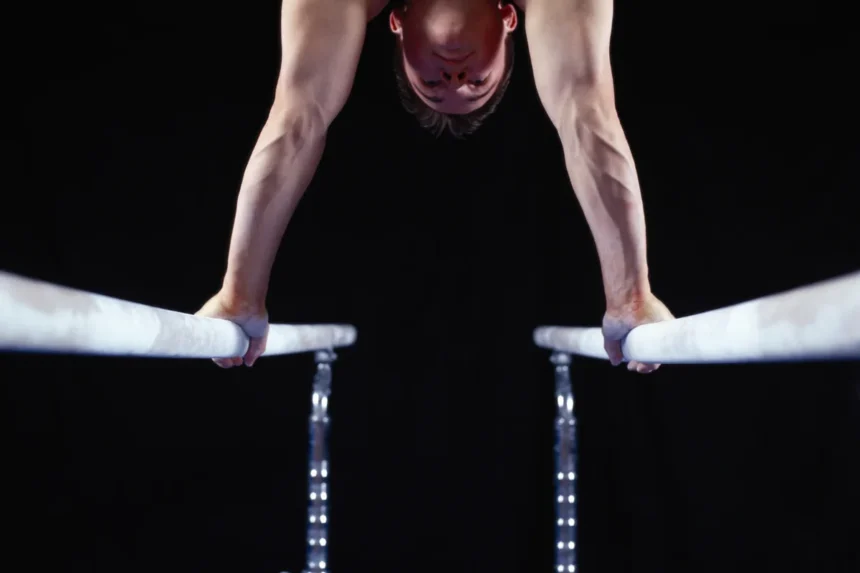
Parallel bars is where young MAG gymnasts learn to support their bodyweight with straight arms, create real swing rhythm, and start showing clean “shapes” like an L-sit, planche, and handstand stops, all while staying safe and controlled.
In the USA Gymnastics (USAG) Men’s Development Program, Levels 1–2 are non-competitive (“Essential Elements”), and Levels 3–5 are competitive compulsory levels with specific routine construction and performance expectations.
Quick progression map (Levels 1–5)
| Level | What parallel bars is building | What changes most |
|---|---|---|
| 1 | First support comfort + basic shapes | Mount safely, stay tight, learn straight-arm support habits |
| 2 | Stronger supports + cleaner swings | Better swing timing, early holds, more confident dismount control |
| 3 (Compulsory) | First true routine rhythm | Swings to set angles + a clear hold (L/V option) + controlled dismount |
| 4 (Compulsory) | Long-hang + upper-arm foundation | Long-hang swings, uprise to upper arm, L/V/Manna options, handstand push-off |
| 5 (Compulsory) | “Real p-bars” basics begin | Glide kip, Moy bail, clearer swing-to-handstand, turning dismount |
Level 1–2 (Developmental): what a gymnast should be able to do
In the U.S. system, Levels 1–3 fall under the Essential Elements pathway, which USA Gymnastics describes as a fundamentals-based, pre-competitive program emphasizing basic shapes, support strength, and introductory swing mechanics.
At this stage, parallel bars isn’t about difficulty. It’s about learning how to stay together on top of the bars through the shoulders, arms, and core, so higher-level skills can be added later without rebuilding fundamentals.
Level 1 parallel bars benchmarks
At Level 1, the priority is owning basic support without collapsing.
A gymnast should be able to hold a clean front support shape with straight arms, shoulders pushed tall, and a tight body line from shoulders through heels, no sagging hips or soft elbows. From there, he begins exploring simple support movement, such as small controlled swings or gentle “bounces,” while remaining stable on top of the bars rather than tipping forward or backward.
Equally important is learning a safe dismount habit. Stepping down under control, often with mats or spotting blocks. It teaches consistency, awareness, and safe finishes from day one.
Level 2 parallel bars benchmarks
Level 2 is where the basics should start to look intentional, not improvised.
Support swings show a clearer forward–back rhythm, with more consistent timing and better shoulder control. Gymnasts also begin developing early hold awareness, short tuck or L-style positions where the body visibly pauses, even if the hold is not yet a full two seconds.
Execution details matter more here. Straighter knees, pointed toes, and cleaner leg alignment help prevent small form errors from becoming habits that are difficult to fix once compulsory judging begins.
Practical coaching note: If a gym doesn’t have competition-ready parallel bars for beginners, USA Gymnastics allows the use of boxes constructed from spotting blocks or panel mats in developmental or lower-level settings, as long as the setup is communicated clearly. This ensures athletes can build correct support mechanics without unsafe improvisation.
Level 3 Parallel Bars (National Track Compulsory)
Level 3 is the first time many boys perform a fully judged compulsory parallel bars routine. The routine is evaluated on specific swing angles, clearly defined holds, and a controlled, intentional finish.
The major elements you must show (Level 3)
The routine is built around support-based swings and introductory strength positions:
- Jump to support → swing forward / swing back, with emphasis on reaching a defined height on the backward swing
- Swing to straddled support, followed by a momentary straddled L hold (straddled V is an allowed bonus option)
- Rear support extension, showing a tight body line before continuing swing work
- Dismount: backward swing into a controlled dismount, with an optional bonus for rising to a momentary handstand before leaving the bars
Judges expect to see each position, not infer it.
Level 3 bonus options (what they’re really testing)
Level 3 bonuses are not about difficulty for difficulty’s sake. They test whether the gymnast can stop, control, and resume movement rather than relying on momentum.
Bonus paths evaluate the ability to:
- Press into a tucked planche hold with hips near horizontal, show the stop, then extend back to bar height
- Upgrade the hold from a straddled L to a clearer straddled V
- Show a momentary handstand before the dismount
These skills preview the strength and positional awareness required in Levels 4–5.
What judges hit hardest at Level 3
The Junior Competition Manual uses threshold-style deductions, especially for holds. If a hold is rushed or never clearly stops, deductions add up quickly.
The biggest score killers are:
- No real hold (passing through instead of pausing)
- Sagging hips in front or rear support
- Soft legs and feet—bent knees, leg separation, or unpointed toes
Level 4 Parallel Bars (National Track Compulsory)
Level 4 is a major turning point. The routine shifts decisively into long-hang and upper-arm work, laying the groundwork for future Moy swings, peach variations, and true swing-to-handstand development.
The major elements you must show (Level 4)
The routine tests smooth transitions between hang, upper arm, and support:
- Jump to long hang swing, followed by long-hang swing combinations with defined shapes
- Uprise to upper-arm hang, then controlled upper-arm swings forward and backward
- Uprise to support (typically a straddled front uprise) without hesitation
- Required hold (L hold), with optional upgrade to V or Manna
- Finish: momentary handstand work and a push-off dismount to stand, with a bonus for a true two-second handstand
“Almost” positions are no longer enough. Shapes must be obvious and deliberate.
The handstand push-off dismount: why it matters
This dismount often separates average from strong Level 4 routines.
USA Gymnastics guidance makes it clear judges evaluate:
- How high the gymnast actually reaches before pushing off
- Whether a real handstand position is shown
- Alignment at the top—straight arms, tight core, stacked shoulders
A calm, controlled handstand, even if brief often outscores a rushed dismount.
Level 5 Parallel Bars (National Track Compulsory)
Level 5 is where parallel bars truly looks like “real p-bars.” The routine introduces the glide kip, a recognizable Moy bail to upper-arm support, and a turning dismount, all demanding better timing and confidence.
The major elements you must show (Level 5)
The routine connects swing, strength, and vertical control:
- Jump to glide kip to support, followed by swings that establish correct set angles
- Swing backward and bail to Moy, finishing in upper-arm support (limited hand-on-hand spot allowed in certain cases)
- Upper-arm swing backward → uprise to support
- Swing to L hold, with an optional press-toward-handstand bonus path
- Clear swing-to-handstand expectation
- Dismount: forward swing into a ½-turn posting action over one bar (Stützkehr forward)
What judges reward at Level 5
Judges reward routines that look confident and composed:
- A clean glide kip that finishes in true support
- A controlled bail to Moy, not rushed or unstable
- An intentional handstand, even if momentary
At Level 5, strong routines don’t rush, they look calm and deliberate.
Meet-day rules & equipment notes that affect scores
Some meet-day details quietly matter:
- Springboards or mats are allowed for mounts, but if a springboard is placed between uprights, it must be removed immediately after the mount or a deduction applies.
- There is no minimum height requirement for parallel bars in the Men’s Development Program.
- Panel mats, spotting blocks, and equipment substitutions are permitted at lower levels when used consistently and communicated properly.
Judges care less about what equipment is used and more about safety, consistency, and proper handling during the routine.