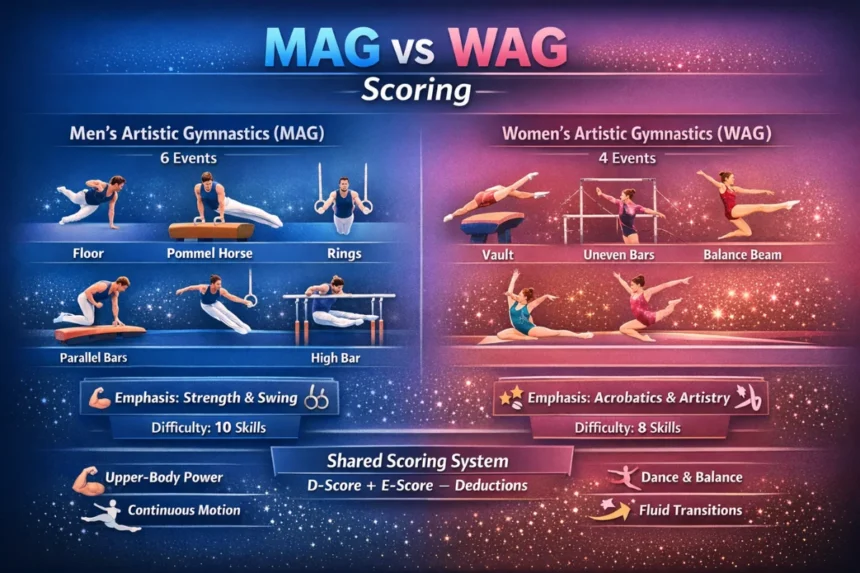
At first glance, men’s and women’s gymnastics scores can feel confusing. A men’s routine might earn a 15.400, while a women’s routine that looks just as impressive scores 14.200. Are they judged differently? Is one “harder” to score than the other?
The short answer is yes and no.
Men’s Artistic Gymnastics (MAG) and Women’s Artistic Gymnastics (WAG) use the same scoring framework under the Fédération Internationale de Gymnastique (FIG), but the events, skill demands, and judging priorities are very different.
The Core Scoring System (Shared Framework)
Both MAG and WAG use the open-ended FIG scoring system, which works the same way in both disciplines:
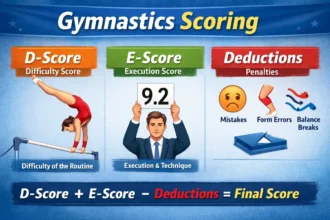
Final Score = D-score (Difficulty) + E-score (Execution) − Neutral Deductions
- D-score (Difficulty): What skills are performed and how difficult the routine content is
- E-score (Execution): How well the routine is performed; starts at 10.0 and deductions are taken
- Neutral deductions: Penalties for rule violations such as time, line errors, attire, or behavior
There is no perfect 10 cap in either men’s or women’s gymnastics. Scores can rise as difficulty increases.
So if the math is the same, why do scores feel so different?
How Events Differences Shape MAG vs WAG Scoring
The number and type of events are the main reason men’s and women’s gymnastics are judged differently.
Men’s Artistic Gymnastics (MAG) — 6 events
- Floor Exercise
- Pommel Horse
- Still Rings
- Vault
- Parallel Bars
- High Bar
Women’s Artistic Gymnastics (WAG) — 4 events
- Vault
- Uneven Bars
- Balance Beam
- Floor Exercise
Each apparatus emphasizes different physical qualities. MAG leans heavily on strength, swing, and continuous motion. WAG balances acrobatics, precision, and artistry, especially on beam and floor. Those differences shape both difficulty construction and execution deductions.
Difficulty (D-Score): Same Logic, Different Requirements
Both disciplines use the same open-ended D-score concept, but difficulty is built very differently because the apparatus and required elements are not the same.
Men’s Artistic Gymnastics (MAG)
At the highest levels, such as the Olympics, MAG routines typically count 10 skills toward difficulty.
Difficulty in men’s gymnastics is driven largely by:
- Strength holds, especially on still rings
- Large swing elements on parallel bars and high bar
- Release-and-regrasp combinations
- Turning sequences and travel skills, particularly on pommel horse
These elements allow difficulty to accumulate through power, endurance, and sustained motion, often producing higher raw D-scores when routines are fully credited.
Women’s Artistic Gymnastics (WAG)
In contrast, WAG routines generally count the eight most difficult elements toward the D-score (with vault scored separately).
Women’s difficulty construction places greater emphasis on:
- Acrobatic elements and series
- Dance elements such as leaps and turns
- Connection bonuses, especially on balance beam and floor
Because dance and connections are central, WAG difficulty is more sensitive to rhythm breaks or missed links, which can quickly reduce the D-score. Many of these requirements do not have direct equivalents in men’s gymnastics.
Execution (E-Score): Same Method, Different Emphasis
Both MAG and WAG use the same execution framework. The E-score starts at 10.0, and judges deduct for errors in form, technique, control, and overall performance quality.
Where they differ is which execution mistakes matter most, based on the demands of each apparatus.
Execution Priorities in Men’s Artistic Gymnastics (MAG)
In MAG, judges emphasize technical precision under physical strain. Key focus areas include:
- Straight legs, pointed toes, and tight body lines
- Swing amplitude and extension on bar events
- Accuracy and duration of strength holds, especially on rings
- Stability and uninterrupted rhythm, particularly on pommel horse and parallel bars
Because men’s events are power- and strength-driven, even small form breaks or rhythm interruptions can add up quickly in deductions.
Execution Priorities in Women’s Artistic Gymnastics (WAG)
In WAG, execution judging balances technical correctness with control and presentation. Judges place strong emphasis on:
- Leg and foot form, such as separations or bent knees
- Balance checks, especially on balance beam
- Artistic presentation on floor, including choreography and expression
- Smooth, fluid transitions between acrobatic and dance elements
Women’s routines are expected to combine difficulty with polish and expressiveness, making artistry and control especially important on beam and floor.
Apparatus-Specific Scoring Differences
Because MAG and WAG use different apparatus, the mechanics of scoring vary in important ways:
- Vault (shared event): Both men and women receive a fixed D-score for the vault performed and an E-score out of 10 for execution.
- Uneven Bars vs. Parallel Bars: Both involve swings and releases, but body mechanics, rhythm expectations, and connection requirements differ, affecting both difficulty and execution.
- Balance Beam (WAG only): Beam includes dance, balance, and artistry requirements that have no equivalent in MAG, making rhythm and presentation especially influential on scoring.
These event-specific demands explain why the Code of Points assigns different values and deductions depending on the apparatus.