Olympic gymnastics scores can look confusing at first. One routine earns a 15.700, another a 14.966, and to most viewers, both performances look incredible. So where do those differences actually come from?
The answer isn’t just “harder skills” or “better landings.” Olympic scores are built from a careful balance of difficulty, execution, and rule precision. Every tenth matters, and small decisions in routine design can decide medals.
In this guide, we’ll break down how Olympic gymnastics scores are built, how top gymnasts maximize every point under the FIG Code of Points, and how real Olympic routines show these scoring principles in action.
How Olympic Scores Are Built
At the Olympic level, artistic gymnastics uses a modern, open-ended scoring system defined by the FIG Code of Points, a detailed rulebook that determines how routines are evaluated and scored.
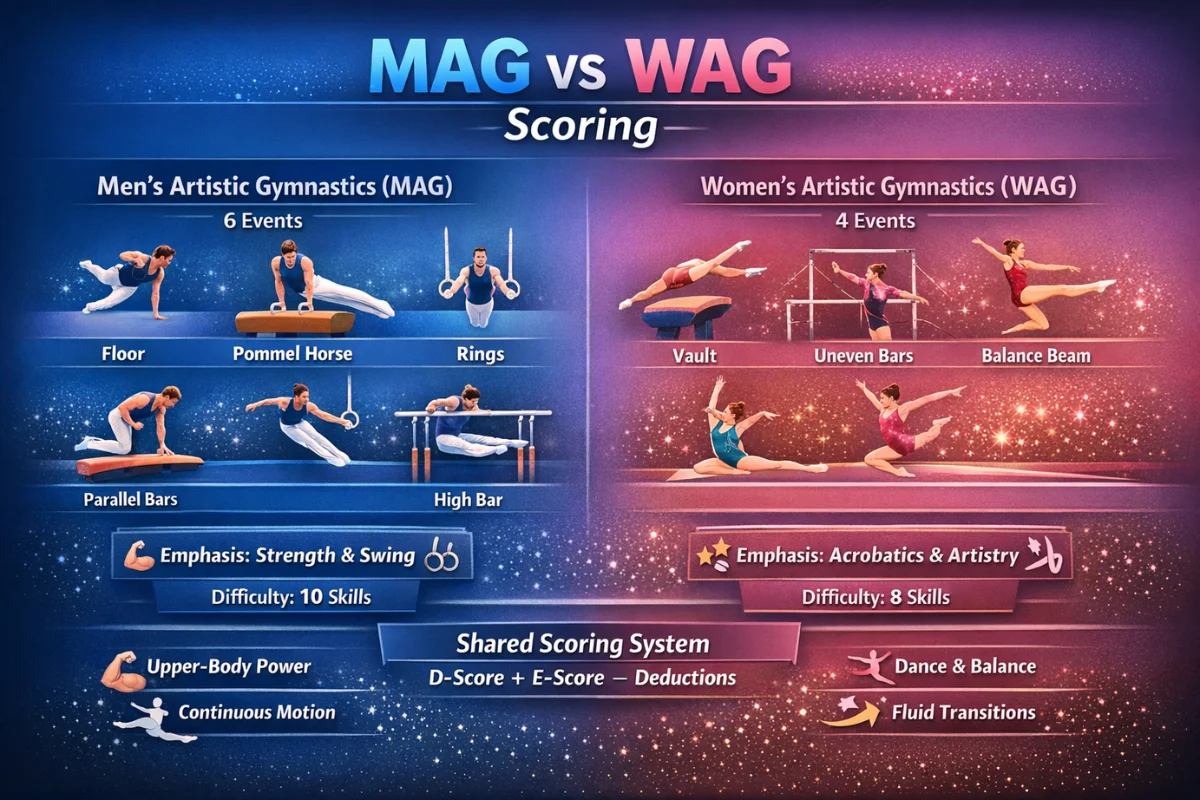
Final Score Formula
Every gymnast’s final score is calculated with this fundamental formula:
Final Score = Difficulty (D-Score) + Execution (E-Score) − Neutral Deductions
This structure makes the scoring system both objective and strategically rich.
How Gymnasts Maximize Their Scores
At the Olympic level, scoring success is about doing the right skills, in the right combinations, with the least possible deduction.
1, Strategic Use of High-Value Skills
Because the D-score is open-ended, gymnasts raise their scoring ceiling by including high-value skills. However, difficulty alone does not guarantee a high final score.
Harder skills:
- Increase the D-score
- Also increase the risk of execution deductions
As a result, gymnasts rarely choose skills based only on maximum difficulty. Instead, they prioritize consistency. A slightly easier skill performed cleanly can outscore a harder skill that regularly causes form breaks, balance checks, or landing errors.
2. Using Connection Bonuses Efficiently
Connection bonuses are one of the most powerful scoring tools in modern gymnastics. When gymnasts link difficult elements directly without hesitation, they earn extra tenths added to the D-score.
This is especially important on uneven bars and floor, where well-planned connections can add 0.1–0.2 points or more per combination. At the Olympic level, that margin frequently separates medal positions.
Because of this, routines are often designed around clusters of connected skills, rather than scattered high-difficulty elements.
3. Protect the Execution Score (E-Score)
Execution is where most points are lost. Even a routine with world-class difficulty can fall out of medal contention if execution deductions pile up. Elite gymnasts train routines so they look repeatable and calm, even under Olympic pressure. A routine that looks effortless to viewers is often one that gives judges very little to deduct.
4. Avoiding Neutral Deductions at All Costs
Neutral deductions are among the most damaging mistakes because they are:
- Applied after D + E
- Unrelated to skill quality
- Often easy to avoid
Out-of-bounds steps on floor, time violations, or other rule penalties can instantly erase large difficulty advantages. At the Olympic level, avoiding these mistakes is considered a basic requirement, not a bonus.
Real Olympic Routine Examples (Paris 2024)
Here are real Olympic routine examples showing how top athletes applied scoring strategy in action at Paris 2024.
Uneven Bars Final (Paris 2024): When Clean Execution Decides Gold
| Gymnast | Nation | D-Score | E-Score | Penalties | Final Score | Medal |
|---|---|---|---|---|---|---|
| Kaylia Nemour | ALG | 7.200 | 8.500 | 0.0 | 15.700 | 🥇 Gold |
| Qiu Qiyuan | CHN | 7.200 | 8.300 | 0.0 | 15.500 | 🥈 Silver |
Source: Wikipedia
What this shows: Both gymnasts built routines with identical D-scores (7.200), meaning they chose similarly high-value skill sets and connections. The difference came from execution. Nemour’s cleaner technique, more precise handstands, and smoother transitions earned her a 0.200 higher E-score, which was enough to decide gold.
Floor Final (Paris 2024): Difficulty Isn’t Enough if Penalties Hit
| Gymnast | Nation | D-Score | E-Score | Penalties | Final Score | Medal |
|---|---|---|---|---|---|---|
| Rebeca Andrade | BRA | 5.900 | 8.266 | 0.0 | 14.166 | 🥇 Gold |
| Simone Biles | USA | 6.900 | 7.833 | 0.600 | 14.133 | 🥈 Silver |
Source: Wikipedia
What this shows: Biles brought significantly higher difficulty, including signature high-value tumbling passes (e.g., the “Biles II”), but her execution score was lower and she incurred multiple out-of-bounds penalties (totaling −0.600). These penalties, which are neutral deductions applied after D and E, ultimately cost her the gold by a razor-thin margin.
Vault Final (Paris 2024): Two-Vault Average Strategy
Vault finals work differently: gymnasts perform two vaults, and the average of both determines the final ranking.
| Gymnast | Nation | Vault 1 | Vault 2 | Penalties | Final Average | Medal |
|---|---|---|---|---|---|---|
| Simone Biles | USA | 15.700 | 14.900 | 0.1 | 15.300 | 🥇 Gold |
| Rebeca Andrade | BRA | 15.100 | 14.833 | 0.0 | 14.966 | 🥈 Silver |
Source: Wikipedia
What this shows: Biles’s strategy combined a very high first vault D-score with strong execution; even with a small neutral deduction, that top vault gave her a high average. Andrade opted for slightly lower difficulty but paired it with superb execution on both vaults, keeping penalties at zero. Consistency across both vaults (execution protection) kept her total competitive.
Balance Beam Final (Paris 2024): Execution Over Difficulty
| Gymnast | Nation | D-Score | E-Score | Penalties | Final Score | Medal |
|---|---|---|---|---|---|---|
| Alice D’Amato | ITA | 5.800 | 8.566 | 0.0 | 14.366 | 🥇 Gold |
| Zhou Yaqin | CHN | 6.600 | 7.500 | 0.0 | 14.100 | 🥈 Silver |
Source: Wikipedia
What this shows: Zhou had a significantly higher difficulty value on paper, but D’Amato delivered a much cleaner routine and made fewer execution errors, which yielded a higher E-score and ultimately the gold. This highlights that execution quality can outweigh raw difficulty on an event where balance and precision are paramount.
Key Takeaways
The Paris 2024 Olympic finals made one thing clear: gymnastics medals are rarely decided by difficulty alone.
When difficulty is equal, execution decides medals.
When difficulty is higher, penalties and form errors can erase that advantage.
And on events like vault and balance beam, consistency and control matter just as much as power.