Gymnastics meet scores can feel confusing, especially at local meets. One gymnast scores a 9.4, another scores an 8.9, and to many parents, both routines looked just as good.
A big reason for this confusion is that compulsory and optional gymnasts are scored differently, even though they compete under the same Development Program (DP). At the local level, judges are looking for different things depending on the gymnast’s level.
The one scoring formula that applies to both
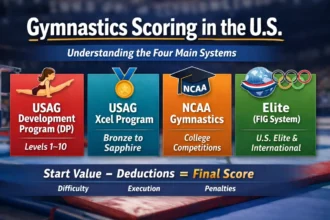
Whether your gymnast is compulsory or optional, the score is built from the same pieces:
- Start Value (SV): what the routine can start from if requirements are met
- Execution deductions: form, rhythm, balance checks, landings, amplitude, and overall control
- Neutral deductions: rule violations (like time, attire, behavior, coaching errors, etc.)
So the overall idea is the same: start value minus deductions. Where compulsory vs optional diverge is how that start value is determined, and how much routine “strategy” matters.
How Compulsory Scoring Works at Local Meets (Levels 1–5)
Compulsory gymnastics (Levels 1–5) is designed to test fundamentals, not creativity or risk. At local meets, compulsory scoring follows the same DP framework used all season, but scores can feel especially tight and detailed.
Compulsory routines are standardized
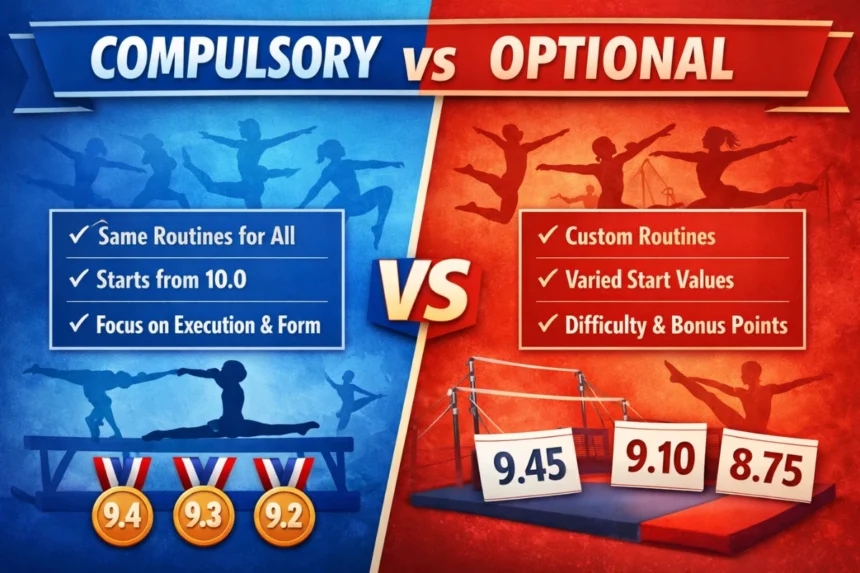
In compulsory levels, gymnasts at the same level perform the same routine structure. On floor, that often means identical music and choreography. On bars and beam, the sequence of skills and shapes is fixed.
Because everyone is doing essentially the same routine, judges are not comparing difficulty. They are comparing how well the routine is performed.
Most compulsory routines start from a 10.0
At Levels 1–5, compulsory routines are designed to begin from a 10.0 start value as long as the routine is performed as required.
That means:
- No gymnast has a built-in difficulty advantage
- Scores are separated almost entirely by execution deductions
If two gymnasts score differently, it’s because one routine lost fewer tenths, not because one routine was “harder.”
What judges focus on most in compulsory scoring
Because the routines are identical, judges are extremely detail-oriented. At local meets, compulsory judging typically emphasizes:
- Leg form: straight knees, tight ankles, pointed toes
- Body position: tight core, correct angles, no arching or piking
- Rhythm and timing: moving continuously without rushing or pausing
- Precision: exact hand and foot placement
- Balance control: especially on beam (wobbles, checks, arm swings)
- Landings: steps, hops, chest position, and control
For many parents, compulsory scoring feels stricter than expected. That’s because compulsory judging is designed to catch small habits early, before harder skills are introduced.
How Optional Scoring Works at Local Meets (Levels 6–10)
Once a gymnast moves into optional levels (Levels 6–10), routines are no longer identical. Gymnasts and coaches choose which skills to include, as long as they meet level rules and requirements.
This makes scoring more complex, and it’s why optional scores can look very different from compulsory scores and from each other, even at the same local meet.
Optional Start Value Can Change by Level
In optional gymnastics, start value is not automatic, especially at higher levels.
In simple terms:
- Levels 6–8 are designed to start from 10.0, as long as all required elements are present.
- Level 9 routines typically begin from a 9.70 base, then work upward by meeting composition requirements.
- Level 10 routines often begin from a 9.50 base, with start value depending heavily on value parts and bonus.
Because of this structure, two gymnasts in the same level may start from different values before execution is even judged.
What Judges Look At in Optional Routines
1. Value parts and special requirements
Each optional routine has a checklist of required elements. If something is missing, the start value is reduced before execution deductions are applied.
2. Routine construction and connections
Clean connections and smart routine construction can help protect or raise the start value. Broken connections or pauses may lose credit.
3. Execution and form
Once the start value is set, judges deduct for execution just like in compulsory:
- Bent knees or legs
- Flexed feet
- Balance checks
- Steps on landings
- Poor rhythm or low amplitude
The key difference is that these deductions are taken after start value is established.
Why Optional Scores Often Appear Spread Out
Because optional routines are unique, two gymnasts can both “hit” (perform without major visible mistakes) yet score differently due to:
- Different start values: One gymnast might successfully fulfill all requirements and earn a higher start value, while another might miss a special requirement or value part.
- Bonus credits: Clean connections and advanced element combinations can raise a gymnast’s competitive start value, separating scores even if execution is similar.
- Execution deductions: Even small form breaks affect the final score after start value is settled.
These factors make optional scoring feel richer and often more spread out than compulsory scoring.
Optional Scoring at Local Meets vs Larger Meets
Local meets use the same DP scoring system as State, Regionals, and Nationals. What may change is how tightly deductions are applied, especially early in the season or at invitationals with different judging panels.
The scoring structure itself does not change as meets get bigger.
FAQ: Compulsory vs Optional at Local Meets
1. Are local gymnastics meets scored using the same rules as DP?
Yes. If a meet is USA Gymnastics-sanctioned, it follows the Development Program scoring framework. The rules don’t change just because the meet is local.
2. Can the same routine score differently at different local meets?
Yes. Even under the same DP rules, judging panels and how strictly deductions are applied can vary from one meet to another, especially at local invitationals where panel size and experience may differ.
3. What do deductions look like in optional scoring?
In optional meets, judges consider the same execution issues as in compulsory (form, rhythm, landings) plus whether:
- Required value parts are included
- Connections are clean
- Routine construction meets level expectations
Missing requirements or poor construction can lower start value before execution deductions are applied.
4. Do compulsory and optional gymnasts compete against each other?
No, gymnasts compete within their level. A Level 5 (compulsory) gymnast will be scored and ranked against other Level 5 gymnasts, while the optional Levels 6–10 are scored against others in their respective levels.
5. Do local scores count toward advancement (like moving up levels)?
Yes, local meet scores can count toward the minimum requirements gymnasts need to advance levels, especially for mobility scores. These results help meet the criteria before State or sectional competition. Advancing to a higher level typically requires meeting specific mobility scores defined by your state or federation committee.