Why does one gymnast start with a 5.4 difficulty score while another starts at 6.2?
- Quick Answer: What Makes Up a Gymnastics D-Score?
- What Is the D-Score in Gymnastics?
- What Is a Difficulty Value?
- How Is the Women’s Gymnastics D-Score Calculated?
- Women’s D-Score Example
- How Is the Men’s Gymnastics D-Score Calculated?
- Men’s D-Score Example
- Women’s vs. Men’s D-Score
- How Is the Vault D-Score Calculated?
- Frequently Asked Questions
- How the 2025–2028 Code Changed the D-Score
The answer is the D-score, short for Difficulty Score.
Under the current 2025–2028 FIG Code of Points, the D-score measures the difficulty content of a routine. It is built from the Difficulty Values of recognized elements, plus requirements, connections and applicable bonuses.
The exact calculation is different for women’s artistic gymnastics (WAG) and men’s artistic gymnastics (MAG), and vault uses a different system from the other apparatus.
This guide explains how the gymnastics D-score is calculated step by step.
Note: This article covers the international FIG scoring system. USAG Development Program, Xcel and NCAA gymnastics use different scoring rules.
Quick Answer: What Makes Up a Gymnastics D-Score?
For most WAG events:
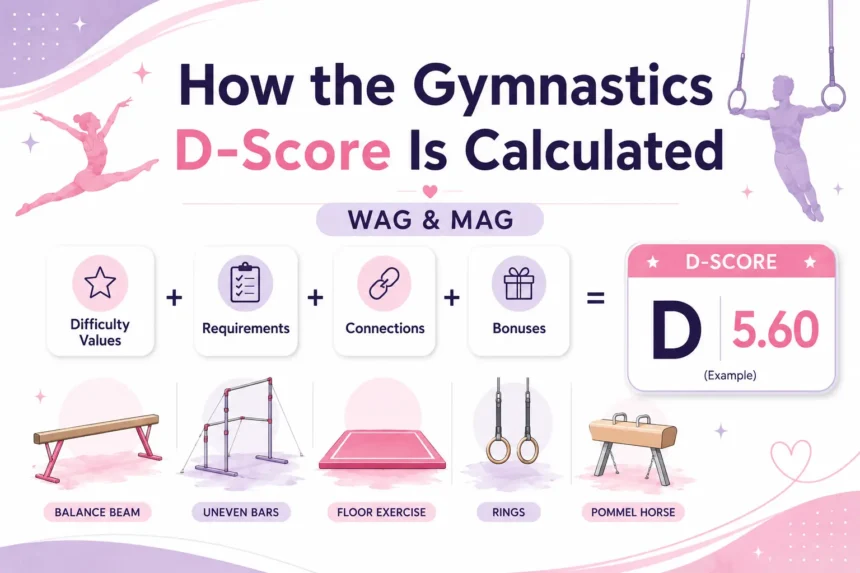
D-Score = Difficulty Value + Composition Requirements + Connection Value + Applicable Bonuses
For most MAG events:
D-Score = Difficulty Value + Element Group Credit + Connection Points
Vault is the major exception. Instead of building a D-score from several elements, each vault already has a predetermined difficulty value in the Code of Points.
| D-Score Component | WAG | MAG |
|---|---|---|
| Counting elements | 8 | 8 |
| Element Difficulty Value | Yes | Yes |
| Composition/Element Group Requirements | Yes | Yes |
| Connection Value | Event-dependent | Event-dependent |
| Dismount bonus | Yes on UB, BB and FX | Dismount has element-group credit |
| Vault | Fixed DV | Fixed DV |
One of the biggest changes for the 2025–2028 cycle is that MAG routines now count eight elements instead of 10 on the five non-vault apparatus.
What Is the D-Score in Gymnastics?
The D-score, or Difficulty Score, represents how difficult the content of a gymnastics routine is. It is separate from the E-score, or Execution Score.
The two are combined to produce the gymnast’s final score:
D-Score + E-Score − Neutral Penalties = Final Score
The D-score rewards what the gymnast attempts, while the E-score measures how well it is performed.
Unlike the old 10.0 scoring system, the D-score is generally open-ended. A gymnast can increase scoring potential by performing harder elements, more valuable connections and other qualifying difficulty.
What Is a Difficulty Value?
Before calculating a D-score, it is important to understand Difficulty Value (DV). A Difficulty Value is the numerical value assigned to an individual recognized element in the FIG Code of Points.
On uneven bars, balance beam, floor exercise, pommel horse, rings, parallel bars and horizontal bar, FIG uses the following scale:
| Difficulty Rating | Difficulty Value |
|---|---|
| A | 0.10 |
| B | 0.20 |
| C | 0.30 |
| D | 0.40 |
| E | 0.50 |
| F | 0.60 |
| G | 0.70 |
| H | 0.80 |
| I | 0.90 |
| J | 1.00 |
For example:
- C element = 0.30
- D element = 0.40
- E element = 0.50
- G element = 0.70
The current WAG and MAG Codes both use values from A (0.10) through J (1.00).
How Is the Women’s Gymnastics D-Score Calculated?
On uneven bars, balance beam and floor exercise, the women’s D-score includes:
- the eight highest Difficulty Values, including the dismount
- Composition Requirements (CR)
- Connection Value (CV)
- applicable bonuses
The current WAG Code specifically defines the D-score on these three events as the eight highest difficulties plus Composition Requirements, Connection Value and bonuses.
So the basic formula is:
WAG D-Score = DV + CR + CV + Bonuses
Let’s look at each part.
1. Count the Eight Highest Difficulty Values
On uneven bars, balance beam and floor, a maximum of eight elements contribute their Difficulty Values to the routine.
Suppose the eight counting elements are:
- 3 C elements
- 3 D elements
- 2 E elements
The calculation is:
3 × 0.30 = 0.90
3 × 0.40 = 1.20
2 × 0.50 = 1.00
Total Difficulty Value:
0.90 + 1.20 + 1.00 = 3.10
This 3 C + 3 D + 2 E example is also used in the current WAG Code to illustrate D-score construction.
But the routine’s D-score is not yet 3.10. Other components must still be added.
2. Add Composition Requirements
Women’s routines must include certain types of elements called Composition Requirements (CR). There are four Composition Requirements on uneven bars, balance beam and floor exercise.
Each is worth:
0.50
So fulfilling all four gives:
4 × 0.50 = 2.00
The exact requirements depend on the apparatus.
For example, balance beam requirements include specific dance, turning and acrobatic content, while floor has its own combination of dance and acrobatic requirements.
The maximum CR contribution is therefore:
2.00 points.
This version is already clear and concise. I’d only make one small wording change for smoother flow:
3. Add Connection Value
Gymnasts can increase the D-score by directly connecting eligible elements.
This is called Connection Value (CV).
For example, two elements performed separately might be worth:
D + D = 0.40 + 0.40 = 0.80
If the direct connection qualifies for an additional 0.20 CV, the combination contributes:
0.40 + 0.40 + 0.20 = 1.00
However, not every D + D connection automatically earns 0.20. The amount depends on the apparatus, element type and difficulty, and whether the elements are connected correctly.
So, in simple terms:
Eligible direct connections can add extra difficulty to the D-score.
4. Add Applicable Bonuses
Some routines can earn additional difficulty bonuses.
One important example in the current WAG Code is the 0.20 dismount bonus for qualifying D-or-higher dismounts on uneven bars, balance beam and floor exercise.
Floor has additional conditions: the routine must contain more than two acrobatic lines, and the final acrobatic line must meet the Code’s requirements to earn the bonus.
Balance beam also uses Series Bonus (SB) for certain connections of three or more elements.
Women’s D-Score Example
Using the earlier example:
| D-Score Component | Value |
| 3 C + 3 D + 2 E elements | 3.10 |
| Composition Requirements | 2.00 |
| Connection Value | 0.60 |
| D-Score | 5.70 |
The eight elements themselves are worth only 3.10.
After adding 2.00 in Composition Requirements and 0.60 in Connection Value, the routine has a:
5.70 D-Score
How Is the Men’s Gymnastics D-Score Calculated?
Men’s artistic gymnastics follows the same general idea, but the details are different.
For floor exercise, pommel horse, still rings, parallel bars and horizontal bar, the D-score is built from:
- Difficulty Values (DV) of the counting elements
- Element Group Requirements (EG)
- Connection Value, where applicable
- applicable bonuses
So the simplified formula is:
MAG D-Score = DV + EG + CV + Bonuses
Under the 2025–2028 MAG Code, the number of elements used to build difficulty was reduced from 10 to eight on the non-vault apparatus.
1. Count the Difficulty Values
As in women’s gymnastics, each recognized men’s element has a Difficulty Value:
A = 0.10 → B = 0.20 → C = 0.30 → D = 0.40, and so on through J = 1.00.
The relevant counting elements are added together to create the first part of the D-score.
For a simplified example, suppose the counting values total:
3.40
That 3.40 becomes the basic Difficulty Value portion of the routine.
2. Add Element Group Requirements
Instead of WAG’s Composition Requirements, men’s gymnastics uses Element Groups.
These ensure that a gymnast shows different types of gymnastics rather than building an entire routine around only one movement family.
For most men’s apparatus, there are:
- Element Group I
- Element Group II
- Element Group III
- Dismount Group IV
Floor exercise uses four Element Groups rather than a separate dismount group.
The exact groups depend on the apparatus. For example, rings must include different types of swing and strength elements, while high bar includes different swing and flight families.
Under the current cycle, using sufficiently difficult elements to fulfill the Element Groups can add substantial value to the D-score. In general, a D-or-higher element can earn 0.50 group credit, while lower-value elements may receive reduced credit under the applicable rules.
World Gymnastics later approved a change capping the MAG Dismount Element Group credit at 0.50, so current amendments should be checked alongside the original 2025 Code.
3. Add Connection Value
Some men’s apparatus reward difficult elements performed in direct connection. Connection Value is especially important on events such as:
- Floor Exercise
- Horizontal Bar
The exact bonus depends on the apparatus.
For example, the current MAG rules allow connection points only for qualifying directly connected recognized high-value elements performed without a fall.
This means there is no single connection formula that applies to every men’s event.
4. Add Applicable Bonuses
The current MAG Code also contains certain difficulty-related bonuses.
One notable example is a 0.10 stick bonus for qualifying dismount landings on most men’s apparatus, subject to the Code’s conditions. Pommel horse is excluded from that specific stick bonus.
Because the exact bonus rules vary by apparatus, the current apparatus section and amendments should always be checked when calculating an official D-score.
Men’s D-Score Example
A simplified men’s floor example might look like this:
| D-Score Component | Value |
| Counting Difficulty Values | 3.40 |
| Element Group credit | 2.00 |
| Connection Value | 0.20 |
| D-Score | 5.60 |
So:
3.40 + 2.00 + 0.20 = 5.60 D-Score
This is only an illustrative example. Actual routines must satisfy the apparatus-specific rules for which elements count, Element Groups, repetition and connections.
Women’s vs. Men’s D-Score
The overall concept is similar, but WAG and MAG use different composition systems.
| D-Score Component | WAG | MAG |
| Difficulty Values | Yes | Yes |
| Counting elements | Up to 8 on UB, BB, FX | 8 on non-vault events |
| Composition Requirements | Yes | No |
| Element Groups | No | Yes |
| Connection Value | Yes, depending on event | Yes, depending on event |
| Dismount-related credit/bonus | Yes | Yes |
| Other bonuses | Event-specific | Event-specific |
| Vault | Fixed numerical DV | Fixed numerical DV |
The easiest way to remember the difference is:
WAG → DV + Composition Requirements + Connections + Bonuses
MAG → DV + Element Groups + Connections + Bonuses
How Is the Vault D-Score Calculated?
Vault is different from every other apparatus. A vault consists of one recognized vault rather than a routine containing multiple separately valued elements.
Each vault already has a predetermined numerical Difficulty Value in the Code.
For WAG, the Code states:
Vault D-Score = Difficulty Value in the Table of Vaults
MAG works the same general way: every vault is listed in a vault group and given its own value.
For example, if a vault is worth:
5.4
the gymnast begins with a:
5.4 D-Score
The E-score is then used to evaluate how well the vault is performed.
Vault therefore does not use:
8 elements + requirements + connections
to construct its D-score.
Why Are Vault Values So Much Higher Than A–J Values?
This can be confusing for beginners.
A G element on floor or bars is worth:
0.70
But a vault might have a Difficulty Value above:
5.00
These values cannot be compared directly.
On bars, beam, floor and most men’s apparatus, 0.70 is the value of one element within an entire routine.
On vault, the numerical value represents the difficulty of the complete vault.
That is why vault has its own scale.
Frequently Asked Questions
Do All Elements in a Routine Count?
No. A gymnast may perform more movements than the number used to calculate Difficulty Value.
In WAG, only the maximum eight highest DVs count on uneven bars, balance beam and floor.
MAG also uses eight counting elements in the current cycle on the non-vault events, although the exact counting and Element Group rules depend on the apparatus.
Can the Same Element Count More Than Once?
Usually, no. A gymnast generally cannot repeat the same element just to collect its Difficulty Value again.
In WAG, the same element receives DV only once in the routine.
MAG similarly states that an element with the same Code identification may be repeated, but the repeated element does not contribute again to the D-score.
What Happens If a Skill Is Not Recognized?
Attempting a high-value element does not automatically guarantee its Difficulty Value. The gymnast must perform the element closely enough to its technical description for the D-Jury to recognize it.
The current WAG Code states that an element must meet its technical description to receive DV. The MAG Code similarly says that poorly performed elements may not be recognized by the D-Jury.
How the 2025–2028 Code Changed the D-Score
The basic D-score concept remains the same, but the current Code changed several important details.
Women’s Gymnastics
WAG still counts up to eight Difficulty Values on uneven bars, beam and floor.
The current cycle also retained the 0.20 qualifying dismount bonus and adjusted the values of selected uneven-bars elements. Vault values remained stable when the new cycle began.
Men’s Gymnastics
MAG saw larger changes.
The biggest was reducing the number of counting elements from:
10 → 8
World Gymnastics said this was intended partly to reduce physical load and place greater emphasis on technical quality.
Other changes included:
- revised Element Group credit
- new incentives around difficulty
- upgraded and downgraded elements
- changes to connection rules
- all vault values reduced by 0.40 at the start of the cycle
- J-level elements worth 1.00
A later 2025 amendment also approved a 0.50 maximum for MAG dismount Element Group credit.
Because the Codes can be updated during the cycle, the latest official Code, appendix and Help Desk documents should always take priority.