Gymnastics scoring can look confusing at first glance, especially if you’re used to legacy systems where every routine was judged out of a perfect 10. Today’s system is open-ended, meaning there’s no fixed maximum score. Instead, a gymnast’s total is built from difficulty and execution, with deductions applied for errors along the way.
This guide explains the modern gymnastics scoring system, including:
- How gymnastics scores are calculated
- What the D-Score and E-Score actually measure
- How deductions and penalties affect the final score
- Why a perfect 10 no longer exists in today’s scoring
Whether you’re a parent, new fan, athlete, or coach, this article gives you the big picture first and then points to deeper resources.
How Gymastics Scores Are Calculated Today
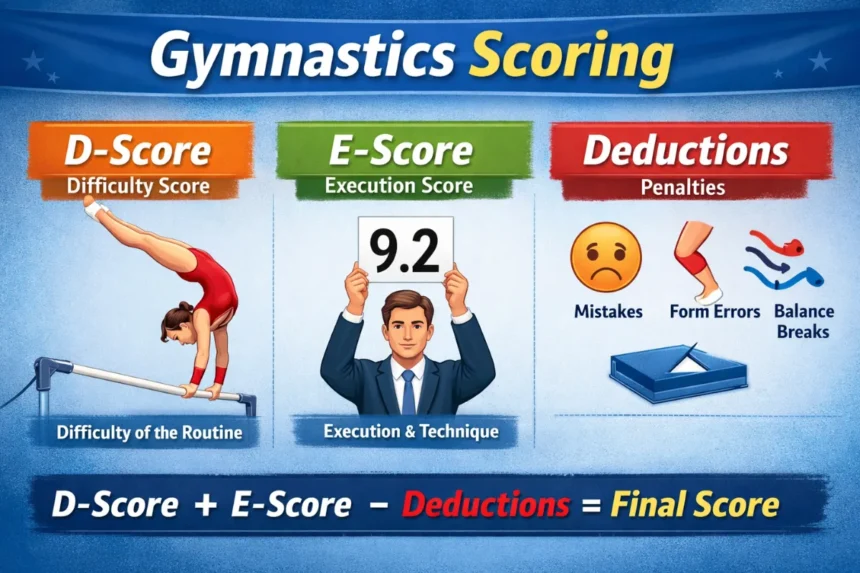
The final score in modern gymnastics is calculated with a simple formula:
Final Score = D-Score + E-Score − Neutral Deductions
What that means:
- D-Score measures how difficult the routine is.
- E-Score measures how well the routine is performed.
- Neutral deductions are penalties applied after difficulty and execution are combined.
This scoring framework is used internationally and is outlined in the FIG Code of Points, which is updated each Olympic cycle to reflect evolving skills and expectations.
What Is the D-Score? (Difficulty Score)
The Difficulty Score (D-Score) reflects the technical content of a routine, basically how hard it is.
It starts at zero and increases based on the difficulty values of skills included in the routine. Each skill has a difficulty rating (often denoted A to J), with more complex skills earning more points.
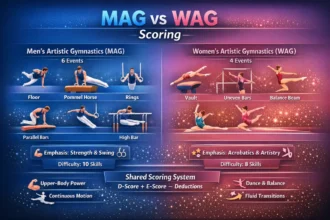
- In women’s gymnastics, the routine’s 8 most difficult skills (including connection and compositional requirements) count toward the D-Score.
- In men’s gymnastics, the routine’s highest-value skills are counted (historically up to ten, with updated practices per Code revisions).
There’s no theoretical limit to the D-Score, routines can continue to increase difficulty points by adding harder elements.
Composition and connection bonuses:
Some skills performed in a specific sequence or fulfilling certain groups of required elements can earn additional points toward the D-Score.
What Is the E-Score? (Execution Score)
The Execution Score (E-Score) reflects how cleanly and correctly a routine is performed. While the D-score rewards difficulty, the E-score measures quality.
Every routine begins with a maximum E-score of 10.0. Judges then subtract deductions for errors they see during the performance. The cleaner the routine, the higher the remaining E-score.
Common Execution Errors
Judges apply deductions for issues such as:
- Bent arms or bent legs
- Flexed or poorly pointed feet
- Poor body alignment or technique
- Balance checks or wobbles
- Steps, hops, or instability on landings
- Lack of rhythm, control, or artistry (where applicable)
Typical deductions range from: 0.1 for small errors, 0.3–0.5 for larger errors, 1.0 for falls. Multiple small deductions can add up.
Neutral Deductions: Penalties After the Fact
Neutral deductions are taken after the D-Score and E-Score are combined and usually relate to:
- Stepping out of bounds
- Time violations
- Incorrect attire or illegal equipment
- Coaching interruptions
These penalties are not part of execution, they are administrative or rule-based deductions that affect the final score.
How the Panels Work (Judging Process)
At high-level competitions, gymnastics routines are evaluated by separate judging panels, each responsible for a specific part of the score.
- A D Panel assesses the routine’s difficulty, including skill values, connections, and composition.
- An E Panel evaluates execution, artistry, technique, and form, starting at 10 and subtracting for errors.
At major competitions such as World Championships and the Olympic Games, both the D and E panels may include multiple judges.
For execution:
- Each judge submits an independent E-score
- The highest and lowest scores may be dropped
- The remaining scores are averaged to produce the final E-score
This system helps reduce the impact of individual bias or human error and is governed by the rules set by the Fédération Internationale de Gymnastique (FIG).
Why There’s No “Perfect 10” (Open-Ended Scoring)
Before 2006, gymnastics used the famous “perfect 10” system, where routines started from a fixed maximum score and judges deducted points for mistakes. While iconic, this system became limiting as skills and routines grew more difficult.
The main issue was that difficulty had a ceiling. Once a routine reached the highest allowed start value, adding harder skills offered little scoring advantage, despite increasing risk and complexity. To solve this, gymnastics adopted an open-ended scoring system, separating difficulty from execution.
Instead of asking, “How close is this routine to perfect?”, judges now evaluate two separate questions:
- How difficult was the routine? (D-score)
- How well was it performed? (E-score)
Because difficulty is added rather than capped, there is no theoretical maximum score. As skills evolve, scores can rise with them.
How Scores Look Different Across Events
Although the scoring formula is the same across artistic gymnastics, how scores appear can vary by apparatus.
Vault
Vault scoring is more standardized. Each vault has a pre-determined difficulty value, so the D-score is fixed once the vault is successfully performed. As a result, execution plays a major role in separating scores.
Bars, Beam, and Floor
On uneven bars, balance beam, and floor exercise, the D-score is more flexible. It is built from:
- Individual skill difficulty values
- Connections between elements
- Composition requirements, such as required skill groups
Because these events involve longer routines with more elements, there are more opportunities to both earn difficulty and lose execution points.
*For official scoring rules and detailed explanations, see the Fédération Internationale de Gymnastique Code of Points and USA Gymnastics scoring resources.