
Gymnastics is a sport where extraordinary strength meets skill. As modern gymnastics has evolved, skills have become faster, higher, and more complex. Gymnasts can experience very high impact forces during landings, often many times their body weight, depending on the skill and surface.
That’s a major reason today’s programs pair technical training with structured strength and conditioning: not to “bodybuild,” but to help gymnasts generate force efficiently, control positions under fatigue, and improve durability over time.
Bodyweight Training: the Foundation of Gymnastics Strength
Bodyweight training is the cornerstone of gymnastics conditioning. It builds relative strength, the ability to move and control one’s own body with precision. This type of strength transfers directly to gymnastics skills because it reinforces the exact shapes and positions used in competition.
Key bodyweight exercises include:
1) Planche Progressions – The planche, a horizontal hold with hands on the floor, requires exceptional shoulder and core strength. Gymnasts train by progressing from tucked planche holds to advanced straddle and full planche positions, developing extraordinary straight-arm strength.
2) Pull-Ups and Rope Climbs – Pulling exercises are fundamental for upper-body strength. Gymnasts perform strict pull-ups on bars and rings, often aiming for high reps with perfect form. Rope climbs using only the arms further enhance lat, bicep, and grip strength, all of which are crucial for swinging and holding skills.
3) Dips and Press Handstands – Pushing strength is developed through parallel bar dips, ring dips, and handstand push-ups. These exercises strengthen the chest, shoulders, and triceps, benefiting ring support holds and vault push-offs. Gymnasts perform high-rep dip sets and advance toward pressing their body into a handstand position.
4) Core Conditioning – Gymnasts are renowned for their core strength. Training the midsection is a daily focus, utilizing movements like hanging leg raises, L-sits, hollow body holds, planks, and V-ups. These exercises build the abdominal and hip flexor strength necessary for skills from pommel horse circles to tumbling take-offs.
In addition to these, gymnasts perform countless push-ups, jump squats, muscle-ups, back extensions, and other bodyweight drills. The emphasis is on high-quality movement and consistency, sets of 10–20 perfectly controlled push-ups or regular rope climbs. This regimen not only builds raw strength but also enhances neuromuscular control for applying that strength in routines.
Weightlifting in Gymnastics: Adding External Resistance
While bodyweight exercises form the foundation, many Olympic-level gymnasts incorporate weightlifting to further enhance their strength. External weights, when used strategically, target specific muscle groups, increase maximal strength, and improve explosive power for gymnastics skills.
Gymnastics strength researchers have identified four key lifts that are most relevant to gymnasts:
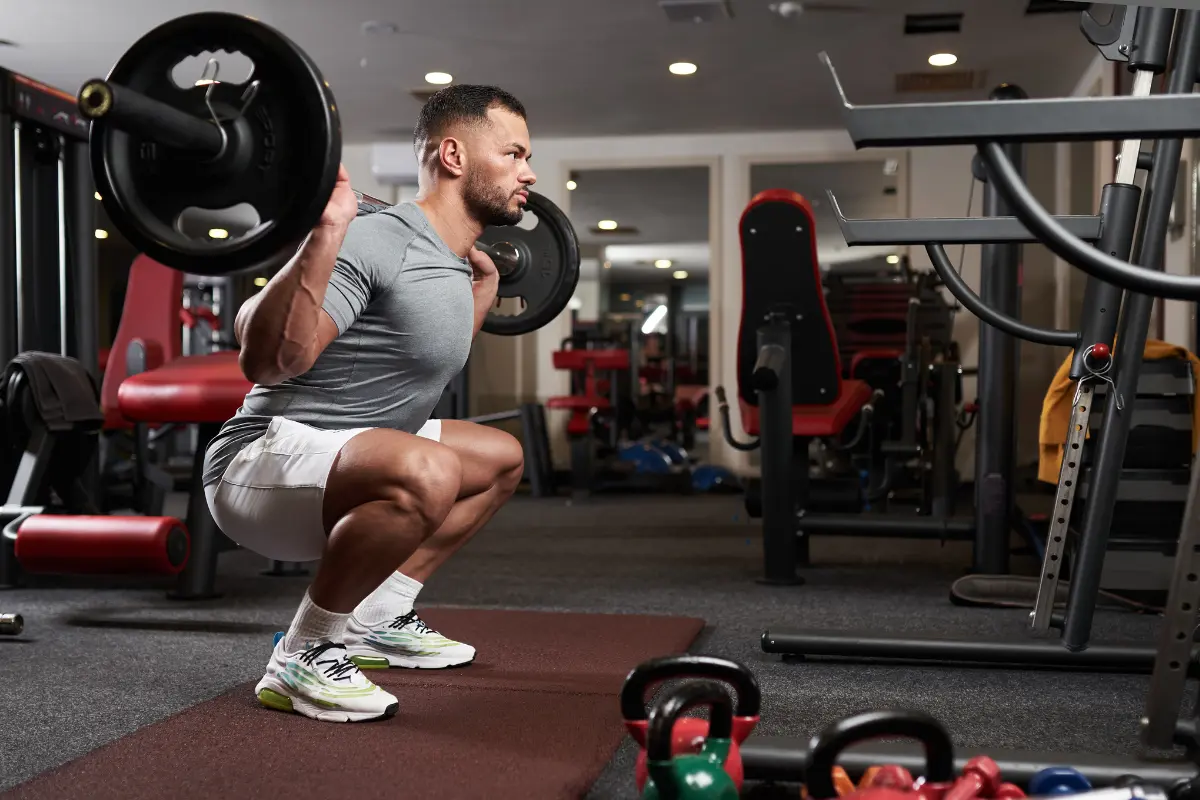
Squats
Barbell squats (and variations like front squats or single-leg squats) strengthen the thighs, hips, and glutes. Strong legs contribute to faster runs and higher jumps, translating to more powerful tumbling and vaulting.
Coaches have found that weighted squats yield better strength gains than excessive bodyweight jumping reps, while also reducing injury risk. Gymnasts typically lift heavy but low-rep to build strength without excessive muscle bulk, focusing on proper form and full range of motion.
Presses
Pressing exercises include the overhead press, bench press, weighted push-ups, and weighted dips. These movements develop pushing strength in the shoulders, chest, and triceps—essential for vault blocking, pommel horse support, ring presses, and handstands.
For instance, overhead dumbbell presses enhance shoulder stability, aiding handstand holds and ring strength elements.
Pull-Downs/Pulls
These movements, similar to pull-ups but with external resistance (e.g., lat pull-down machines or weighted pull-up belts), strengthen the lats, biceps, and upper back.
Weighted pull-ups or lat pull-downs benefit climbing, swinging, and strength holds. Many male gymnasts train weighted chin-ups for a few low-rep sets to improve their one-rep max, making high-rep bodyweight sets more manageable.
Deadlifts
Deadlifts (and variations like trap-bar deadlifts or heavy kettlebell lifts) develop the posterior chain, including the back, glutes, and hamstrings, while also enhancing core stability. This lift teaches athletes to generate force through the legs and transfer it through a braced core, essential for powerful tumbling take-offs and stable landings.
Gymnasts typically perform these lifts in low to moderate rep ranges (3–6 reps per set) to maximize strength gains while minimizing hypertrophy. The goal is to increase neural strength and power rather than bulk.
Additionally, elite gymnasts may incorporate power exercises like power cleans, medicine ball throws, or squat jumps with weight to develop explosive strength. However, all weight training is carefully balanced with gymnastics practice to avoid overtraining.
Integrating Strength With Skill: A Sample Weekly Structure
Elite and high-level gymnasts typically integrate strength training, bodyweight conditioning, technical skill work, and recovery throughout the week.
Day 1 – Heavy Strength (Lower Body Focus)
- Squat Pattern (e.g., back or front squat): 3–5 sets of 3–6 reps
Builds leg and hip strength for sprinting, tumbling power, and controlled landings. Longer rest periods (2–3 minutes) allow high-quality effort. - Pull-Ups (weighted if appropriate): 3–5 sets of 3–6 reps
Develops lats, upper back, and arm strength for bars and rings. - Core – Hanging Leg Lift Progressions: 2–3 sets of controlled reps
Load is added only when technique, hip control, and spinal positioning are consistent.
(Followed by flexibility work and event practice.)
Day 2 – Gymnastics-Specific Conditioning
- Rope Climbs: 2–4 ascents (legs-free as appropriate)
- Planche Leans or Tuck Planche Holds: 2–3 short holds
- Ring Support Holds or Dips (selective): based on shoulder readiness
- Hollow & Arch Rocks: short, precise sets reinforcing body shapes
Focus: shape control, shoulder stability, and endurance, not fatigue.
Day 3 – Recovery / Active Rest
Light mobility, stretching, therapy work, or easy aerobic movement to promote recovery.
Day 4 – Heavy Strength + Power (Upper Body Emphasis)
- Hinge Pattern (e.g., trap-bar or conventional deadlift): 3–5 sets of 3–6 reps
- Overhead Press (DB or barbell): 3–4 sets of 5–8 reps
- Medicine Ball Throws: low-volume, high-intent explosive work
- Posterior Chain Accessories: carefully selected, technique-focused
Day 5 – Skill Integration + Conditioning
- Plyometric Rebounds: short, high-quality sets emphasizing landing mechanics
- Event-Specific Drills: trampoline sticks, mushroom circles, swing endurance
- Bodyweight Circuit: limited rounds, stopped before form degrades
Day 6 – Maintenance & Prehab
- Flexibility training (yoga, ballet, or structured stretching)
- Shoulder, ankle, and core stabilization exercises
Day 7 – Full Rest
Complete rest to allow adaptation and recovery.
These sessions focus on lower reps with higher effort, along with longer rest between sets. While this can feel unusual in a sport known for nonstop conditioning, giving athletes time to recover between heavy sets often leads to better strength gains and cleaner movement.
On other days, strength work is blended into regular gymnastics practice. Short conditioning circuits or specific strength drills are added alongside skill training to build endurance without excessive fatigue.
As competition season approaches, the focus usually shifts from building strength to maintaining it, while adding more explosive work and reducing overall volume so gymnasts stay fresh for routines.
Expert Opinions: Coaches & Trainers on Weight Training
One gymnastics coach who introduced a formal weightlifting program for her team reported remarkable results. After 18 months of working with a strength trainer, her female gymnasts (ages 13–18) were noticeably more powerful and had far fewer injuries.
She described starting with technique using light dumbbells and bars, then progressing to heavy “max strength” phases with squats, weighted pull-ups, and overhead presses. They devoted two days a week to heavy lifts and three days to gymnastics-specific conditioning (often with added weights), and even the younger girls (10–13) were gradually learning weightlifting form.
Athlete Examples: Strength Training in Action
Elite gymnasts don’t rely on skills alone. They also train their bodies to be strong enough to perform those skills safely and consistently.
Simone Biles, for example, combines traditional gymnastics conditioning like rope climbs, leg lifts, and core work with strength exercises that build power in her hips and legs. This type of strength training helps her jump higher, tumble harder, and land more securely.
U.S. Olympian Sam Mikulak has also shared that strength training played a major role in his success. His workouts included a mix of weight training and explosive exercises to build full-body strength and power, which supported his tumbling and bar routines.
These examples show a simple truth: strength training helps gymnasts perform skills better. As gymnastics skills become more difficult, building strength in a safe, well-planned way helps athletes stay powerful, controlled, and more resilient over time.