Front Lever vs. Back Lever on Rings: Positions, Demands and Learning Order
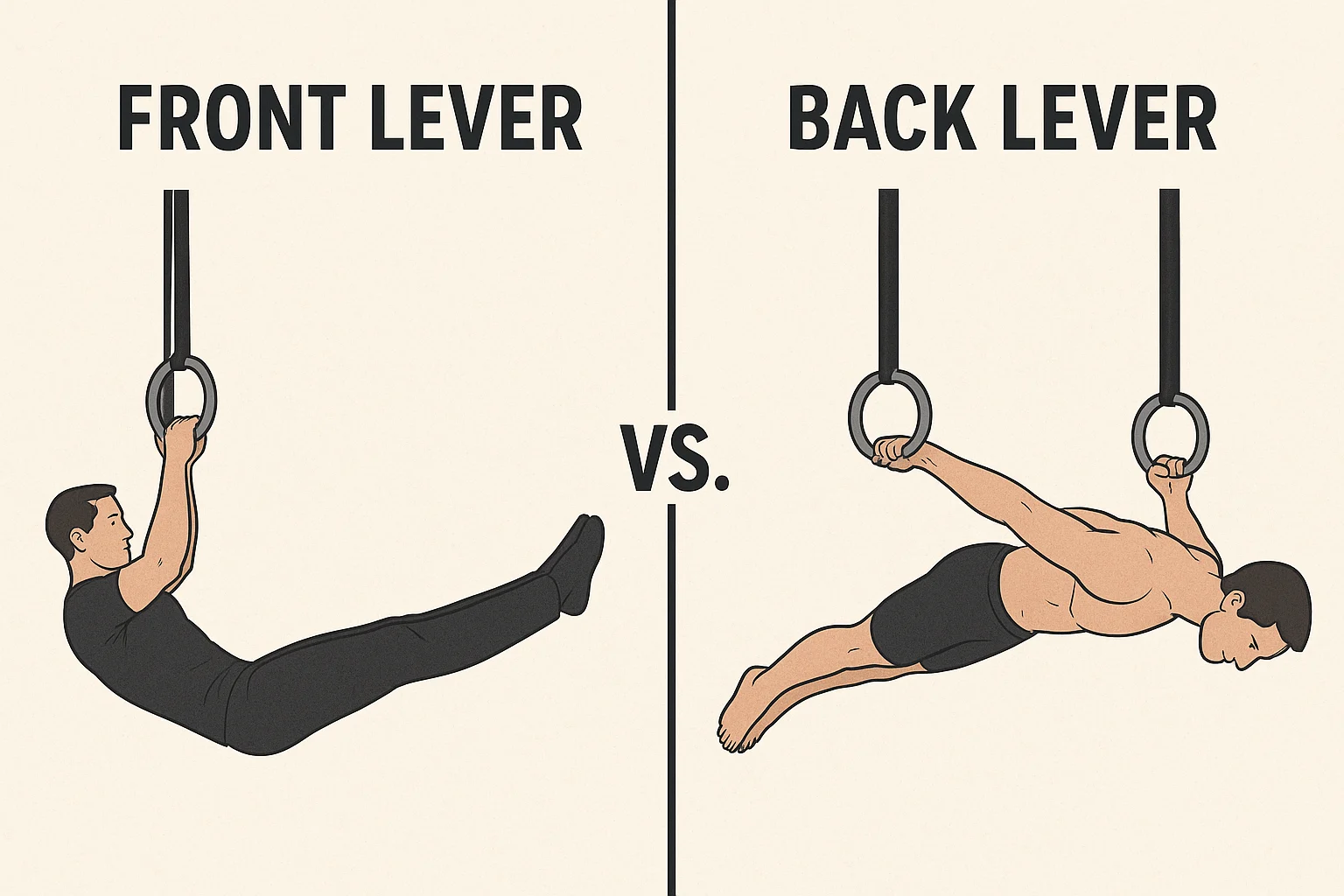
The front lever and back lever are horizontal straight-body holds performed below the rings. In a front lever, the gymnast faces upward. In a back lever, the gymnast faces downward, with a different relationship between the arms, shoulders and trunk.
Contents
- Recognize the two positions
- They are different from planche and Maltese positions
- What their FIG difficulty values mean
- Why body shape changes the difficulty
- Why the back lever is not a passive shoulder lock
- Choose the learning order from the gymnast’s needs
- Use assistance with a clear purpose
- Build the foundations without rushing the hold
Neither is a universal beginner exercise, and there is no reliable rule that everyone should learn the back lever first. The appropriate order depends on the gymnast’s current strength, available positions, technical experience and coaching plan. A hold that appears earlier in one person’s training can still be inappropriate for somebody else.
Recognize the two positions
In the front lever, the chest faces upward and the body extends horizontally away from the hand supports. The gymnast maintains a straight body while hanging below the rings. It is different from a bent-arm row, even though both involve pulling capacity.
In the back lever, the chest faces downward and the arms reach behind the trunk toward the rings. This places the shoulders in a different position. It should not be described as simply turning the same exercise over while keeping the loading unchanged.
| Feature | Front lever | Back lever |
|---|---|---|
| Chest orientation | Upward | Downward |
| Official rings terminology | Hanging scale frontways | Hanging scale rearways |
| Arm position | Straight arms connecting the body to the rings in front of the torso’s shoulder line. | Straight arms reaching behind the torso toward the rings. |
| Shared demand | Maintain the intended horizontal shape and control the entry, hold and exit. | |
The words front and back describe these different orientations; they do not mean that one is only an abdominal exercise and the other only a back exercise. Both involve coordinated work through the upper body and trunk.
They are different from planche and Maltese positions
A face-down body does not automatically identify a back lever. In a planche or support scale, the gymnast supports the body above the rings. In a Maltese, the body is near ring height with a different arm arrangement.
Look at the shoulders relative to the rings and the direction of the arms, not just whether the gymnast faces the floor. The guide to cross, Maltese and support-scale positions helps distinguish those neighboring skill families.
Camera angle can obscure these relationships. A still image may also capture a transition rather than a hold. Watching the movement immediately before and after the position usually makes identification easier.
What their FIG difficulty values mean
The 2025–2028 men’s Code of Points lists both independent hanging scales in Group II at A value, worth 0.1, with a two-second hold: back lever in box 7 and front lever in box 13.
Equal value does not establish equal effort for every gymnast. It also does not make them entry-level recreational skills. A difficulty table classifies recognized elements within a sport; it is not a universal exercise progression.
The entry or subsequent movement may also belong to a different element. When comparing videos, make sure both clips show the same task. Holding a position, lowering into it and lifting out of it are related but distinct demands.
Why body shape changes the difficulty
Extending the legs places more of the body’s mass farther from the shoulder region than a compact tuck does. The gymnast must manage the resulting rotational demand while preserving the intended line. This helps explain why coaches may use shorter-body-shape preparations.
Basic torque principles connect force with its perpendicular moment arm. Applied cautiously, they explain why changing the body’s geometry can change the task even when bodyweight stays the same.
However, a tuck, straddle or one-leg variation is not a perfectly standardized difficulty step. The amount of hip bend, leg separation and assistance can vary substantially. A coach should compare the actual positions rather than assuming that every variation with the same name is equivalent.
Why the back lever is not a passive shoulder lock
The back lever requires active control in a shoulder position that may be unfamiliar or demanding for the gymnast. Describing the shoulders as locking into place can encourage someone to rely on an end position without the capacity to manage it.
Do not force a deeper position in the hope that the joints will hold the body more easily. A comfortable movement range in an unloaded situation is also different from controlling bodyweight in that position. The coach needs to assess both the position and the loading.
Similarly, a skin-the-cat movement or an inverted hang is not an automatically safe introductory step for every beginner. Entry, clearance, assistance and exit all require planning. These skills belong in an appropriate coached setting rather than an improvised home sequence.
Choose the learning order from the gymnast’s needs
Some gymnasts may find a back-lever progression more accessible; others may be better prepared for front-lever work, or need more general preparation before either. Previous training and individual movement differences make a fixed order unreliable.
The NSCA’s long-term development guidance supports training matched to the individual. It does not prescribe front or back lever as a universal first milestone for young athletes.
Ask the coach what the chosen preparation is intended to develop. Is the limitation maintaining body shape, producing force in a particular shoulder position, controlling the rings or coordinating the entry? The answer should guide the next task.
Use assistance with a clear purpose
Assisted work can reduce the demand while preserving useful parts of the target action. The location and amount of support matter, so an assisted hold should be described precisely. “Band-assisted lever” is incomplete if the band placement or tension changes each session.
Keep track of the body shape, support arrangement, duration and quality. When the task becomes consistent, the coach can adjust one feature. Changing to straighter legs, less assistance and longer attempts at once makes the response harder to interpret.
There is no dependable promise that the back lever takes a few months while the front lever takes a year. A learning timeline depends on starting capacity, training consistency and many individual factors. Progress should be judged against the assigned task, not somebody else’s calendar.
Build the foundations without rushing the hold
Controlled rows and assisted pulling exercises can contribute to general preparation. They are useful in their own right, although they do not prove readiness for a full lever. Straight-arm work and skill-specific positions need their own assessment.
Stop painful attempts and report recurring shoulder, elbow or wrist symptoms. Also review the plan if repeated efforts lose their shape or interfere with the rest of practice. Extra effort cannot compensate for an unsuitable task or inadequate recovery.
The most useful decision is therefore not which lever every gymnast should learn first. It is which well-defined preparation the gymnast is ready to practice now. Both holds can be long-term technical goals, and both deserve more careful planning than an easier-versus-harder label.