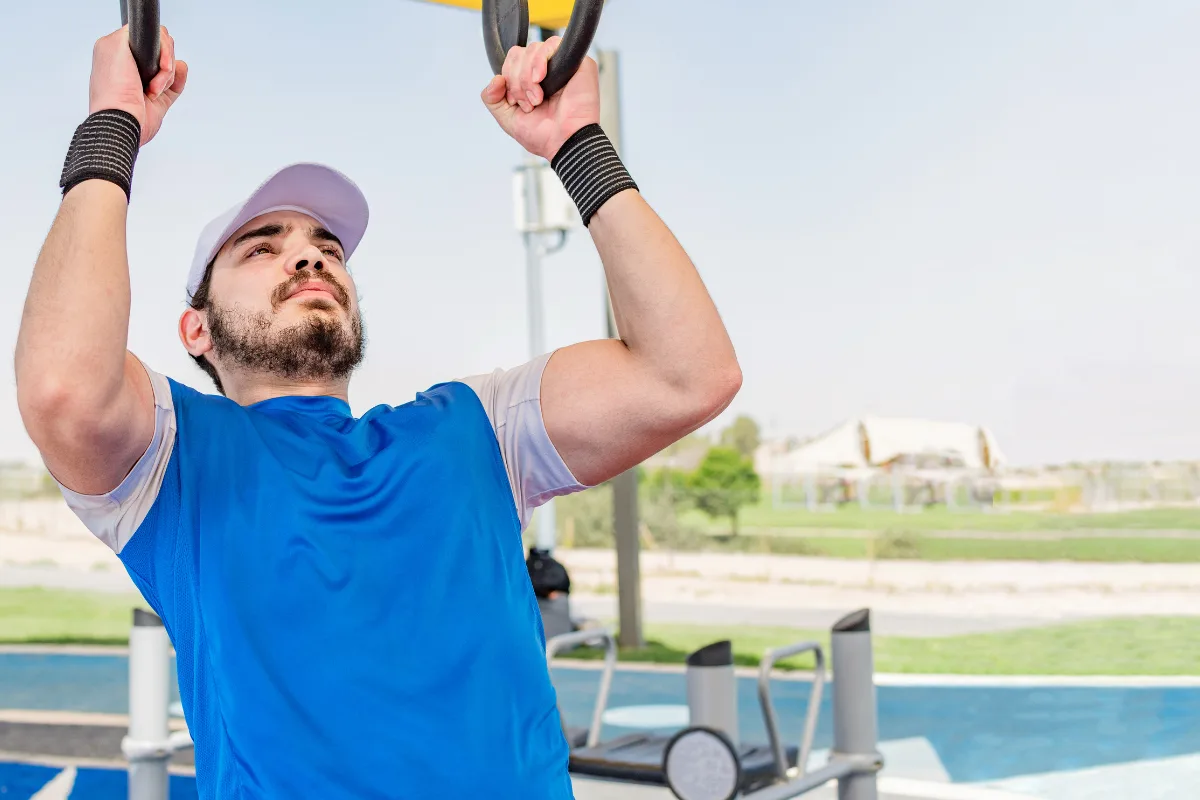
“Gymnastics rings” and “calisthenics rings” are often overlapping retail labels. They do not reliably identify two different grades of equipment. A set sold for general strength work may have the familiar dimensions of competition rings, while a product called gymnastics rings may still be a portable fitness set rather than certified competition apparatus.
- Competition rings are part of a complete apparatus
- Read the specification instead of the category label
- What 28-millimeter and 32-millimeter grips mean
- Wood, synthetic material and outdoor use
- Straps are part of the equipment, not an afterthought
- Understand what a load rating covers
- Check age restrictions before buying for a child
- Choose for a defined training task
For an artistic gymnast, compare the actual specifications and intended use. The questions are whether the rings suit the assigned exercises, whether the complete setup is appropriate and whether the manufacturer permits the gymnast to use it. The name printed on the box cannot answer those questions.
Competition rings are part of a complete apparatus
The 2026 FIG Apparatus Norms specify an inner ring diameter of 18 centimeters and a grip profile diameter of 2.8 centimeters, with stated tolerances. The grip measurement is the thickness of the material around which the hand closes; it is not the diameter of the opening.
The same document describes the suspension, frame, functional properties and testing requirements. Rings can be made from wood or a suitable synthetic material. Matching the two ring measurements alone does not demonstrate that a portable set and its installation meet the complete apparatus requirements.
This distinction matters when a listing uses phrases such as Olympic dimensions. That phrase may describe the size of the hand-held rings, without establishing certification of the apparatus or approval for swings and dismounts. Ask what, specifically, the claim covers.
Read the specification instead of the category label
| Specification | What to establish |
|---|---|
| Grip diameter | The thickness held by the hand, normally listed in millimeters. |
| Inner diameter | The opening inside each ring, separate from grip thickness. |
| Material and finish | What the rings are made from and how the surface should be maintained. |
| Straps and adjustment | Compatible components, working length and the correct locking method. |
| Intended use | Permitted exercises, environment and user restrictions. |
| Installation | Approved supports and any professional installation requirements. |
A comparison table becomes useful only when the entries describe the actual products. Statements such as “gymnastics rings have heavy-duty buckles” and “calisthenics rings have quick buckles” invent a distinction that the labels do not guarantee.
What 28-millimeter and 32-millimeter grips mean
A 28-millimeter grip matches the nominal FIG ring profile. A thicker grip changes how the hand wraps around the ring. That can affect comfort and the feel of an exercise, but it does not create a universal division between a skill ring and a strength ring.
Hand size is relevant, yet “larger hands always need thicker rings” is also too broad. The intended task and the gymnast’s experience matter. When possible, discuss the choice with the coach and compare suitable equipment in a supervised setting before assuming that a different diameter will solve a training problem.
A 32-millimeter grip doesn’t automatically slow skill learning, and 28 millimeters isn’t automatically right for every child. A familiar competition-like size does not override a product’s age restrictions, installation instructions or intended use.
Wood, synthetic material and outdoor use
Wood is common in gymnastics and fitness rings, but its presence does not establish the quality of the complete set. Examine the manufacturer’s information about the surface, inspection and care. Cracks, splinters or other damage require attention; chalk cannot repair a damaged ring.
Synthetic rings also vary. “Plastic” is a broad material description, not a promise that every product can remain outside in rain, heat and sunlight. The straps, stitching and metal components may have different exposure limits from the rings themselves.
The GORNATION wooden ring specification, for example, permits indoor and outdoor use while also requiring dry storage and care after moisture exposure. This illustrates why outdoor use and permanent outdoor storage are different claims. Apply the instructions for the exact product you own.
Comfortable grip also depends on surface condition and the task. Avoid promises that wood can never slip when sweaty or that another material guarantees secure handling. Follow the coach’s and manufacturer’s guidance on permitted grip aids and maintenance.
Straps are part of the equipment, not an afterthought
Look beyond the rings to the strap material, stitching, buckle and adjustment method. The components must be compatible. A replacement strap that happens to fit through a ring is not necessarily an approved replacement.
Numbered markings can make it easier to repeat a setting, but equal numbers do not always mean equal ring heights. The supports may be at different heights, or the straps may take different routes around them. The final position still needs checking.
Quick adjustment is useful when a session alternates exercises, provided the locking system is used correctly. It is not a reason to improvise the threading or adjust the equipment while it is supporting someone. Our ring setup guide explains the questions to resolve before loading the apparatus.
Understand what a load rating covers
A stated load rating may refer to one component, one ring-and-strap assembly or the complete product under specified use conditions. Read that wording carefully. Do not add two separate component ratings together and assume the result is the permitted user weight.
The anchor and supporting structure have their own requirements. A high rating on the rings says nothing by itself about the ceiling attachment or doorway bar used to hang them. Dynamic movement also changes the forces involved, so a static-looking number is not permission to perform any exercise.
There is no defensible universal shopping rule that every set must display a particular number such as 600 pounds. Clear intended-use information, compatible installation and reliable inspection instructions are more useful than an impressive number with no explanation.
Check age restrictions before buying for a child
Products marketed to adult fitness customers may not be intended for young gymnasts. The GORNATION Workout Rings manual, for example, states that the product is not suitable for children under 14. That is a restriction for that product, not a minimum age for the sport of gymnastics.
A gymnastics club may use different apparatus designed for its participants and teaching program. Ask the child’s coach what equipment, if any, is appropriate for an assigned home exercise. Lowering an adult product and placing a mat below it does not cancel the manufacturer’s restrictions.
Choose for a defined training task
If the goal is basic pulling strength, compare whether rings add anything useful to an existing setup. The rings versus pull-up bar guide can help separate exercise needs from equipment appeal.
If the goal is learning the rings event, the club’s apparatus, coaching and progression plan should lead the decision. A family does not need to recreate a competition setup to support a gymnast’s development. A suitable purchase begins with a clear task, then a check that every part of the equipment and installation supports it.