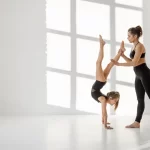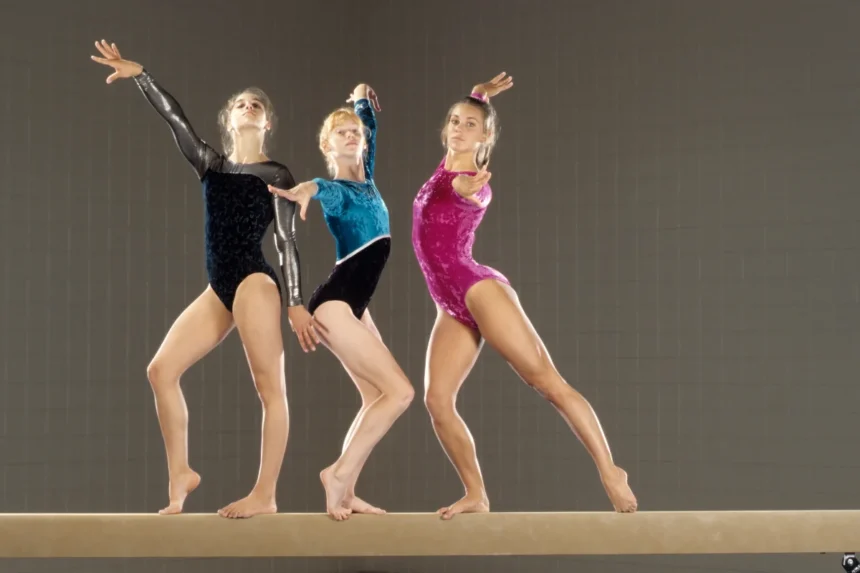
Dance plays a huge role in how gymnasts move, perform, and express themselves. Learning basic dance skills early helps gymnasts build better posture, flexibility, rhythm, and control.
Below are the 6 core dance elements every gymnast should learn, along with why they matter and how they progress from beginner to advanced levels.
Split Leaps
What They Are
A split leap begins from one foot and rises into a front-to-back split position before landing on the opposite leg. Although taught early, split leaps remain a foundation of artistic gymnastics.
Why Gymnasts Need Them
- Demonstrate flexibility, extension, and strong body lines.
- Required on both floor and beam.
- Help gymnasts earn leap credit and avoid amplitude deductions.
Progression (Beginner → Advanced)
Beginner:
Floor splits, basic split jumps, and small split leaps focusing on straight legs, pointed toes, and posture.
Intermediate:
Work toward deeper splits (90° → 120° → 150°), increasing height and reducing knee bend while strengthening the hip flexors, hamstrings, and glutes.
Advanced:
Achieve a clean, fully extended 180° split in the air, connecting into series without hesitation.
Training Tips
- Use controlled leg kicks to build active flexibility.
- Incorporate split jumps, switch prep drills, and plyometrics.
- Prioritize pointed toes, straight legs, lifted chest, and a strong “punch step.”
Switch Leaps (and Variations)
What They Are
A switch leap involves changing legs midair, the front leg swings back as the back leg swings forward. Variations include switch side, switch ring, and switch half leaps.
Why Gymnasts Need Them
- Essential in optional-level choreography.
- Show dynamic power, hip flexibility, and artistic expression.
Progression (Beginner → Advanced)
Beginner:
Establish strong split leaps and hip flexibility.
Intermediate:
Practice low switch drills, leg lift drills, and small switch jumps to develop control and timing.
Advanced:
Perform a fully extended 180° switch with height and clean shape; add variations and connect them into leap series.
Training Tips
- Use resistance bands to strengthen hips and adductors.
- Emphasize explosive hip extension and clean leg change.
- Progress from low drills → full switch leaps → advanced variations.
Turns (Pirouettes, Dance Turns, Twists)
What They Are
Turns include pivots, passé turns, pirouettes, and other single-leg rotations performed on floor or beam. They bring elegance and flow to routines.
Why They Matter
- Improve balance, alignment, and body control.
- Help routines feel fluid, expressive, and connected.
Progression (Beginner → Advanced)
Beginner:
Quarter turns, pivots, relevé balance, and learning posture and spotting.
Intermediate:
Full turns with controlled rotation, accurate arm placement, and clean finishes.
Advanced:
Multiple turns (single, double, triple) linked to leaps, jumps, or choreography.
Training Tips
- Strengthen the core, ankles, and feet.
- Practice ballet drills like relevés and spotting.
- Start slowly to develop precision before adding speed.
Surface Note
Gymnasts turn barefoot on carpeted or spring floors, making friction higher than in dance studios. Technique must therefore be exceptionally clean.
Chassés (Traveling Steps)
What They Are
A chassé is a gliding step where one foot “chases” the other. It is used to travel smoothly and set up leaps, turns, or choreographic sequences.
Why Gymnasts Need Them
- Create fluid transitions and prevent routines from appearing choppy.
- Reinforce rhythm, timing, and coordination.
Progression (Beginner → Advanced)
Beginner:
Basic chassé steps with pointed toes and clean foot placement.
Intermediate:
Add arm pathways, changes in tempo, and directional shifts.
Advanced:
Use chassés as expressive transitions within choreography (e.g., chassé → leap → turn → jump).
Training Tips
- Begin slowly to refine alignment and weight transfer.
- Use full-body coordination (arms, posture, and torso) to enhance movement quality.
Arm Pathways & Body Lines
What They Are
Arm pathways describe how the arms flow, curve, and transition through choreography. Combined with strong body lines, they create clean, elegant movement.
Why Gymnasts Need Them
- Enhance the artistic quality of leaps, turns, and choreography.
- Improve balance, control, and the overall look of routines.
Progression (Beginner → Advanced)
Beginner:
Learn basic arm positions and gentle transitions with proper posture.
Intermediate:
Coordinate arms with legs and torso, practicing fluid motion during leaps and turns.
Advanced:
Use expressive, stylized arm choreography that matches music and emotion.
Training Tips
- Incorporate ballet or dance-based arm drills.
- Use mirrors or video for symmetry and alignment checks.
- Remember: arms should support the movement, not distract from it.
Body Waves / Fluid Body Movements
What They Are
Body waves are smooth motions traveling through the torso (spine, chest, ribs, and hips) that add softness, musicality, and expressive depth.
Why They Matter
- Improve body control and fluidity.
- Smooth transitions between skills for a cohesive routine.
- Add emotional expression and musical interpretation.
Progression (Beginner → Advanced)
Beginner:
Torso isolations and slow, controlled wave motions.
Intermediate:
Blend waves with arm and leg movement, level changes, and transitions.
Advanced:
Integrate waves into full choreography, matching musical phrasing and expression.
Training Tips
- Take dance classes emphasizing torso articulation.
- Start slow, then add complexity and tempo.
- Let music guide the direction and emotion of each wave.
Putting It All Together: How to Build a Dance-Ready Gymnast
- Cross-train with dance.
Ballet, jazz, contemporary, and lyrical all develop posture, lines, musicality, and expressive movement. - Integrate dance drills into warm-ups and conditioning.
Include kicks, split jumps, hip-strengthening drills, and active flexibility to support leaps and turns. - Progress gradually and intentionally.
Build from basic posture and splits toward more complex leaps, turns, and transitions. - Prioritize form and artistry.
Clean legs, pointed toes, lifted posture, and fluid arms elevate even simple skills. - Blend dance and gymnastics seamlessly.
Use chassés, waves, and arm pathways to connect tumbling and leaps, turning routines into cohesive artistic performances.