Published heights offer a useful way to compare familiar gymnasts, provided each number has a source and a date. They do not establish an ideal height for the sport or reveal an athlete’s current health, strength or body composition.
- Selected women’s artistic gymnast heights
- Why the original unit matters
- Several familiar numbers need careful checking
- What does this selection actually show?
- Why a team photograph is not a measuring tool
- Height is not the same as reach or body proportions
- Does height decide an athlete’s best event?
- What should parents take from the chart?
The chart below covers selected women’s artistic gymnasts. It preserves the height listed by the named official source, including the season or publication where available. These are documented profile measurements, not fresh measurements taken for this article.
Selected women’s artistic gymnast heights
| Gymnast | Listed height | Approximate equivalent | Official source |
|---|---|---|---|
| Simone Biles | 4′8″ | 142.2 cm | Team USA, June 2021 |
| Flavia Saraiva | 1.48 m | 4′10.3″ | Brazil’s Santiago 2023 guide, page 279 |
| Jordan Chiles | 4′11″ | 149.9 cm | UCLA, 2025 roster profile |
| Sunisa Lee | 5′0″ | 152.4 cm | Auburn, 2022 roster profile |
| Rebeca Andrade | 1.55 m | 5′1.0″ | Brazil’s Santiago 2023 guide, page 282 |
| Jade Carey | 5′2″ | 157.5 cm | Oregon State, 2025 roster profile |
Sources checked September 30, 2026. The dates in the table identify the source material; they do not claim that every athlete was measured on that publication date. Converted values are rounded, and the original listed unit remains visible.
Why the original unit matters
One inch equals 2.54 centimeters. A listed height of 5′2″ is therefore 62 inches, or 157.48 cm before rounding. It is not 5.2 feet. Confusing feet-and-inches notation with a decimal is an easy way to introduce an error.
Likewise, 1.48 meters means 148 centimeters. Its converted feet-and-inches value is about 4′10.3″. Rounding that to the nearest whole inch is reasonable for casual conversation, but the source’s original metric value should remain available in a reference chart.
A conversion cannot make the original measurement more precise. Reporting ten decimal places from a profile rounded to the nearest inch would create an appearance of accuracy that the source does not support.
Several familiar numbers need careful checking
UCLA lists Jordan Chiles at 4′11″. A claim that she is 5′5″ is a substantial discrepancy, not a harmless difference caused by rounding. The roster entry is the appropriate reference for the height shown here.
Oregon State’s cited profile lists Jade Carey at 5′2″. Other lists may use a different height, but this chart identifies exactly which official entry it follows instead of presenting an unexplained range as though both endpoints were simultaneously measured.
The Brazilian Olympic Committee’s 2023 guide lists Saraiva at 1.48 m and Andrade at 1.55 m. Those values differ from several frequently repeated online numbers. Using the dated official guide allows readers to see where the figures came from without claiming to resolve every historical listing.
What does this selection actually show?
The listed heights span approximately 142 to 157 cm. That is the span of these six selected profiles. It is not the minimum and maximum for all women’s artistic gymnasts, all Olympians or every gymnast in the countries represented.
The list is also not a random sample. It includes familiar athletes for whom a useful official source was available. Calculating its mean would describe this selection, but it would not establish the sport’s worldwide average.
For a different question, our Olympic height research guide examines published cohort data. A list of individuals and a study of an Olympic field are related resources with different purposes.
Why a team photograph is not a measuring tool
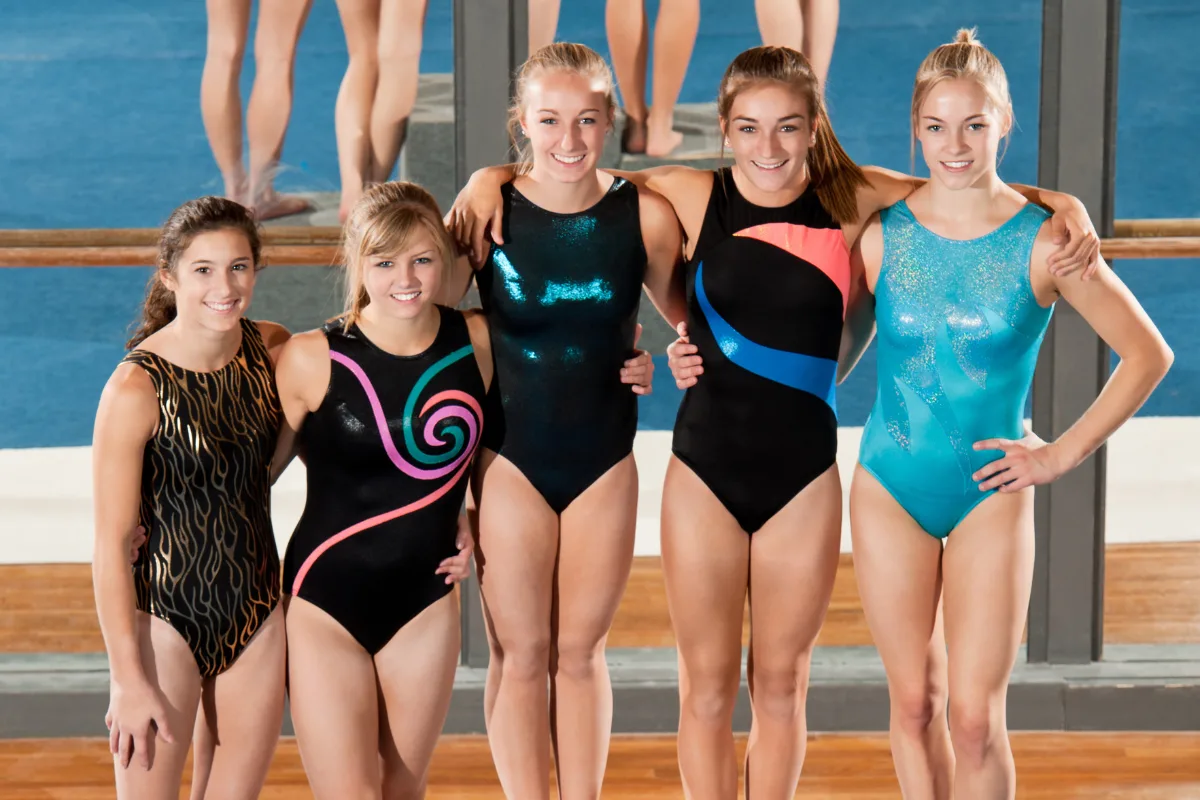
Posture, footwear, camera position and distance from the camera can change apparent height. An athlete standing slightly forward or rising onto the toes may look taller than someone whose listed height is greater.
Even a clear photograph does not reveal whether a published profile is current. Use photographs to recognize the athletes and enjoy the occasion, not to estimate missing measurements or overturn a documented number without better evidence.
If two official sources disagree, preserve their dates and identify the discrepancy. Do not average the two figures and describe the result as the athlete’s verified height. An average of conflicting reports is a calculation, not a new measurement.
Height is not the same as reach or body proportions
Two gymnasts with the same standing height can have different arm spans, leg lengths and torso lengths. The chart does not contain those measurements. It therefore cannot explain exactly how far each gymnast reaches from a support or how a particular body shape fits an apparatus.
For example, imagine two athletes both listed at 155 cm. If one has longer arms, a comparison based only on standing height misses a dimension relevant to reaching and supporting. That example illustrates missing information; it is not a claim about any named athlete in the table.
The same caution applies when a broadcast describes a gymnast as having a long line. That description may refer to posture, straight knees, pointed feet and the visual shape of a skill. It need not mean that the athlete has an unusually tall standing measurement. Biographical height and the presentation of a movement answer different questions.
Does height decide an athlete’s best event?
Body dimensions affect the mechanics of particular movements, but they do not assign an athlete to an apparatus. Strength, technique, coordination, preparation and individual experience matter alongside proportions.
It is too simple to say that short gymnasts belong on vault and taller gymnasts belong on bars. The athlete must demonstrate the skills and complete the routine. A height chart contains no direct test of either.
Our body-type research guide explains why characteristics observed in selected elite athletes should not become requirements for beginners. A familiar athlete’s measurement is descriptive information, not a talent-identification rule.
What should parents take from the chart?
A child does not need to match one of these heights to begin or enjoy artistic gymnastics. Class placement should reflect the child’s experience and the instruction offered. Questions about growth belong with the child’s healthcare professional, not with a celebrity comparison.
Our gymnastics and growth article separates training questions from assumptions based on elite appearance. Looking at short adult gymnasts cannot establish how another child will grow.
For a more focused comparison of U.S. athletes, see the U.S. women’s height list. In either chart, the most useful habit is the same: read the athlete, original value, source and date together before repeating the number.