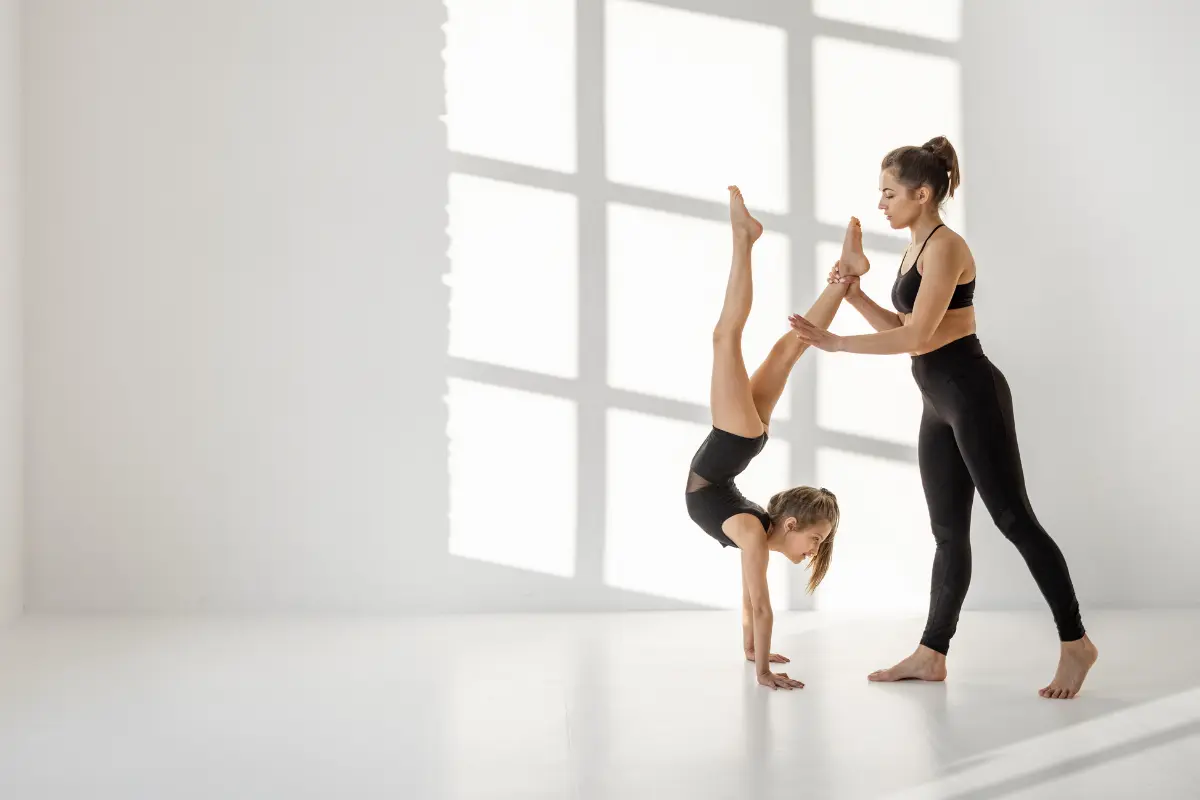
Gymnastics is often described as the perfect blend of art and physics. Behind every flip, twist, and landing lies a complex interaction of biomechanics, where limb length, torso proportions, upper-to-lower body ratios, and overall height influence how efficiently a gymnast rotates, balances, generates power, and absorbs force.
The scientific field that explores how body size, shape, and composition affect athletic performance is called kinanthropometry. In gymnastics, this discipline helps explain why certain athletes naturally excel at specific skills or apparatuses, and why body proportions can shape a gymnast’s development from an early age.
Key Biomechanical Principles in Gymnastics
Several foundational physics concepts help explain why body proportions play such a large role in gymnastics performance.
1. Center of Gravity & Moment of Inertia
A gymnast’s center of gravity and mass distribution determine how easily they can rotate or balance. Shorter limbs and compact torsos create a lower moment of inertia, meaning the athlete requires less effort to initiate flipping or twisting. This gives compact gymnasts a natural advantage in rotational speed.
2. Angular Momentum & Rotation Control
Flipping and twisting rely on the gymnast’s ability to generate and manage angular momentum. Shorter limbs allow a gymnast to rotate faster and adjust their shape mid-air with greater precision — a major advantage in tumbling, vaulting, and twisting elements.
3. Balance, Stability, and Landings
Balance on beam, bar dismounts, and controlled landings depend heavily on alignment and the center of gravity. Athletes with a naturally lower center of gravity tend to experience greater stability, while limb-to-torso ratios influence how reliably a gymnast can “stick” a landing after high-impact skills.
4. Power-to-Mass Ratio
Vaulting, tumbling, and explosive jumps all require high power relative to body mass. Compact athletes often achieve favorable strength-to-weight ratios, giving them strong acceleration during run-ups and powerful lift-offs during dynamic skills.
Empirical Evidence: What Research Says About Proportions in Gymnastics
1. Anthropometric Profile of Elite Gymnasts
Research on world-class male and female gymnasts consistently reveals a trend toward compact body structure, shorter height, lower mass, and proportionally balanced limbs.
Typical findings include:
- Male all-around champions: 162–169 cm tall, with the upper body making up roughly 41–44% of body length
- Female champions: 151–161 cm tall, with similar segment ratios
This ecto-mesomorphic profile provides mechanical efficiency for balance, rotation, and power generation.
2. Segmental Proportions and Skill Execution
Biomechanical modeling of skills like the planche shows that:
- Longer legs paired with shorter torsos can improve balance for certain static strength skills
- Increased body mass significantly raises mechanical difficulty, even at the same height
- Training is most effective when tailored to the gymnast’s unique limb-torso proportions, rather than following a universal technique
This highlights an important point: total height is less important than how that height is distributed across the body.
3. Body Composition and Event Specialization
Comparative athlete studies show meaningful differences across events:
- Vault and floor specialists tend to have higher muscularity and superior lower-body power
- Bar specialists often have limb proportions that support efficient swing mechanics
- Beam specialists may benefit from body proportions that naturally enhance balance and stability
These patterns suggest that body type can subtly guide gymnasts toward events where their biomechanics offer an advantage or a natural “feel.”
Why Limb Length and Proportions Affect Specific Gymnastics Skills
1. Flips & Twists (Floor, Vault, Tumbling)
Compact torsos and shorter limbs reduce rotational inertia, allowing gymnasts to:
- Spin faster
- Achieve tighter twisting shapes
- Control rotation with less effort
This creates clear advantages during tumbling passes and complex vaults.
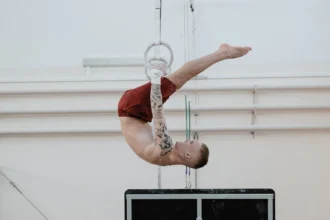
2. Static Strength & Balance Skills (Rings, Planche, Handstands)
These skills are heavily dependent on leverage:
- Longer limbs increase torque demands, making positions like the planche or inverted cross mechanically harder
- Compact athletes have shorter lever arms, making these skills more attainable with less strength
Gymnasts with longer limbs can still excel — but they must develop disproportionately higher strength to counteract biomechanical leverage.
3. Bars, Beam, and Vault Mechanics
Bars
- Longer arms generate greater swing amplitude and momentum
- Shorter athletes excel at rapid transitions and high-rotation elements
Beam
- Lower center of gravity enhances stability
- Longer limbs create beautiful lines but require greater precision
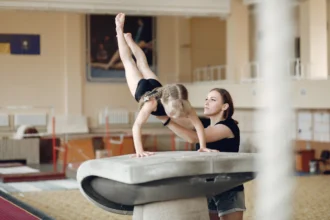
Vault
- Compact athletes rotate efficiently in the post-flight phase
- Longer-limbed athletes generate speed but must control more mass during rotation
4. Landing & Impact Absorption
Safe landings depend on proportional limb lengths and balanced muscle distribution. These factors influence:
- How force is absorbed through the legs
- The gymnast’s ability to maintain control
- Stability upon impact
Proportions affect both shock absorption and landing consistency.
Limitations & What We Don’t Know (Yet)
Even though research shows that body proportions affect gymnastics performance, there are still important things we don’t fully understand:
- Most studies look at individual skills, not the whole sport, so we can’t say there is one “ideal” gymnast body type.
- Many research models are simplified and don’t include real-life factors like flexibility, strength, coordination, confidence, or training experience.
- We still need more data on how body proportions differ across ages, genders, ethnicities, and during growth spurts.
- Scientists don’t yet know how long-term training might help athletes overcome biomechanical disadvantages or how proportions influence injury risk over time.
In short: body proportions matter, but they don’t decide a gymnast’s future. Many other factors like training, technique, strength, and mindset, play just as big a role in success.