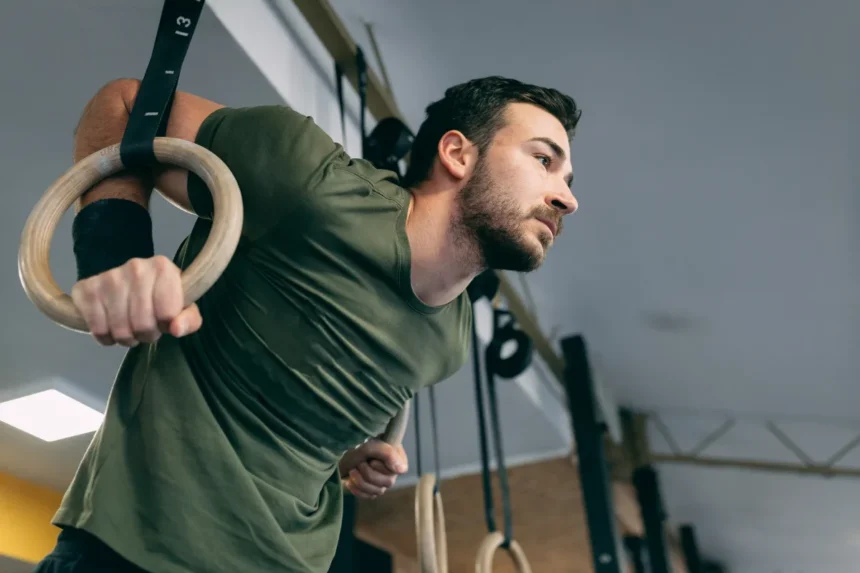
Gymnastics rings can look intimidating, but a good ring workout does not need dozens of complicated exercises.
For most people, five basic movements can cover nearly everything needed for a simple full-body strength program:
- Ring push-ups
- Ring rows
- Ring dips
- Ring pull-ups
- Ring-assisted leg exercises
Together, these exercises train horizontal pushing, horizontal pulling, vertical pushing, vertical pulling and the lower body. The moving rings also require constant control from the shoulders, arms and core. GMB notes that ring instability can make familiar bodyweight exercises considerably more challenging than performing them on a fixed bar.
Better still, nearly every exercise can be adjusted from beginner to advanced simply by changing body position, adding assistance or moving to a harder variation.
Quick Guide: The 5 Essential Gym Ring Exercises
| Exercise | Main Muscles | Beginner Version | Advanced Progression |
|---|---|---|---|
| Ring Push-Up | Chest, shoulders, triceps, core | Incline ring push-up | Archer or one-arm ring push-up |
| Ring Row | Back, biceps, rear shoulders, core | Upright ring row | Archer or one-arm ring row |
| Ring Dip | Chest, triceps, shoulders | Foot-assisted or band-assisted dip | Weighted ring dip |
| Ring Pull-Up | Lats, upper back, biceps, forearms | Band-assisted pull-up | Weighted or one-arm progression |
| Ring-Assisted Legs | Quads, glutes, hamstrings | Assisted squat and hamstring curl | Pistol squat and single-leg curl |
The idea is not that these are literally the only exercises that can ever be performed on rings. Muscle-ups, front levers, skin-the-cat variations and other gymnastics skills can all be added later.
Instead, these five movements provide a simple foundation that can take someone from their first ring workout to surprisingly advanced strength.
1. Ring Push-Ups
The ring push-up is one of the best exercises for learning how to stabilize the rings.
It works like a normal push-up, but instead of placing the hands on the floor, the athlete supports the body on two independently moving rings.
Because the rings can be adjusted higher or lower, the exercise can be made easy enough for a beginner or difficult enough for an advanced calisthenics athlete.
Muscles worked: Chest, front shoulders, triceps, serratus anterior, core stabilizers.
How to Do a Ring Push-Up
- Set the rings approximately waist height for an easier version.
- Hold one ring in each hand and walk the feet backward until the body forms a straight line from the shoulders through the hips to the feet.
- Keep the core tight.
- Slowly bend the elbows and lower the chest between the rings.
- Press through the rings until the arms are straight again.
- Try to keep the rings controlled rather than allowing them to swing outward.
Beginner Ring Push-Up
The easiest way to scale the exercise is to increase the height of the rings. The more upright the body remains, the less body weight must be pressed. A beginner can therefore start with something closer to a standing incline push-up.
As strength improves, gradually lower the rings or move the feet farther away so the body becomes more horizontal. Changing the body angle is one of the main progression methods demonstrated for ring push-ups.
Intermediate Progressions
Once standard ring push-ups become comfortable, several variations can increase the challenge:
- Lower the rings closer to the floor
- Elevate the feet
- Pause at the bottom
- Perform deeper push-ups
- Turn the rings slightly outward at the top
- Begin shifting more weight toward one arm
The rings can allow the chest to travel below hand level, but additional depth should only be used if the shoulders remain comfortable and controlled.
Advanced Progressions
One progression is the archer ring push-up. As the body lowers, most of the weight shifts toward one arm while the opposite arm moves farther to the side.
Over time, assistance from the second arm can gradually be reduced until the athlete begins working toward a one-arm ring push-up. The movement made progression similarly moves from side-to-side loading into archer push-ups and eventually one-arm variations.
Another route is toward overhead pressing:
Ring push-up → pike push-up → feet-elevated pike push-up → assisted ring handstand push-up
These variations require considerably more shoulder strength and should be treated as long-term progressions rather than necessary beginner exercises.
Best for: Chest strength, pressing strength, shoulder stability and core control.
2. Ring Rows
If ring push-ups provide the horizontal pushing movement, ring rows provide the horizontal pull. They are also one of the most beginner-friendly ring exercises because the difficulty can be changed simply by moving the feet.
Muscles worked: Latissimus dorsi, rhomboids, trapezius, rear deltoids, biceps, forearms, core.
How to Do a Ring Row
- Set the rings around waist height.
- Hold the rings and lean backward with the arms straight.
- Keep the hips extended so the shoulders, hips and knees remain roughly in one line.
- Pull the chest toward the rings by driving the elbows backward.
- Pause briefly at the top.
- Slowly lower until the arms are straight again.
- Avoid allowing the hips to sag or using momentum to throw the body upward.
Beginner Ring Row
Beginners should start fairly upright. Moving the feet farther from the anchor point reduces the percentage of body weight being pulled.
The athlete can therefore practice the full rowing movement without needing enough strength for a horizontal bodyweight row.
How to Make Ring Rows Harder
Gradually move the feet closer toward the point directly underneath the rings. As the body becomes more horizontal, more body weight must be lifted.
A basic progression might look like this:
Upright row → inclined row → horizontal row → feet-elevated row
This ability to adjust difficulty through foot position is one of the biggest advantages of ring rows.
Advanced Ring Row Progressions
After horizontal rows become easy, unilateral variations can be introduced. A useful progression is:
Side-to-side row → archer row → assisted one-arm row → one-arm ring row
During one-arm rows, the torso should remain as square as possible rather than twisting toward the working arm.
Ring rows are also useful preparation for pull-ups because they develop many of the same back and arm muscles. GMB uses ring-based rowing movements as part of its progression toward full pull-ups.
Best for: Back strength, posture, pulling strength and preparation for pull-ups.
3. Ring Dips
Ring dips are where ring training becomes noticeably more demanding. Someone who can perform several dips on parallel bars may still find the rings difficult because the hands are no longer supported by a fixed surface.
Before worrying about repetitions, beginners should learn to control a basic ring support position.
Muscles worked: Chest, triceps, front shoulders, serratus anterior, core stabilizers.
Start With the Ring Support Hold
- Set the rings around hip height.
- Push down into the rings until the arms are straight and the feet are off the floor.
- Keep the rings close to the sides of the body.
- Hold the position without allowing the rings to swing excessively.
A strong, stable support makes the actual dip much easier to learn.
How to Do a Ring Dip
- Begin in the top support position.
- Slowly bend the elbows and lower the body.
- Keep the rings relatively close to the torso.
- Descend only as far as can be controlled comfortably.
- Press downward into the rings and return to the support position.
Beginners do not need to force an extremely deep dip. The bottom of the movement places the shoulder into a demanding position, so range should be built gradually.
Beginner Ring Dip Progressions
A full bodyweight ring dip is often too difficult at first.
Instead, use:
Ring support hold → foot-assisted dip → band-assisted dip → negative dip → full ring dip
For foot-assisted dips, keep the feet lightly on the floor or a box and use the legs only as much as necessary.
Resistance bands can also reduce the amount of body weight being pressed. Assisted feet and resistance bands are both commonly used to scale ring dips.
Advanced Ring Dip Progressions
Once controlled ring dips become comfortable, difficulty can be increased with:
- Paused ring dips
- Slow eccentric dips
- Weighted ring dips
- Wider ring dips
- Ring turnout support work
There is no need to rush into extreme variations. A clean set of controlled standard ring dips provides plenty of strength stimulus.
Best for: Triceps, chest strength, shoulder control and preparation for more advanced ring skills.
4. Ring Pull-Ups
Ring pull-ups provide the main vertical pulling movement.
Unlike a fixed pull-up bar, rings can rotate while the athlete pulls. This allows the hands and forearms to find a comfortable position rather than being locked into one grip.
A common technique is to begin with the palms facing forward or toward each other and allow the rings to rotate naturally during the pull.
Muscles worked: Latissimus dorsi, biceps, brachialis, upper back, forearms, rear shoulders, core.
How to Do a Ring Pull-Up
- Hang from the rings with straight arms.
- Keep the body controlled rather than swinging.
- Pull the shoulders down and begin driving the elbows toward the ribs.
- Continue pulling until the chin rises above the hands or the rings reach approximately chest or shoulder level.
- Lower slowly back to a full controlled hang.
The rings may rotate during the repetition. That is normal.
Beginner Ring Pull-Up Progressions
Someone who cannot perform a pull-up yet can start with:
Ring rows → foot-assisted pull-ups → band-assisted pull-ups → negative pull-ups → full ring pull-ups
For negatives, begin at the top of the pull-up and lower slowly.
GMB specifically recommends controlled negative pull-ups as a way to build strength through the full pulling range, while cautioning that eccentric work can be demanding and should be progressed gradually.
Resistance bands are another useful option. Thicker bands provide more assistance, while thinner bands move the athlete closer to lifting full body weight.
Intermediate Pull-Up Progressions
Once several clean repetitions are possible, try:
- Paused pull-ups
- Chest-to-ring pull-ups
- Slow eccentric pull-ups
- L-sit pull-ups
- Weighted pull-ups
These variations increase difficulty without immediately requiring a completely new movement.
Advanced Pull-Up Progressions
Advanced athletes may eventually work toward one-arm pulling. A gradual progression could include:
Two-arm pull-up → uneven pull-up → finger-assisted one-arm pull-up → band-assisted one-arm pull-up → one-arm pull-up
One-arm work places much greater stress on the elbows, shoulders and grip, so the progression should be slow.
Strong ring pull-ups are also an important foundation for the ring muscle-up. GMB includes pull-ups and dips among the complementary exercises used to build toward muscle-ups.
Best for: Lats, upper-back strength, arm strength and muscle-up preparation.
5. Ring Leg Exercises
Rings are usually associated with upper-body training, but they can also make lower-body exercises much easier to scale. Instead of using the rings as resistance, beginners can use them for balance and assistance.
Two movements work especially well:
- Ring-assisted squats and pistol squats
- Ring hamstring curls
Together, they train both the front and back of the legs.
A. Ring-Assisted Squat
Muscles worked: Quadriceps, glutes, adductors, hamstrings, calves, core.
- Hold the rings lightly and stand with the feet in a comfortable squat stance.
- Sit the hips downward while bending the knees.
- Use the rings only as much as necessary for balance.
- Drive through the feet to stand.
- As strength improves, gradually use less arm assistance.
The rings are especially useful for people learning squat depth because they provide something stable to hold while practicing the movement.
Progress Toward the Pistol Squat
The same setup works well for single-leg training.
A simple progression is:
Assisted squat → assisted split squat → assisted single-leg squat → ring-assisted pistol squat → unassisted pistol squat → weighted pistol squat
During a ring-assisted pistol squat, one leg stays extended forward while the athlete lowers on the opposite leg.
Holding the rings reduces the balance and strength requirement, making it possible to practice the movement gradually. Ring assistance is specifically used as a scalable route toward the pistol squat in ring-training progressions.
B. Ring Hamstring Curl
Squats and pistol squats emphasize the quadriceps and glutes, so adding a hamstring exercise makes the lower-body portion more complete.
- Set the rings close to the floor.
- Lie on the back and place one heel inside each ring.
- Raise the hips.
- From the straight-leg position, bend the knees and pull the heels toward the glutes.
- Slowly extend the legs again while keeping the hips elevated.
Muscles worked: Hamstrings, glutes, calves, core.
Making Hamstring Curls Harder
Begin with a comfortable body position and gradually increase the leverage.
Progressions include:
Two-leg curl → slower curl → extended-leverage curl → assisted single-leg curl → single-leg ring hamstring curl
Movement Made similarly progresses ring hamstring curls by changing foot position before eventually moving to single-leg repetitions.
Best for: Lower-body strength, hamstrings, single-leg balance and pistol squat development.
Beginner-to-Advanced Ring Exercise Progression
The five exercises can grow with the athlete for years.
| Movement | Beginner | Intermediate | Advanced |
| Ring Push-Up | High incline | Standard ring push-up | Archer/one-arm variation |
| Ring Row | Upright row | Horizontal row | One-arm row |
| Ring Dip | Foot-assisted | Full ring dip | Weighted ring dip |
| Ring Pull-Up | Band-assisted | Full pull-up | Weighted/one-arm progression |
| Ring Legs | Assisted squat | Assisted pistol + hamstring curl | Pistol + single-leg curl |
Progress when the current version can be performed through a controlled range of motion without swinging, collapsing or losing position.