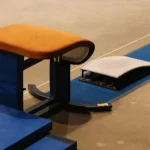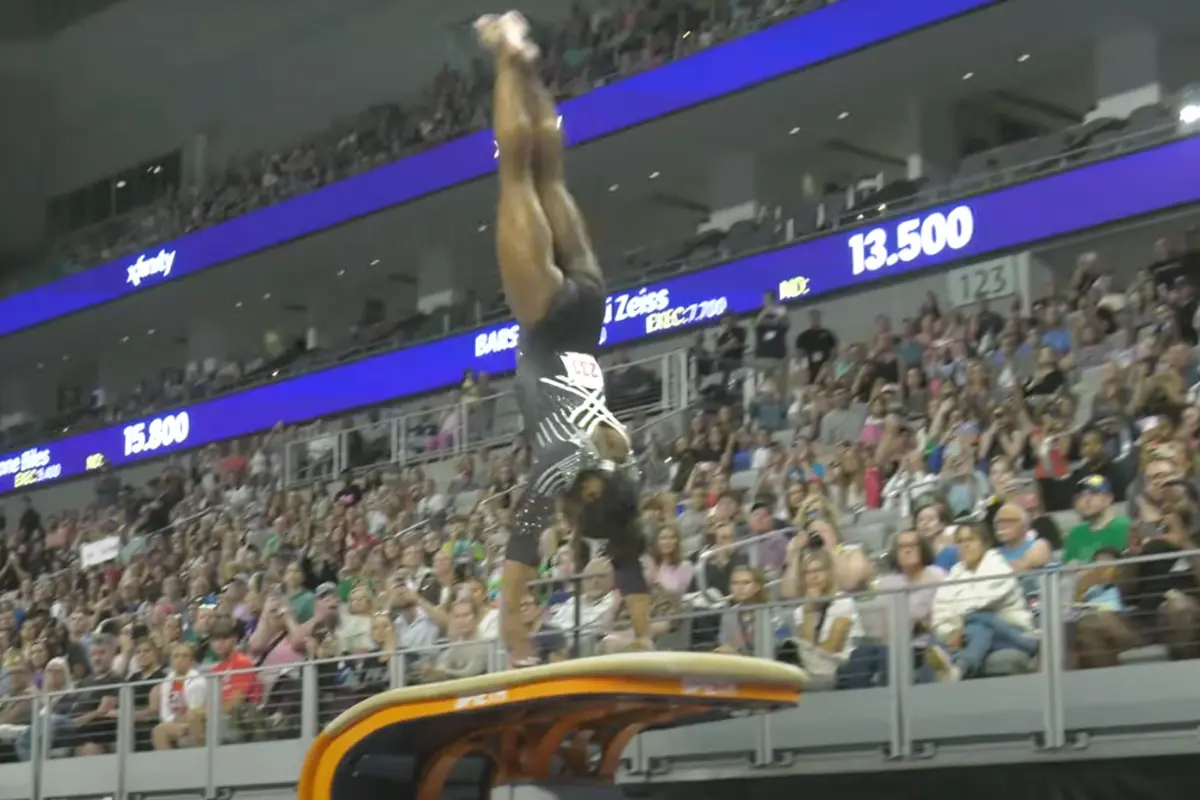
Vault is the fastest event in artistic gymnastics and often the most decisive.
In just about one second, a gymnast sprints down a 25-meter runway, strikes the springboard, contacts the vault table, and launches into the air to perform a salto (often with twists) before landing. There’s no rhythm to settle into and no second chance to recover. One vault. One landing. One score.
That’s exactly why vault can make or break a competition.
Why Vault Carries So Much Weight in Gymnastics
Vault stands out because of its huge difficulty range.
Under the 2025–2028 FIG Code of Points (WAG):
- A very basic vault, such as a handspring, starts at 1.60
- The hardest vault currently listed, Simone Biles’ Yurchenko double pike (Biles I), is valued at 6.40
That’s nearly five full points of difference in start value, before execution deductions are even applied.
No other event offers that kind of scoring swing from a single skill.
In team finals, this matters even more. Only the top three scores on vault count toward the team total, so one powerful vault can lift an entire rotation. That’s why national programs around the world invest heavily in vault development, teaching it carefully and progressively from the very beginning.
How Vaults Are Classified: FIG Vault Groups Explained
Every vault in artistic gymnastics is assigned to one of five FIG vault groups. These groups are based on:
- How the gymnast enters the vault table (the first flight)
- What type of salto and twists are performed after block (the second flight)
The grouping system allows judges to correctly identify vaults, assign the proper Difficulty Score (D-score), and evaluate similar vaults using the same technical expectations.
FIG Vault Groups in Women’s Artistic Gymnastics (WAG)
| FIG Group | Vault Entry & Flight Style | D-Score Range (2025–2028) |
|---|---|---|
| Group 1 | Vaults without salto (e.g., handsprings, round-offs) | 1.60 – 3.60 |
| Group 2 | Handspring entry, forward salto (with or without twist) | 3.60 – 4.60 |
| Group 3 | ¼-turn onto the table, backward salto with twist (Tsuk/Kasamatsu) | 3.20 – 4.60 |
| Group 4 | Round-off onto board, back handspring onto table, backward salto (Yurchenko) | 3.00 – 4.80 |
| Group 5 | Round-off + ½-on entry, forward salto (Cheng-style) | 3.80 – 4.80 |
Each vault group follows specific entry mechanics and flight patterns, which allows judges to easily identify and evaluate the skill. The harder the vault (more twists, higher salto, more complex entry), the higher the base D-score.
Vault Progression: From Beginner to Elite
Vault skills can be grouped by difficulty and complexity. Here’s a breakdown of foundational vaults, mid-level upgrades, and elite vaults:
Starter Vaults: The Basics
Vault skills are built step by step, starting with basic vaults and progressing to higher-difficulty moves with multiple flips and twists.
| Vault Name | FIG Group | D-Score (WAG) | Why It’s Foundational |
|---|---|---|---|
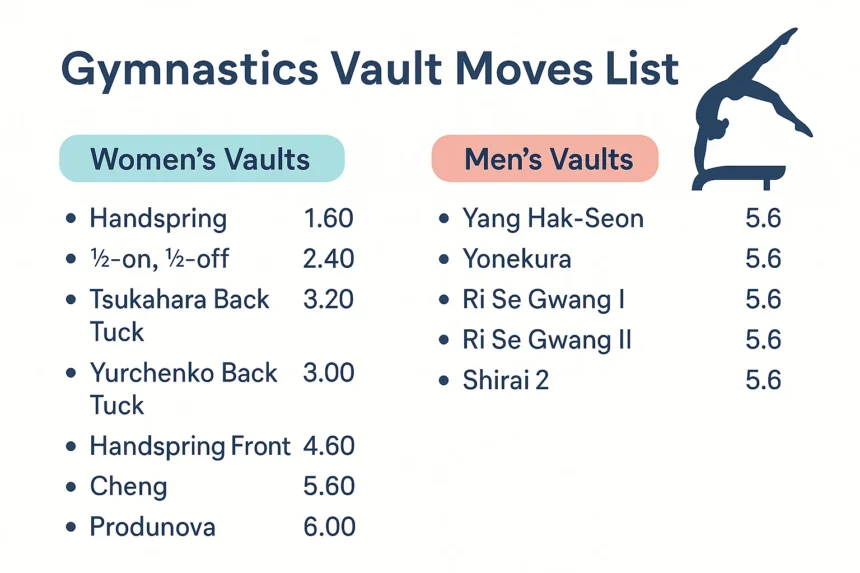
| Handspring | Group I | 1.60 | Teaches clean posture, heel drive, and basic block technique. |
| ½-on, ½-off (Quarter Twist) | Group I | 2.40 | Introduces simple twisting without changing salto direction. |
| Tsukahara Tuck | Group III | 3.20 | Adds a blind quarter-turn entry and a back tuck. |
| Yurchenko Back Tuck | Group IV | 3.00 | Combines a round-off and back handspring entry with a back tuck off the table. |
Mid-Level Upgrades: Layouts and Twists
Once gymnasts are comfortable with their body positions and flight mechanics, they begin adding layouts (straight-body vaults) and twisting skills. These vaults represent a natural progression into competitive-level skills.
| Vault Name | FIG Group | D-Score (WAG) | Why It Matters |
|---|---|---|---|
| Handspring Front Pike ½ | Group II | 4.00 | Introduces blind landings while maintaining forward rotation. |
| Handspring Front Layout ½ | Group II | 4.60 | Adds twist in a stretched body, prepping for harder layouts. |
| Tsukahara Layout 1/1 | Group III | 4.40 | Builds full twist timing on a ¼-on entry. |
| Yurchenko Layout 1½ (DTY) | Group IV | 4.80 | High scoring potential with solid control. |
| RO ½-on Front Layout ½ | Group V | 4.80 | Combines difficulty with controlled rotation. |
Elite Vaults: The Big Moves
These vaults are highly difficult and demand exceptional power, control, and execution. They are often seen in Olympic finals and World Championship podiums.
| Vault Name | FIG Group | D-Score (WAG) | Why It’s Elite |
|---|---|---|---|
| Biles I – Yurchenko Double Pike | Group IV | 6.40 | The highest-valued WAG vault, requiring massive block and control. |
| Produnova – Handspring Double Front | Group II | 6.00 | Extreme risk, blind landing. |
| Cheng – RO ½-on, Layout 1½ Twist | Group V | 5.60 | A rare combination of speed and twisting complexity. |
| Tsukahara Layout 2½ Twist | Group III | 5.60 | Rarely performed due to high air control demands. |
| Amanar – Yurchenko Layout 2½ Twist | Group IV | 5.40 | Former Olympic standard, fast and powerful. |
Men’s Vault: Top Skills Capped at 5.6
Men’s vault is no less intense, though the highest D-scores are capped at 5.6 in the 2025–2028 Code, even though the vaults are incredibly difficult.
Some of the toughest men’s vaults include:
- Yang Hak-Seon – Handspring layout with triple twist
- Yonekura – Tsukahara double pike with 2½ twists
- Ri Se Gwang I & II – Handspring double front (with or without ½ twist)
- Shirai 2 – Yurchenko 3½ twists
The Five Technical Phases Every Vault Shares
No matter how simple or how difficult the vault, every successful vault follows the same five phases.
1. Approach & Hurdle
The sprint generates speed, but the final steps matter most. A low, fast hurdle allows the gymnast to convert horizontal speed into vertical lift.
2. Pre-Flight
This phase runs from springboard takeoff to hand contact on the table. Good alignment through the shoulders and hips preserves momentum and direction.
3. Block
The block is a rapid shoulder shrug and wrist extension at table contact. It works like a spring-loaded rebound, launching the gymnast upward. Height and airtime are determined here.
4. Post-Flight
This is where the salto and twists happen. Strong blocks create time; weak blocks force rushed rotation and messy landings.
5. Landing
Judges look for feet together, hips stacked over heels, controlled knee bend, and an upright chest. Steps, hops, or deep squats lead to deductions.
Strong vaulting is built on:
- Straight-arm, fast blocking
- Incremental twist progressions
- Soft-surface training before hard landings
- Rebound landing drills to protect joints
The 2025–2028 Code rewards clean gymnastics. High difficulty helps, but it won’t hide bent knees, low height, or uncontrolled landings.