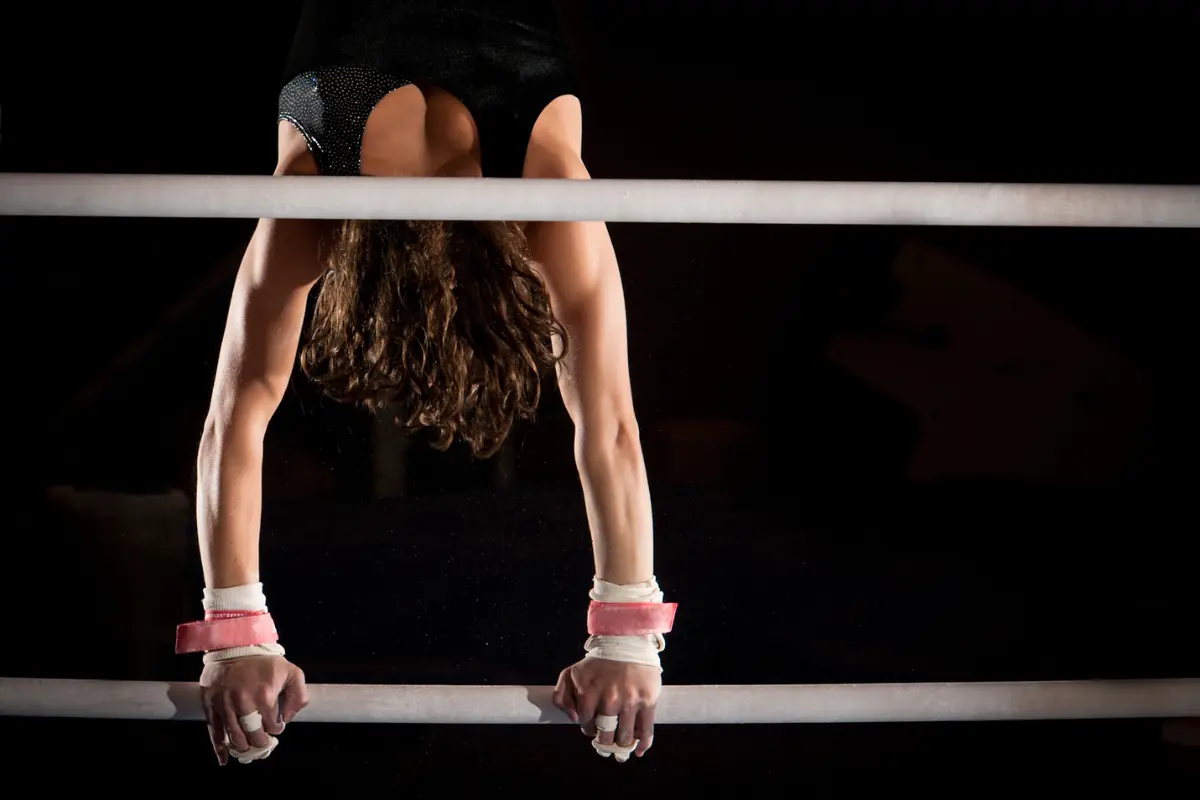
Some uneven bars skills are difficult because of their twists. Others involve flying over a bar with a straight body, catching after a somersault or fitting three flips into a dismount.
The eight movements below are tied at G difficulty, worth 0.70, the highest value in the uneven bars tables of the 2025–2028 FIG women’s Code of Points. Here, “most difficult” means highest-rated in that published table. The numbering helps readers follow the list; it does not rank one G skill above another. Source: FIG Code of Points, uneven bars tables.
The values were checked on September 22, 2026, against the Code listed in FIG’s rules directory on August 27, 2026. Later amendments may change an element’s rating.
What Does G Difficulty Mean?
FIG uses letters to describe an element’s difficulty. A is worth 0.10, B is worth 0.20, and each step adds another 0.10. A G element therefore contributes 0.70 when it receives credit and is included among the routine’s counting elements.
That is only the skill’s difficulty contribution. It is not a score for how well the gymnast performed it, and it is not the whole routine’s D-score. Execution deductions and the rest of the routine still matter.
The movement descriptions also use three body shapes: tucked means the knees are bent toward the body; piked means the hips are bent while the legs stay straight; stretched, or layout, means the body stays extended. The tuck, pike and layout guide explains the differences.
The Eight Skills at a Glance
| Skill | What the gymnast does | Current FIG value | Code number |
|---|---|---|---|
| Nemour | An inbar circle into a stretched release over the high bar | G — 0.70 | 4.708 |
| Zhang | A clear-hip circle into a stretched release over the high bar | G — 0.70 | 2.706 |
| Hristakieva | A stretched backward somersault with 1½ twists, returning to the high bar | G — 0.70 | 3.705 |
| Mo | A tucked forward somersault over the high bar, followed by a catch | G — 0.70 | 3.708 |
| Yang | A stretched Jaeger with one full twist, returning to the high bar | G — 0.70 | 3.708 |
| Piked Arabian mount | A roundoff and piked Arabian over the low bar to catch the high bar | G — 0.70 | 1.709 |
| Ray dismount | Two backward somersaults in a stretched position with two twists | G — 0.70 | 6.706 |
| Magaña dismount | Three backward somersaults in a tucked position | G — 0.70 | 6.707 |
The table counts eight different movements across seven G-rated element boxes. Mo and Yang share box 3.708, but the Code gives them separate movement descriptions. Counting the boxes alone would leave out one of those two skills.
What Makes These Skills Difficult?
1. Nemour: An Inbar Entry Into a Stretched Release
The Nemour begins with an inbar circle, called a clear-pike circle in the Code. The gymnast folds at the hips and circles beneath the bar with the legs between the arms, without placing the feet on the bar.
She then releases, opens into a stretched body position and travels over the high bar before catching it again. It belongs to the Tkatchev, or reverse-hecht, family of releases.
The useful viewing clue is the entry. Several releases have a similar flight above the bar, but the circle that comes before the release can identify a different element.
This movement is named after Kaylia Nemour. Its current value is G, under element 4.708.
2. Zhang: A Clear-Hip Entry Into a Stretched Release
The Zhang also travels over the high bar in a stretched position, but it starts from a clear-hip circle.
In that entry, the gymnast circles close to the bar with the hips clear of it. This differs from the deeply folded inbar entry used for the Nemour and from a toe-on entry, where the feet contact the bar during the circle.
Watching only the airborne portion can make these releases look nearly identical. Watching the circle first makes the distinction easier to see.
The current Code lists the Zhang at G, under element 2.706. The release-moves guide explains how entries, body shapes and turns distinguish release families.
3. Hristakieva: A Backward Somersault With 1½ Twists
The gymnast releases the high bar, performs a stretched backward somersault with one and a half twists, then catches the same bar.
The extra rotation has to finish in time for the gymnast to locate the bar and regrasp. Unlike a dismount, the skill ends with the routine continuing on the apparatus.
This element is sometimes discussed using the nickname “Def.” In the women’s Code, the G-rated element 3.705 is named Hristakieva. Using that name makes the women’s classification clear.
It should not be confused with an ordinary piked Gienger, which has a half twist and is a different element.
4. Mo: A Forward Somersault Over the High Bar
The Mo starts from a backswing. The gymnast releases, completes a tucked forward somersault over the high bar and catches it again.
The word “over” matters. A forward-somersault release does not automatically become a Mo; the flight path in relation to the bar is part of the element’s identity.
Named after Mo Huilan, the skill is G, in element box 3.708. Its high value does not establish how often it is performed or make it objectively harder for every gymnast than another G skill.
5. Yang: A Stretched Jaeger With a Full Twist
The Yang combines a forward somersault in a stretched position with one full twist before the gymnast catches the high bar again. It belongs to the Jaeger family of forward-somersault releases.
The gymnast has to fit the flip and twist into the flight, then bring the hands back to the bar for the catch. The body position distinguishes it from the piked Jaeger with a full twist, called the Minamino, which is rated F.
Although it shares the G-rated box 3.708 with the Mo, the Yang is a different movement: the Mo is tucked and passes over the high bar; the Yang is a stretched, full-twisting Jaeger. This is why both belong in the list.
6. Piked Arabian Mount: Flying From the Floor to the High Bar
A mount is the skill used to begin the routine. This one starts with a roundoff on the floor in front of the low bar.
The gymnast takes off backward, makes the Arabian half turn into forward rotation and performs the somersault in a piked shape. She travels over the low bar and catches the high bar without touching the low bar.
That last detail separates it from mounts that use the low bar for support. Here, the low bar is an obstacle to clear during flight.
The current Code gives this mount G, under element 1.709. The tucked Arabian version appears separately at a lower value, so the body shape cannot be left out of its description.
7. Ray Dismount: Two Flips and Two Twists in a Layout
The Ray dismount combines two backward somersaults with two complete twists while the gymnast maintains a stretched body position. It ends on the landing mat rather than with another bar catch.
Its name can cause confusion because Elise Ray has more than one named uneven bars element. “Ray dismount” identifies the skill meant here.
The full description also matters. A plain double layout, a full-twisting double layout and a double-twisting double layout are three different dismounts. In the current Code, they are D, F and G, respectively.
The G-rated Ray is element 6.706.
8. Magaña Dismount: Three Backward Somersaults
The Magaña is a triple backward somersault in a tucked position. The gymnast completes three flips after releasing the bar, then opens for the landing.
There is no twist in this description. The defining feature is the third somersault, which distinguishes it from a double-back dismount.
Named after Brenda Magaña, it is G, under element 6.707. The official value supports including it among the highest-rated bars elements; it does not establish a claim that only one gymnast has ever performed it.
Why Some Older Lists Give Different Ratings
Difficulty values can change between rule cycles. A list based on the 2022–2024 Code may therefore disagree with the current table even when it identifies the movement correctly.
Three useful examples in the current uneven bars table are:
| Element | Current value | Code number |
|---|---|---|
| Black: clear-hip piked reverse hecht with a half turn to mixed L grip | F — 0.60 | 2.606 |
| Nabieva: toe-on stretched reverse hecht | F — 0.60 | 5.610 |
| Derwael: toe-on stretched reverse hecht with a half turn to mixed L grip | F — 0.60 | 5.610 |
These remain advanced releases. Their current F rating puts them below the G-rated group covered here. The table also shows why names and element numbers are more reliable than judging difficulty from appearance alone.
Judges must recognize the movement actually performed. A listed value is not automatically awarded when the required body position, turn or other defining feature is missing. The skill-recognition guide explains that distinction.
Frequently Asked Questions
Is there one hardest uneven bars skill?
The current FIG table has several elements tied at G. It does not rank those elements from hardest to easiest within the letter group. Individual gymnasts can find different types of movement more demanding.
Does a G skill guarantee a higher final score?
No. Its potential difficulty contribution must be considered alongside recognition, execution, connections and the rest of the routine. A harder attempt can lose more through errors than it adds through difficulty.
Is a release move the same as a dismount?
A release involves letting go during the routine and regrasping a bar. A dismount finishes the routine by leaving the apparatus and landing. This article includes both, as well as one mount.
Are these skills suitable for beginners?
No. These are advanced competition elements. Beginners can use the artistic gymnastics moves guide to learn the basic movement names before studying elite variations.
What to Remember
These eight movements share the highest listed uneven bars difficulty value in the Code checked for this article. Their entries, body shapes and flight paths make them different skills, even when their letters match. A G rating describes potential difficulty credit; the quality of the performance still helps decide the final score.