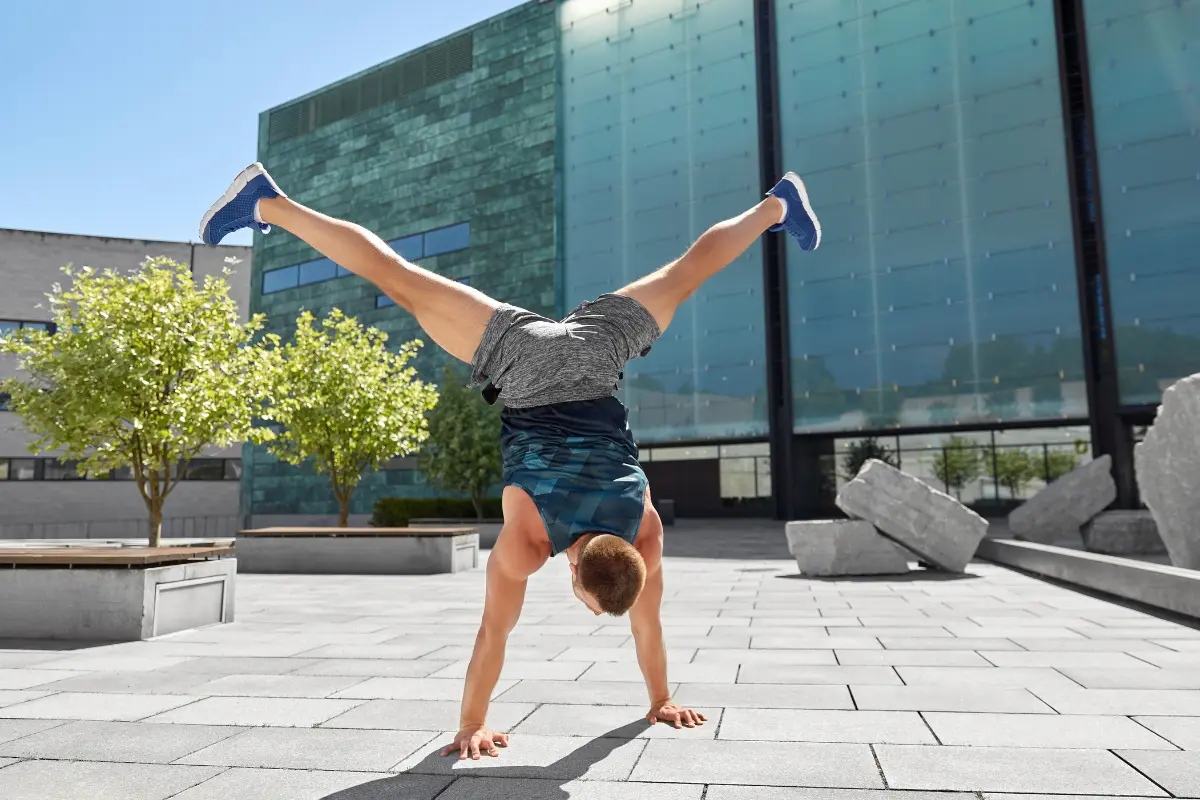
A straddle press to handstand is a controlled rise onto the hands with the legs separated and no jump from the feet. It combines the ability to support the body through the arms, fold the legs toward the trunk and move the hips into position before finishing in handstand. A wide straddle alone does not supply all of those abilities.
The most useful preparation depends on where the movement breaks down. A gymnast who cannot lift the feet has a different problem from one who lifts successfully but loses balance near the top. Understanding those differences makes practice more productive than repeating unsuccessful presses or collecting increasingly difficult drills.
Which straddle press are you learning?
A standing straddle press begins with the feet on the floor. A straddle-sit press begins from a supported sitting position with the feet already clear of the floor. The second version includes an additional lifting and clearance problem. They share features, but success in the standing version does not automatically establish readiness for the seated version.
Hand placement also changes the task. Pressing on the floor, parallettes, parallel bars or beam introduces different support surfaces, clearances and balance demands. A press with bent arms is another variation; it should not be counted as the same achievement when the assigned goal is a straight-arm press.
Before comparing progress with a video, match the starting position, apparatus and assistance. An athlete beginning with the feet on a raised platform is solving a different problem from an athlete beginning in a straddle sit on the floor.
How the movement fits together
In a standing press, weight transfers from the feet toward the hands as the hips rise. The shoulders and arms manage that transfer while the gymnast keeps the legs close enough to the body to avoid sending them prematurely away from the support. Once the hips are better placed above the hands, the legs continue toward the final handstand.
These phases overlap. They are not a command to freeze in three separate positions, nor do they require every gymnast to show identical joint angles. Limb proportions, mobility and the starting arrangement affect the path.
A 2021 study of 59 male gymnasts found differences in hip positioning and estimated joint moments between more and less skilled performers. The researchers examined a legs-together, piked press, not a straddle-press training program. The findings help explain why body position matters, but they do not prove that one straddle drill will work for everyone.
Compression is active movement
Compression means bringing the legs and trunk closer together under muscular control. A gymnast may sit comfortably in a broad straddle while still finding it difficult to lift the legs without leaning backward. That distinction separates available range from the ability to use that range during a press.
A coach may use supported sitting positions or small seated leg lifts to examine active control. The useful observation is whether the athlete can produce the intended movement without changing the rest of the task beyond recognition. A small controlled lift can reveal more than a large swinging repetition.
Stretching can address a relevant restriction, but another person forcing the legs wider is not a substitute for active strength. Sharp discomfort, joint pain or a pulling sensation that persists afterward warrants stopping and reassessing the activity.
Three preparation areas to discuss with a coach
1. Support and shoulder control
The gymnast needs to manage body weight through the hands with the arm position required by the skill. A coach may begin with lower-load supports and progress toward suitable inverted positions. The purpose is to maintain an active, controlled support as the body moves, rather than simply survive a long hold.
A handstand against a wall can contribute to this preparation when entry and exit are already manageable. It does not reproduce the entire press. Our comparison of chest-to-wall and back-to-wall handstands explains the different uses of those supported positions.
2. Active folding and leg clearance
Seated compression work can help a coach identify whether the legs can move close to the trunk without momentum. Hand position, knee position and the amount of support need to match the athlete’s present ability. There is little value in prescribing a difficult version that produces only frustration and compensations.
Leg clearance matters particularly when moving from a straddle sit. The athlete has to create room for the body to travel relative to the hands. This is one reason a seated press deserves its own preparation rather than being treated as a standing press with a different opening pose.
3. Coordinating the rise
A suitably assisted press can let the gymnast experience the movement without supplying all of the force independently. Coach assistance should have a defined purpose: supporting part of the load, guiding a position or slowing a difficult phase. Those are different kinds of help.
Valentin Uzunov’s coaching report on the straddle-sit press organizes preparation around flexibility, strength and movement execution. It is a coaching framework, not a controlled trial establishing a universal sequence or completion date.
Raising the feet and raising the hands do different jobs
Elevating the feet changes the starting height and body arrangement. Elevating the hands can provide extra clearance beneath the body. Neither modification should be described simply as “making the press easier,” because each changes particular parts of the task and may introduce new equipment or balance demands.
The support must be stable and appropriate for gymnastics. Stacked furniture, rolling equipment and slippery blocks create problems unrelated to learning a press. A coach can select the height and assistance while preserving a meaningful connection to the intended floor skill.
What common difficulties can tell you
| Observation | Useful question |
|---|---|
| The feet leave only with a hop | Is the athlete practicing a press, or using a jump to bypass the difficult transfer? |
| The legs swing away early | Can the athlete maintain the required fold while the hips rise? |
| The elbows bend unexpectedly | Is the present variation too demanding for the assigned straight-arm task? |
| The rise succeeds but the finish falls over | Does the final balance need separate attention? |
| Assistance remains unchanged for weeks | Which part of the movement is the assistance actually replacing? |
These observations are starting points for assessment, not diagnoses. Several limitations may appear together, and a movement seen in one attempt may disappear after a clearer explanation or a better starting position.
Measure useful progress
Record the variation, assistance and quality of the movement. Less help through the same controlled range is progress. So is a smoother transfer, a quieter finish or a repeatable exit. Counting only fully independent presses overlooks the changes that make the eventual skill possible.
Keep the amount of practice within the gymnast’s wider training load. Press work adds hand and wrist loading to existing tumbling, vault and bars. Our guide to wrist preparation explains why conditioning and tolerance need to develop alongside technical work.
There is no reliable number of weeks that applies to every learner. Ask the coach which limitation is being addressed now, what successful practice should look like and what evidence will justify the next progression. That gives each session a concrete goal without turning the skill into a deadline.