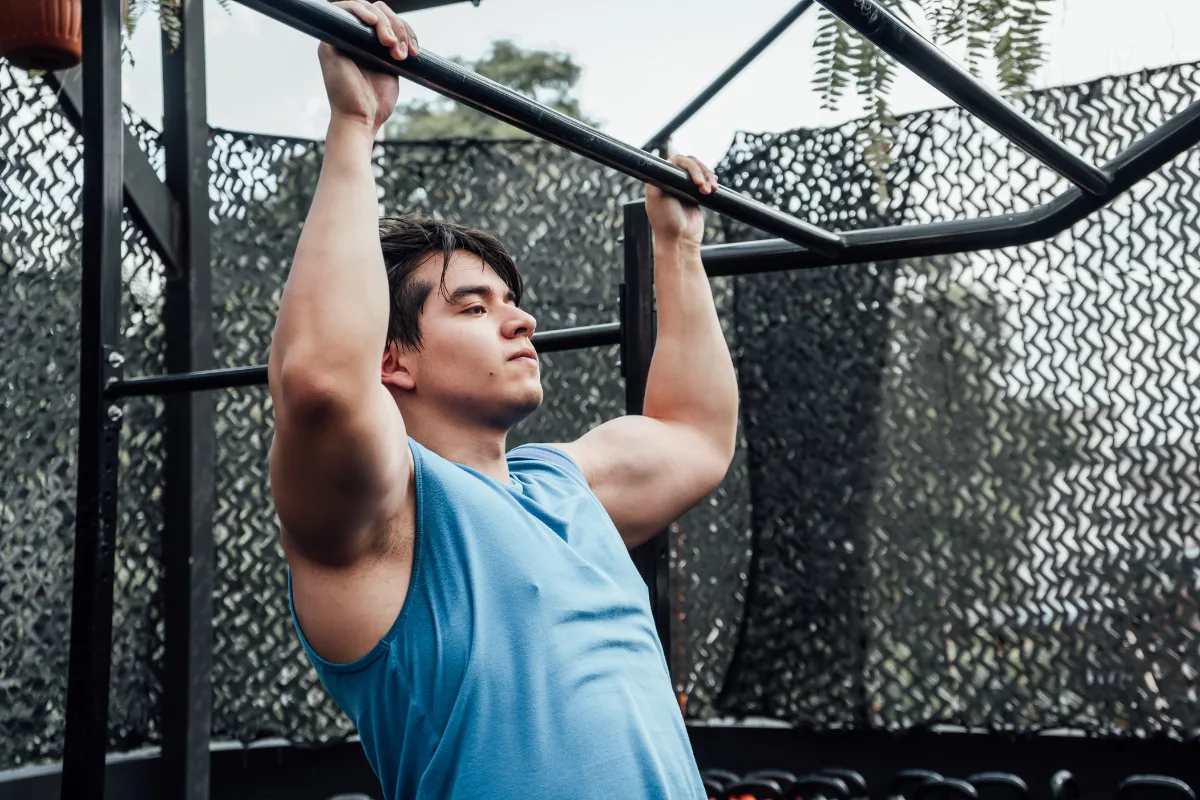
Rings and a pull-up bar can both support useful gymnastics strength work, but they solve different problems. A fixed bar provides one stable hand support. Rings provide two supports that can move and rotate independently. Those differences affect the task, especially when the gymnast moves from hanging below the equipment to supporting the body above it.
- What the equipment changes
- Hanging and supporting are different tasks
- Research does not show that rings always recruit more muscle
- Choose the exercise before choosing the equipment
- Installation is part of the decision
- Home conditioning is different from apparatus practice
- Make the setup serve the training plan
The best choice depends on the planned exercise, the gymnast’s readiness and a suitable installation. Neither piece of equipment guarantees faster progress, safer joints or better muscle growth. A simple arrangement that supports the assigned training is more useful than a versatile one that cannot be installed or supervised properly.
What the equipment changes
| Question | Fixed pull-up bar | Suspended rings |
|---|---|---|
| Do the hand supports move separately? | No; the grip is on one fixed structure. | Yes; each ring can move independently. |
| Can the hands rotate during the movement? | A straight bar fixes their orientation more closely. | The rings can rotate with the hands. |
| Can height be adjusted easily? | Depends on the specific apparatus. | Strap adjustment often permits several working heights. |
| Does it reproduce competition apparatus? | A home pull-up bar is not a competition high bar. | Portable exercise rings are not automatically a complete competition rings setup. |
Height adjustment can make low supported exercises practical. It does not make every ring exercise suitable for a beginner. A feet-supported row and an unsupported ring handstand involve very different demands even though the same rings could be used.
Hanging and supporting are different tasks
During a pull-up, the body hangs below the hand supports. On rings, the hands may rotate as the elbows bend. Some people find that movement comfortable, but the freedom should not be described as an automatic cure for wrist, elbow or shoulder problems.
During a support hold or dip, the body is above the hands. The gymnast must manage the independent movement of the rings as well as the body position. That can make a familiar exercise substantially more demanding than its version on fixed supports.
This distinction explains why “rings are harder” is incomplete. Low rings with the feet on the floor may create an accessible supported exercise, while a high bar may require the gymnast to lift the entire body. Compare equivalent tasks before comparing difficulty.
Research does not show that rings always recruit more muscle
A 2017 study of 15 resistance-trained adults compared traditional, suspension-device and towel pull-ups. It did not find significant differences between those exercises for the measured latissimus dorsi, biceps or posterior-deltoid activity. The suspension device was not a competition rings apparatus, but the result challenges the assumption that moving handles automatically increase every muscle’s demand.
A 2023 study of 10 adult men found greater activity in some upper-limb muscles during ring muscle-ups than bar muscle-ups. Participants performed kipping versions of an advanced movement. That evidence does not establish the best equipment for a beginner’s strict pull-up, nor does it measure long-term muscle growth.
Both studies examined electrical muscle activity during particular tasks. Their practical lesson is to consider the exercise and the participant, rather than treating instability as a universal advantage. More demand is useful only when it matches what the gymnast is ready to train.
Choose the exercise before choosing the equipment
If the assignment is a repeatable strict overhand pull-up, a suitable fixed bar gives a straightforward reference. The coach can define the grip, starting position and finish without also managing separate moving handles. Our chin-up and pull-up guide explains the usual grip choices.
If the assignment is a supported row at a particular body angle, adjustable rings may be convenient. The feet can remain on the floor while the height and body position define the task. Those settings should be recorded so that the next session repeats the intended exercise.
If the assignment concerns rings support, the movement of the rings is part of what the gymnast must learn to control. That is a reason to use coached rings progressions, not a reason to begin with dips, muscle-ups or straight-arm strength holds before the gymnast is ready.
A gymnast can also use both pieces of equipment for different purposes. That does not mean every family needs both at home. Club equipment and a well-chosen conditioning assignment may already provide the necessary opportunities.
Installation is part of the decision
Rings require a suitable anchor as well as suitable straps and rings. A pull-up bar requires an appropriate structure and the installation method specified for that model. A strong-looking branch, ceiling fitting or door frame is not sufficient evidence that it is suitable for the intended loads.
Read the actual manufacturer’s instructions for dimensions, attachment, load limits, inspection and permitted use. For example, the GORNATION Extend-It manual specifies installation and locking steps, checks of the door frame and restrictions on unapproved attachments. Its instructions belong to that product; they cannot be transferred automatically to another bar.
Do not assume a bar sold for pull-ups is also approved as an anchor for rings, swinging work or inverted skills. If the manufacturer does not clearly permit the proposed arrangement, resolve that question before using it. A quoted maximum load alone does not establish permission for every movement.
Check clear space, access and the surface below the equipment. Inspect straps, buckles, attachment points and the supports before use. Keep unused straps and equipment from becoming an unsupervised play opportunity for children. Installation questions that involve the supporting structure may require a competent professional.
Home conditioning is different from apparatus practice
A competition high bar includes a particular structure, working space and surrounding matting. A doorway bar does not reproduce that environment. Likewise, portable rings attached in a small room do not reproduce a rings tower and landing area.
Do not use a home strength station to improvise releases, dismounts, large swings or inverted skills learned from a video. Those activities introduce apparatus, clearance and landing demands beyond ordinary controlled conditioning. They belong in an appropriate coached setting.
For a child, ask the coach to define exactly which home exercises are useful and whether the proposed equipment is suitable. The equipment’s age restrictions still apply. Adult supervision does not turn a product into child-appropriate gymnastics apparatus or replace qualified instruction.
Make the setup serve the training plan
Before changing equipment, identify the current limitation. Is it pulling strength, body position, grip endurance, rings support control or simply the lack of a suitable place to perform an assigned exercise? Different answers lead to different choices.
Then decide how progress will be recorded. Keep track of the exercise, support height, assistance and quality of repetitions. This makes a training change understandable and prevents “harder because it wobbles” from becoming the only measure of improvement.
Our gymnastics conditioning guide places these exercises within the wider workload. Choose equipment that lets the gymnast practice the intended task consistently, with appropriate oversight and a suitable setup. Its usefulness comes from that fit, rather than from a universal claim that rings or bars are better.