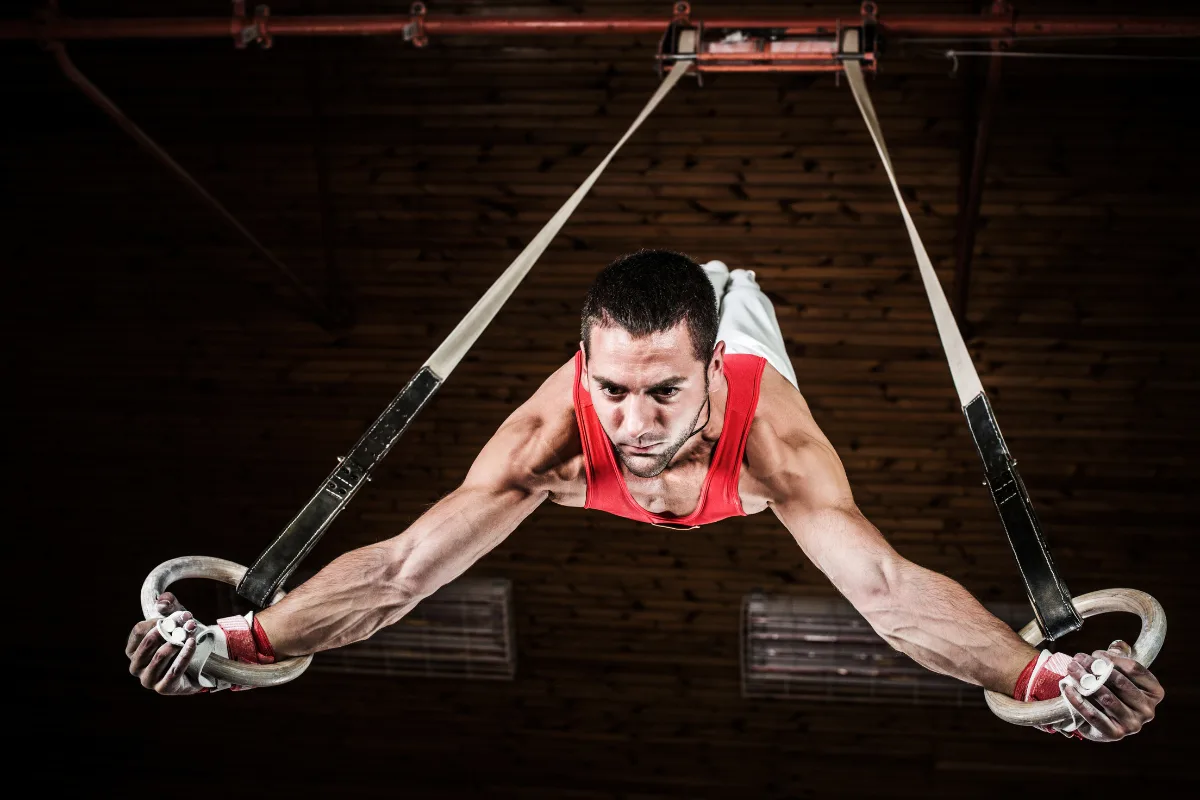
Rings can be used for pulling, pressing and support exercises that involve the shoulders as part of a coordinated upper-body movement. For introductory strength work, ring rows, inclined push-ups and supported holds offer different tasks to discuss with a coach.
The rings’ freedom to move adds a control demand. It does not make every exercise better than its fixed-equipment version, and it does not turn advanced skills into suitable starting exercises.
Set up the equipment for the exercise
Use rings, straps and an anchor intended for the load and activity, following the manufacturer’s instructions. The rings should be set evenly, with a clear working area and the surface or matting required by the exercise. Check the setup before loading it.
For introductory rows and inclined push-ups, the feet remain on a secure surface and the body angle can be adjusted. If the rings cannot be controlled in the intended movement, choose an easier angle or a stable piece of equipment rather than trying to force the same version.
USA Gymnastics includes apparatus checks, supervision and progressions within its safety education. Equipment and coaching are part of the exercise, not optional extras added after it becomes difficult.
Before starting, agree on how the exercise ends. An introductory setup should let the athlete return weight to the feet or another intended support without improvising. Also keep the space free from other people moving through the strap line. These arrangements should be shown as part of the lesson rather than discovered during a difficult repetition.
Ring rows: a pulling option
With the feet supported and the hands holding the rings, the gymnast leans back into a manageable position. The elbows bend to draw the torso toward the rings, then straighten as the body returns under control.
The row asks the arms, upper back and shoulders to work together. A more upright starting angle generally reduces the bodyweight demand. The coach can adjust the angle without asking the athlete to add a swing or lose the chosen body line.
This is a compound pulling movement, not an isolated rotator-cuff exercise, and it doesn’t guarantee against shoulder pain.
For a useful comparison between sessions, record the setup as well as the repetition count. Changing foot position or ring height changes the angle. More repetitions from a much more upright position may be worthwhile practice, but they do not demonstrate an improvement at the previous angle.
Inclined ring push-ups: a pressing option
Set the rings and foot position so the athlete can hold a controlled inclined plank. Bend the elbows to lower through a comfortable range, keeping the rings manageable, then press back to the starting position.
A higher hand position and more upright body can make the introductory version more manageable. Depth should suit the athlete and task; letting the rings spread far apart or forcing a deep shoulder position is not a requirement for a useful repetition.
The coach can first use a stable support if the athlete needs to learn the pressing movement without managing freely moving rings.
A 2026 study using TRX push-ups found that body angle affected muscle activity and that suspension did not raise every measured muscle’s activity uniformly. The participants were trained adult men, and TRX is not identical to separately suspended gymnastics rings. The study helps explain why configuration matters; it does not establish a best ring exercise for every gymnast.
Foot-supported holds: learn to manage the rings
A foot-supported hold keeps some bodyweight through the feet while the gymnast practices the intended arm and shoulder position. The setup should allow the athlete to enter and leave the hold without an uncontrolled drop.
The purpose is to learn a controllable support, not to lean immediately into a planche or turn the rings as far as possible. Removing foot support or changing body position adds a different demand. The straight-arm strength guide explains why those changes need deliberate progression.
Match the adjustment to the task
| What the coach observes | What to review |
|---|---|
| The body line changes during a row | Whether the current angle and amount of work allow the intended movement. |
| The rings move beyond control during a press | The setup, range and whether a stable support is a better teaching choice. |
| The hold relies on an awkward entry or exit | Support height and how the athlete enters and leaves the position. |
| The athlete reports pain | Stop the exercise and arrange appropriate assessment rather than adding difficulty. |
These are discussion points, not diagnoses or an automatic progression chart. The same visible problem can have different causes. A coach can watch the attempt and change the relevant feature, then check whether the intended movement becomes more manageable.
Choose a task rather than copying a long circuit
These examples offer a pull, a press and a supported hold. They are not a requirement to perform all three after every apparatus session. The coach should consider the athlete’s existing work and choose an amount that preserves the intended movement.
Choose a review measure that fits the exercise. A row may be assessed through controlled repetitions at the agreed angle. A supported hold may be assessed through the intended position and a controlled exit. Neither result is a direct measure of readiness for an iron cross or a ring handstand.
For the wider training context, see why gymnastics demands shoulder strength. Specific rotator-cuff conditioning has its own role and should not be replaced by simply making a ring exercise harder.
For example, a coach might retain a stable pressing exercise while introducing a foot-supported ring row. There is no requirement to move every upper-body exercise onto rings at once. Selecting equipment separately for each task keeps the purpose visible and makes it easier to identify which change affected the gymnast’s response.
Final Takeaway
Ring rows, inclined push-ups and foot-supported holds provide distinct ways to practice pulling, pressing and support. Start with a setup the athlete can control and progress for a clear purpose. Pain or loss of control calls for reassessment, not extra repetitions.