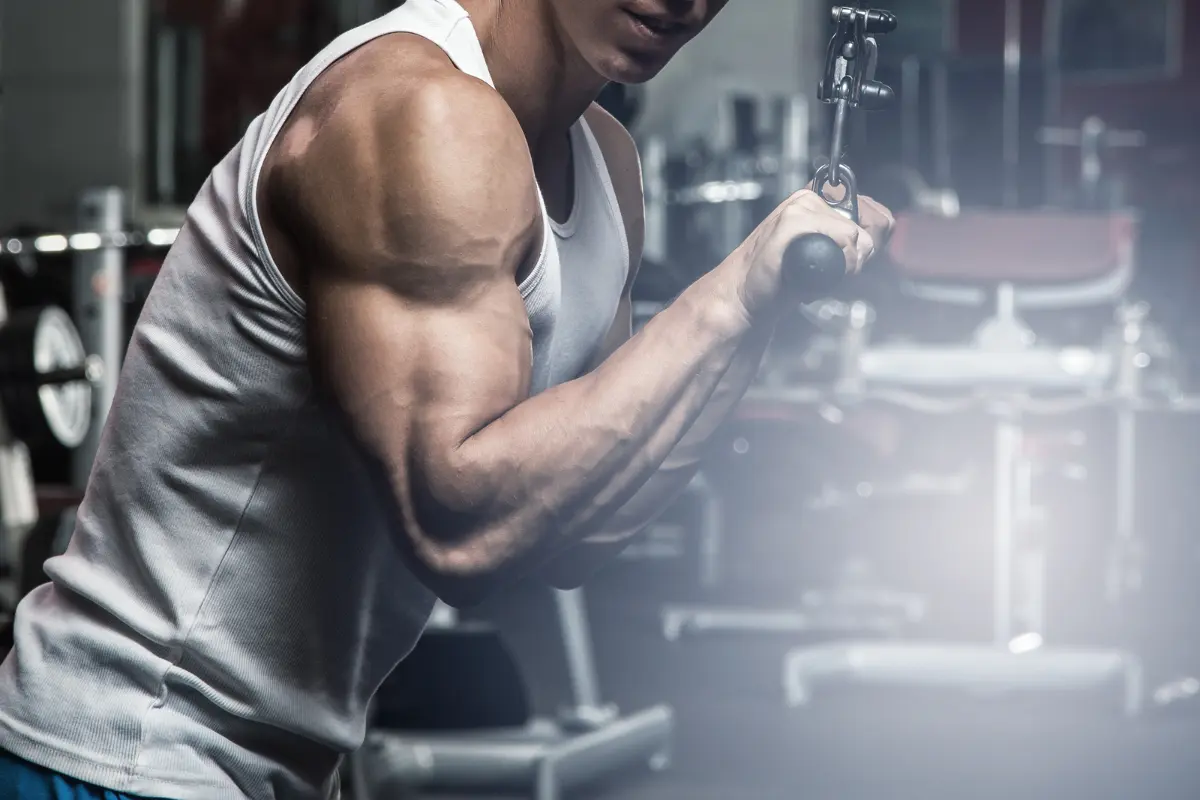
The developed biceps seen on some gymnasts reflect years of demanding upper-body work. Pulling, controlling holds and training apparatus skills can all load the arms. There is no single secret exercise that gives every gymnast the same appearance.
Ring specialists often attract this question, but they should not be treated as a picture of every gymnast. Age, individual build, event demands and training history vary widely across the sport.
Pulling gives the biceps a familiar job
The biceps helps bend the elbow and turn the forearm so the palm faces upward. In a chin-up or other pulling movement, it works with the back and other arm muscles rather than acting alone.
Gymnastics conditioning can include pull-ups, chin-ups, rows and rope work. These provide repeated opportunities to produce and control force through the arms. The load still depends on the exercise, the assistance used and how the movement is performed; “bodyweight” does not automatically mean light resistance.
For practical exercise choices, the biceps-conditioning guide separates pulling movements from curls and explains their different roles.
The anatomical names help clarify what a photograph leaves out. OpenStax’s upper-limb anatomy chapter identifies the biceps brachii, brachialis and brachioradialis as contributors to elbow flexion. The biceps also crosses the shoulder. A movement described casually as “biceps work” therefore involves a structure whose job depends on more than the visible bend at the elbow.
Arm circumference is not a measurement of that one muscle either. Other muscles and tissues contribute to the outline. A larger-looking arm does not establish which tissue changed, how much it changed or which exercise caused the difference. That is why a training explanation and a physique comparison need different kinds of evidence.
Straight arms do not mean inactive muscles
A gymnast can work hard while the elbow angle barely changes. Supporting the body or resisting an external force requires muscles to produce force even when there is little visible movement. That is one reason a still rings hold can be demanding.
The exact work differs between positions. A straight-arm support, a lever and a cross do not all load the shoulder and elbow in the same way. It is misleading to say that every straight-arm exercise automatically isolates the biceps or gives a greater growth stimulus than a curl.
The guide to straight-arm strength training explains those mechanical demands without turning elite holds into a beginner arm workout.
What muscle-activity studies can tell us
A 2023 study of ring and bar muscle-ups measured muscle activity in ten active adult men. The researchers compared recruitment during the pulling and pushing phases. The study examined an exercise session, not months of muscle growth.
That distinction matters. Electrical activity measured during a movement can help describe its demands, but it does not establish which athlete will develop the largest arms or prove that rings are universally superior for building muscle.
In that study, biceps activity was higher during both phases of the ring muscle-up than during the bar version. However, participants already had to be able to complete both exercises, and the movements used a kip. It would be inaccurate to present the result as a trial of strict beginner muscle-ups or a study of elite ring specialists.
The limited sample and immediate measurements also leave other questions open. The researchers did not assign beginners to months of ring training and then measure biceps growth. Nor did they establish that the exercise was an appropriate choice for every person who wants stronger arms. Those are separate claims requiring separate evidence.
Development comes from the whole training history
A photograph shows the result at one moment. It does not show the years of preparation, the mix of exercises, the periods of reduced training or the athlete’s individual response.
Muscle growth also depends on the overall training and recovery conditions. Adding more repetitions indefinitely is not a reliable substitute for appropriate loading and recovery. A gymnast’s program has to support skill practice and the demands of the full sport, not just increase arm size.
The broader discussion of male gymnasts’ physiques explains why appearance and performance should be considered separately.
Separate four different questions about an arm
| Question | Evidence that would help answer it |
|---|---|
| Is the muscle active in this movement? | A suitably designed muscle-activity study. |
| Has the muscle grown over time? | Comparable measurements before and after a training period. |
| Has the athlete become stronger at a task? | A repeatable strength or performance test for that task. |
| Can the gymnast perform the skill well? | Observation of the actual skill and its technical requirements. |
One result need not answer all four questions. A gymnast can improve how a movement is coordinated without a photograph showing an obvious change. Conversely, a visible change does not establish mastery of a new apparatus skill. Keeping the questions separate makes progress easier to discuss without reducing it to appearance.
Can ordinary strength training develop the biceps too?
Yes. Gymnastics has distinctive skill demands, but the biceps does not require an iron cross to be trained. Curls and scalable pulling exercises can provide useful resistance without asking someone to copy an elite rings routine.
For a learner, the useful question is which exercise can be performed and progressed with control. Choosing an impressive-looking hold solely because a muscular athlete performs it reverses that decision.
For a child or newcomer, the more useful comparison is with their own starting task under similar conditions. The coach can identify whether the selected movement is more controlled or the assigned resistance more manageable. Elite photographs may inspire interest, but they cannot supply an individual training prescription.
There is also no defensible percentage of an elite gymnast’s arm development that can be assigned to one exercise from these results. Knowing that a muscle works during a hold does not reveal the athlete’s lifetime exposure to that hold, other resistance work or individual adaptation. A claim such as “this skill caused most of those biceps” would require information a competition video does not contain.
Key Takeaway
Some gymnasts have highly developed biceps because their sport and conditioning repeatedly demand arm strength over many years. Pulling and straight-arm work can both contribute, but neither a particular hold nor an athlete’s photograph guarantees a physique outcome.