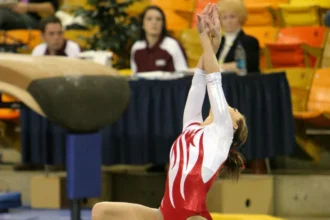
The Olympic Order is the standard event sequence that gymnasts rotate through during official artistic gymnastics competitions. It applies to team meets, all-around finals, and qualification rounds at major events like the Olympics, World Championships, and national competitions.
It’s designed to:
- Provide a consistent structure across meets
- Ensure a balanced physical workload
- Make scoring and comparisons fair and organized
Women’s Artistic Gymnastics (WAG) Olympic Order:
- Vault (VT)
- Uneven Bars (UB)
- Balance Beam (BB)
- Floor Exercise (FX)
This order moves from short, explosive power (vault), to upper-body strength and coordination (bars), to precision and balance (beam), and ends with a mix of tumbling and dance (floor). It’s designed to flow naturally from high-impact skills to more expressive routines.
Men’s Artistic Gymnastics (MAG) Olympic Order:
- Floor Exercise (FX)
- Pommel Horse (PH)
- Still Rings (SR)
- Vault (VT)
- Parallel Bars (PB)
- Horizontal Bar (HB)
This six-event sequence starts with energy-intensive tumbling and ends with the high-flying spectacle of the horizontal bar. The order is structured to balance strength, endurance, and apparatus type over the course of the meet.
Why the Olympic Order Matters
1. Standardization for Fairness
A universal event order:
- Keeps scoring consistent across all competitors and teams
- Helps judges compare routines without variation in event order
- Simplifies meet organization and scoring systems
Regardless of which event a gymnast begins on due to rotations, everyone moves through events in the same sequence, preserving fairness.
Example:
A gymnast starting on beam will rotate as follows:
Beam → Floor → Vault → Bars
2. Flow and Physical Demand Management
The Olympic order is not random. It’s designed to balance physical fatigue and recovery:
- For women, the sequence avoids back-to-back upper-body events or mentally draining routines.
- For men, it breaks up high-demand strength events like rings and pommel horse with skill-based transitions like vault.
This helps reduce injury risk and allows gymnasts to perform at their best across all events.
3. Team Strategy and Lineups
The Olympic Order also affects coaching strategy, especially in team finals:
Lineup Planning
- Coaches often lead with confidence-builders (e.g., strong vaulters or floor tumblers).
- They anchor the end of each lineup with experienced gymnasts who can handle pressure and recover from earlier mistakes.
Rotation Groups
In major competitions, teams are assigned starting events (e.g., a team might start on bars instead of vault). Regardless, they rotate in Olympic order from that starting point.
Example:
A team starts on Uneven Bars:
UB → BB → FX → VT
This structure ensures every team completes all events in the same order, just staggered in time.
4. Mental and Emotional Impact
The event order plays a significant psychological role:
For Women:
- Vault-first builds momentum quick routines with instant scoring feedback.
- Beam placed third avoids starting with the most nerve-wracking event.
- Floor last allows gymnasts to finish strong and celebrate in front of the crowd.
For Men:
- Floor-first burns energy, ideal when legs are fresh.
- Pommel horse is notoriously difficult, getting it out of the way early is beneficial.
- High bar finishes the rotation with risk and excitement, often determining medal positions.
Event placement can make or break a gymnast’s mindset, especially in pressure-filled finals.
Olympic Finals vs. Qualifications
✔️ Team Finals and All-Around
- The Olympic Order is strictly followed.
- Gymnasts rotate in fixed sequences, maintaining competitive balance.
- Start apparatuses are assigned to teams in advance and rotated fairly.
✔️ Event Finals
- The order is not followed, since each gymnast only competes on one apparatus.
- Gymnasts are arranged based on qualification ranking (top scorers go later in the order).
- There is no rotation—only one event is contested.
What About Individual Event Finals?
In individual event finals:
- The Olympic Order is not used.
- Each final is a single-apparatus showdown.
- Gymnasts perform one at a time, in qualification rank order.
In individual all-around finals, however, the Olympic Order still applies. Gymnasts are assigned rotation groups and start on different apparatuses, but still move through the events in Olympic sequence.
Olympic Order vs. Club Meets: Is It Always the Same?
In recreational or lower-level competitions (e.g., Xcel or local USAG meets), the Olympic Order may be loosely followed, but often adjusted for logistics.
Typical Patterns:
- WAG meets usually start on Vault and rotate clockwise.
- MAG meets typically begin on Floor and follow Olympic sequence.
- Flight groups rotate in Olympic order, but starting event may vary by team.
Judges, coaches, and athletes are trained to follow the order, even when rotations start from different apparatuses.
In a word, the Olympic order plays a major role in the structure, fairness, and strategy of artistic gymnastics.