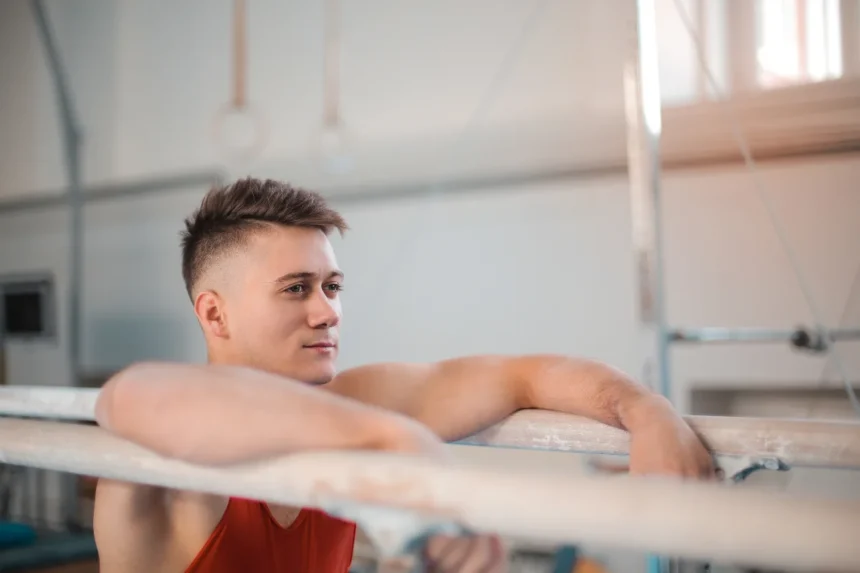
In gymnastics, Male gymnasts are shorter, more compact, and incredibly muscular, with broad shoulders, thick arms, and powerful legs. In this article, we’ll explore what the typical male gymnast’s body looks like, why these traits give them an edge, and how their build compares to other elite athletes.
At a Glance: The Typical Male Olympic Gymnast Physique
1. Stature: Commonly short-to-average height for adult men, often around 5’4″–5’8″ (162–173 cm), though successful outliers exist on both ends.
2. Body Mass: Typically 60–77 kg (132–170 lb), varying with height, event specialty, and whether the gymnast is an all-arounder or apparatus specialist.
3. Body Fat: Usually 6–12%—lean for performance, not excessively shredded.
4. Build:
- Broad shoulders and dense lats for swing power
- Thick chest and arms, especially forearms, for holds and grips
- Rock-solid core for stability in twists, landings, and strength elements
- Powerful glutes and quads, with functional hamstrings and calves for explosive takeoffs and controlled landings
5. Mobility: High flexibility in shoulders, hips, and spine, plus springy wrists and ankles—paired with exceptional joint control.
This blend of compact power, lean muscle, and mobility maximizes strength-to-weight ratio, rotational speed, swing efficiency, and landing control, the four pillars of men’s artistic gymnastics (MAG).
Physique Attributes of a Male Olympic Gymnast
| Attribute | Typical Profile | Role in Gymnastics |
|---|---|---|
| Height | ~5’4″–5’8″ (162–173 cm), with some outliers | Shorter build helps with rotation, swing control, and stable landings |
| Weight | ~60–77 kg (132–170 lb), proportional to height | Light enough for bodyweight skills, heavy enough for explosive power |
| Body Fat % | ~6–12% (performance-lean) | Keeps them strong, fast, and efficient without extra weight |
| Limb Proportions | Slightly shorter arms/legs vs. trunk | Makes flips quicker and strength holds more controlled |
| Upper Body | Broad shoulders, thick lats, strong arms | Powers swings, holds, and support moves on bars and rings |
| Core | Extremely strong and durable | Stabilizes handstands, shapes swings, and cushions landings |
| Lower Body | Powerful glutes, quads, and calves | Provides lift for vaults, tumbling, and landings |
| Hands/Grip | Strong, callused grip | Essential for giants, releases, and static holds |
Note: These are common trends, not strict requirements. Olympic rosters include taller and shorter athletes, heavier and lighter builds, and a range of body proportions.
Why the Sport Selects This Body
The physique of a male Olympic gymnast is the result of a selection effect. Certain body types naturally excel in the sport’s demands, so those athletes progress faster and remain in the pipeline to the elite level. Here’s why:
- Strength-to-Weight Ratio
Every event in men’s artistic gymnastics is a battle against gravity. Athletes with higher relative strength can lever, hold, and launch their bodies with less effort and fatigue. A lighter, denser build makes static holds on rings or explosive vaults more efficient. - Rotational Mechanics
Compact frames with shorter limbs lower rotational inertia—the resistance to spinning. This makes flips and twists faster, cleaner, and easier to control during complex tumbling and vaulting sequences. - Swing Physics
On the high bar and parallel bars, gymnasts rely on their shoulders and lats as the “engine” of their swing. A stiff, strong shoulder complex paired with dense back musculature turns the body into a stable pendulum, producing more speed, higher releases, and straighter handstands. - Balance and Landings
A lower center of mass improves stability. Combined with powerful hips and mobile ankles, this allows gymnasts to absorb impact, stick landings, and maintain clean body lines even when fatigued.
Over time, this self-selecting process filters the athlete pool, which is why elite rosters tend to feature compact, muscular gymnasts with remarkable strength-to-weight efficiency.
How Training Builds (and Maintains) the Physique
The body of a male Olympic gymnast is built by years of hard, specific training.
Training Hours
Elite male gymnasts often train 20–30 hours a week. Practices mix technical skills with conditioning, so every routine doubles as both skill work and strength training.
Strength Work
Most of the strength comes from bodyweight training such as push-ups, handstands, levers, planches, and ring holds. These moves demand control through the whole body, especially the shoulders and core. Some weights and resistance work are added too, mainly for legs and overall balance.
Jumping and Landings
Gymnasts do a lot of jump and landing drills to protect their ankles, knees, and hips. This helps them absorb the heavy forces from tumbling and vaulting, and stick their landings more consistently.
Energy and Endurance
Even though routines are short, gymnasts need different kinds of fitness:
- Explosive power for vaults and big tumbling passes
- Anaerobic stamina to repeat hard skills in one routine
- Basic aerobic conditioning to recover during long practices
All together, this training builds the compact, powerful, and resilient body type that defines Olympic gymnasts.
Comparison With Other Athletes
Gymnasts vs. Olympic Swimmers
Swimmers are typically tall with long limbs, ideal for reducing drag and maximizing reach in the water. At the 2016 Olympics, the average height of male finalists was about 6′2″ (188 cm) .
Gymnasts, in contrast, are shorter and more compact. Their dense, muscular builds are designed for fast rotations, efficient swings, and controlled landings. These skills don’t matter in swimming but are essential on apparatus.
Gymnasts vs. NBA Basketball Players
NBA players average around 6′6″ (198 cm), with wingspans that give them a major advantage in shooting, rebounding, and defense . Height is their defining physical asset.
Gymnasts, by comparison, benefit from being shorter. Their compact stature allows them to twist faster, balance more easily, and maintain tight body lines in skills like handstands, vaults, and beam dismounts.
Gymnasts vs. Olympic Middleweight Weightlifters
Weightlifters in the 69–77 kg Olympic classes are usually shorter, about 5′5″–5′7″ (165–170 cm) . Their bodies are packed with dense muscle and bone mass to generate maximal force for heavy lifts.
Gymnasts look similarly muscular but train for relative, not absolute, strength. They need enough power to hold an Iron Cross yet stay light enough to flip and rotate efficiently. Where weightlifters chase maximum load, gymnasts chase maximum control.
Takeaway:
- Swimmers thrive on reach and endurance efficiency.
- Basketball players on height and leverage.
- Weightlifters on maximum load capacity.
- Gymnasts combine compact strength, agility, and body control, making them unique as all-around masters of relative strength.