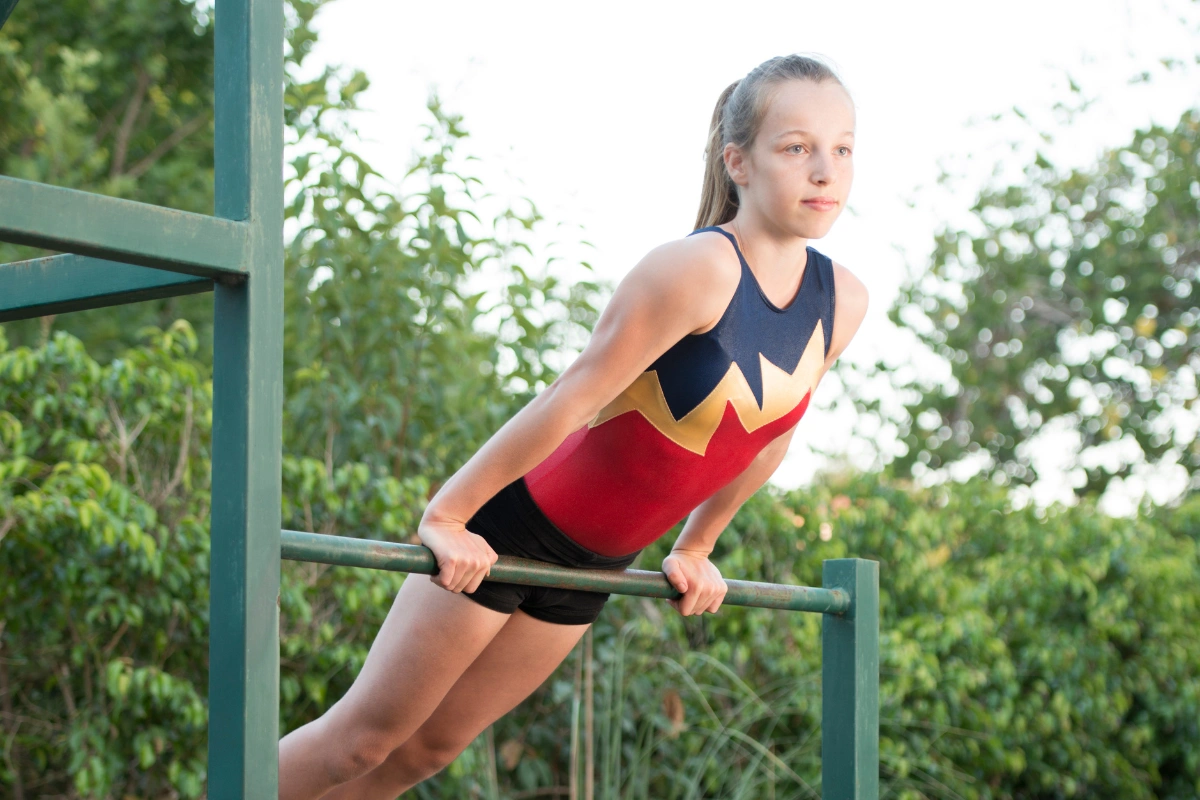
A glide kip brings a gymnast from a swing below the bar into front support above it. It combines a glide, changes in body shape and a coordinated rise to support. It is not simply a pull-up with a stronger kick, and a single “wrist flick” does not explain the whole movement.
This guide explains what coaches are developing when they teach the kip in women’s artistic gymnastics. It helps gymnasts and parents understand the practice, the terminology and useful progress questions. The actual drills, apparatus setup and assistance need to be selected by the gymnast’s coach.
Recognize the Glide Kip Before Breaking It Apart
The gymnast moves through a glide below the low bar, extends away, brings the feet toward the bar and coordinates the return and rise into support. The phases overlap in one movement. Treating them as isolated commands can miss the timing that connects them.
A long-hang kip starts from a different swinging situation, commonly on the high bar. The two belong to the kip family, but they should not be treated as identical practice tasks. Success on one setup does not automatically transfer to every other starting position.
The kip is also different from a pullover. In a pullover, the lower body travels over and around the bar to reach support. In a glide kip, the gymnast coordinates the swing and body action to rise from below. Both can finish above the rail, but their movement patterns are different.
Why Strength Alone Does Not Answer the Problem
A gymnast can be capable of hanging, pulling or lifting the legs and still find it difficult to combine the actions into a kip. Those abilities contribute to the task, but performing them separately does not establish that their timing and direction work together.
A small 2019 kinematic study compared one experienced gymnast with four university students on a low horizontal bar. It found differences in knee movement and in the direction and speed of the leg action, even though aspects of their overall rhythm were similar.
That five-person study did not test a training program for children or establish a universal correction. Its useful contribution is narrower: a similar-looking sequence can contain meaningful movement differences. It supports asking which phase needs attention rather than assuming every missed kip needs more strength work.
What Different Kinds of Practice Are For
| Practice focus | What the coach may be assessing | What it does not prove by itself |
|---|---|---|
| Glide work | Shape, extension, clearance and the return | That the complete rise to support is ready |
| Leg-lift and body-shape work | Control of the intended positions | That the timing matches the moving skill |
| Support and pressing preparation | Control as the gymnast arrives above the rail | That a missed kip is only an arm-strength problem |
| Assisted kip practice | How the phases connect with specific help | That the same attempt should be made independently |
A useful drill has a purpose the gymnast can understand. “We are working on the end of the glide” is more informative than doing an exercise simply because it appears in a kip video. The coach can explain how that practice relates to the full movement and what improvement would look like.
Read a Missed Attempt Without Guessing at a Fix
If the gymnast does not reach support, several different things may have happened. The glide may have changed, the body action may have occurred at a different point, or the final transition may have lacked control. The visible endpoint alone does not identify the cause.
Likewise, bent arms or an uneven arrival don’t point to one cause; the coach looks at the movement that came before. No single drill or number of repetitions fixes it for every gymnast.
Ask the coach to identify the most useful current correction. It might concern the glide, shape, timing or another part of the movement. A concise cue tied to the observed problem is more helpful than stacking several unrelated instructions onto each attempt.
Why the Setup Matters
The rail height, space beneath it, landing area and any approved training aids affect the task. A fixed starting distance such as “three feet from the bar” cannot fit every gymnast and setup. Nor should every learner be told to use a springboard for the largest possible jump.
The uneven-bars setup guide explains why coaches adjust equipment. Clearance and appropriate entry matter before discussing how much effort to put into an attempt. Parents should not recreate a setup from a video without knowing its intended purpose and supervision.
USA Gymnastics’ safety curriculum includes apparatus, preparation, progressions and spotting. A coach’s assistance is part of that broader process. Written descriptions cannot teach a parent where or when to provide physical support during a moving kip.
Where the Kip Fits in Competition
The women’s USAG Level 4 compulsory bars routine includes a glide-kip mount and a long-hang kip. Official compulsory replacement pages describe the required content and its evaluation. The level’s requirements should not be turned into a claim that every child starts kip training at age six or seven.
Learning the movement and competing the prescribed routine are separate milestones. A first independent kip may still need more consistency, a clearer finish or better connection to the next element. The Level 4 requirements guide puts it in the context of the complete program.
Other programs have different routine requirements. Before asking whether a gymnast “needs a kip to move up,” identify the program, division or level and the coach’s development plan. One club’s class name does not establish a universal competition rule.
Track Progress More Precisely Than “Got It”
Record the practice conditions when discussing progress: which bar, what assistance, which starting movement and what the coach wanted to improve. A supported attempt with a smoother transition can be valuable progress even before an independent kip appears.
Once the skill is achieved, the question changes from whether it can happen once to how it fits reliably into the routine. That does not require a universal pass rate invented by an article. It requires the coach to assess the gymnast’s actual performance over time.
Useful questions include: Which phase is our focus now? What is improving? What should I notice in a good attempt? Is any home preparation appropriate? Keeping those questions specific protects the purpose of practice and gives the gymnast something clearer to work toward than an arbitrary deadline.