Higher Leg Holds in Gymnastics: Build Active Flexibility and Control
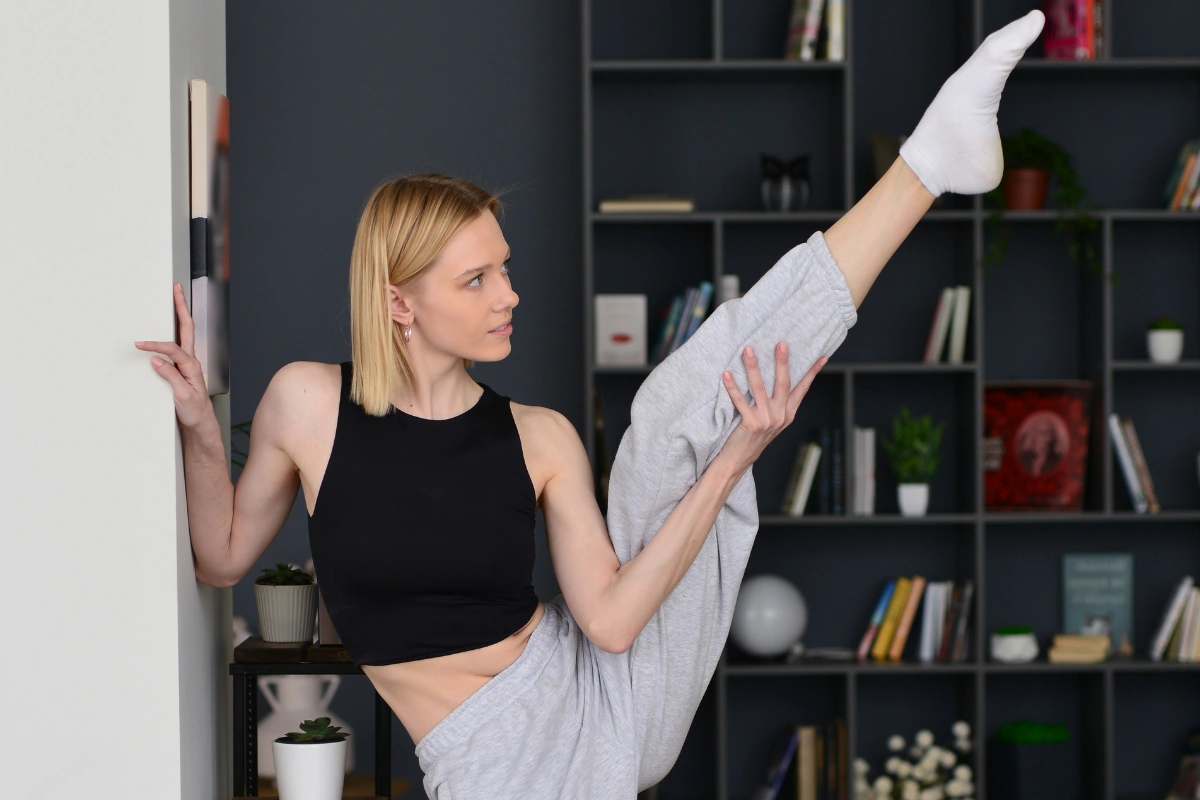
A higher leg hold requires more than the ability to stretch into a split. The gymnast has to lift or position the leg, maintain the intended body shape and control the balance. For an unsupported hold, the muscles must actively keep the leg elevated. For a hand-assisted hold, the arms contribute support, so the task is different.
Contents
- Define the leg hold before training it
- Active and passive flexibility answer different questions
- Look at the whole position
- Separate balance from leg control when necessary
- Choose preparation that matches the direction
- Why forcing the stretch can miss the problem
- Use a consistent way to track progress
- Keep the workload realistic
The most useful goal is a repeatable position that fits the intended skill. Raising the foot farther by twisting the pelvis, leaning unexpectedly or pulling through pain may change the appearance without improving the movement the coach wants.
Define the leg hold before training it
“Leg hold” can mean a front extension, a side extension, a backward extension or a position in which the athlete holds the foot with one or both hands. Those positions require different combinations of hip movement, trunk control and balance.
In artistic gymnastics, the target should relate to a dance position, balance or other movement in the gymnast’s program. A dramatic flexibility pose from another discipline is not automatically relevant to a beam or floor routine.
| Version | What supplies support? | What to compare |
|---|---|---|
| Unsupported leg lift or hold | The athlete’s muscles maintain the leg position | Height with consistent trunk, pelvis and knee position |
| Hand-assisted hold | The hands help support or position the leg | Control and comfortable range with the same assistance |
| Passive stretch | External support helps create the position | Available range, rather than independent holding ability |
A photograph rarely tells you how much assistance is being used. Match the task before deciding that another athlete’s higher foot position represents a strength or flexibility standard you should reach.
Active and passive flexibility answer different questions
Passive range is the movement available with external assistance. Active range is the movement the athlete can produce through muscular effort. A gap between them can explain why someone has a comfortable floor split yet struggles to hold one leg high while standing.
A randomized study of female dance students compared six weeks of end-range strengthening, low-intensity stretching and more intense stretching. Active range improved more in the strengthening and low-intensity groups than in the more intense stretching group. The study involved dancers, not artistic gymnasts, and does not establish an identical program for every child.
Its useful lesson is that harder stretching is not automatically a better route to usable range. Strength and mobility should be considered together, with the exercise selected around the limitation actually observed.
Look at the whole position
Leg height is only one feature. The supporting foot, standing knee, pelvis, trunk and lifted knee all affect what the position means. Some skills intentionally include a particular trunk angle or hip rotation; others require a more upright arrangement.
A coach should define that target rather than apply “keep everything square” to every possible dance movement. Once the target is clear, keep it consistent when measuring progress. Otherwise, a new trunk lean can appear to produce a large improvement in leg range.
Foot shape and knee extension may also be part of the assignment. They should develop with control rather than being forced to satisfy a photo. The athlete needs to understand which features matter for the particular skill and which are simply aesthetic preferences in an online example.
Separate balance from leg control when necessary
Standing on one foot introduces a balance challenge. If the athlete spends the entire attempt trying not to fall, the coach may use light hand support or a suitable seated or lying exercise to examine leg control more clearly.
This is a change in task, not a failure. Removing one demand temporarily can make it easier to identify another. Later, the coach can bring the components together in the position used for gymnastics.
For example, a controlled front lift with light support can show whether the athlete maintains the intended knee and trunk position. An unsupported version then adds the demand of managing the standing balance. Progress in one version should be recorded separately from progress in the other.
Choose preparation that matches the direction
A forward leg hold does not ask the hip to move in the same direction as a backward extension. Repeating only hamstring stretches cannot address every possible limitation in every type of hold.
The coach may combine comfortable mobility work with controlled lifts and brief holds within the athlete’s current range. Small movements can be useful if they preserve the intended position. Large, fast kicks answer a different question because momentum helps move the leg.
Our guide to dance training for artistic gymnastics explains how technical dance work connects shape, timing and control. General flexibility exercises should serve those movement goals rather than become a separate contest for maximum range.
Why forcing the stretch can miss the problem
If the athlete already has enough passive range for the desired position, pushing farther may not address the difficulty holding it. The missing component could involve active strength, balance, coordination or understanding of the position.
Oversplits and forceful partner stretches add demands that need individual assessment. A beginner does not need to progress beyond a floor split simply because an online routine lists oversplits as its next step. Pain, pinching or a feeling of instability should stop the exercise rather than trigger stronger pulling.
Boston Children’s Hospital’s research team describes a relationship between hip pain and microinstability in dancers. This does not mean flexibility itself is an injury, but it reinforces why persistent hip symptoms deserve assessment rather than an assumption that the athlete only needs more stretching.
Use a consistent way to track progress
Choose the same variation, support, warm-up and viewing angle. Record whether the knee remained in the assigned position, whether the trunk changed and whether the athlete could lower the leg smoothly. A controlled return is part of the task.
For an unsupported hold, useful progress might be maintaining a familiar height with less shaking or producing a slightly higher position without new compensations. For an assisted hold, it might mean using less hand support while preserving comfort and control.
A phone image can help document position when used appropriately, but it is not a substitute for coaching. Camera angle can distort the apparent height, and a single frame cannot show how the athlete arrived or whether the position was sustainable.
Keep the workload realistic
Active flexibility work can be tiring even when the movement looks small. Add it with the coach’s knowledge so it fits the gymnast’s existing dance, leaps, conditioning and apparatus sessions. Daily maximum-height attempts are not a necessary sign of commitment.
Our conditioning and strength-training guide explains how exercise selection should match a specific goal. A leg-hold assignment should likewise state the variation, intended quality and stopping point rather than simply demand more repetitions.
If pain persists, range suddenly changes or the athlete starts altering ordinary walking or training, seek advice from a qualified clinician. A return after injury should follow the individual’s care plan.
Ask the coach what limits the current hold: available range, active control, balance or technique. That answer determines the next useful practice. A slightly lower position performed confidently and consistently is often a better foundation for an artistic gymnastics skill than a higher position achieved by pulling harder.