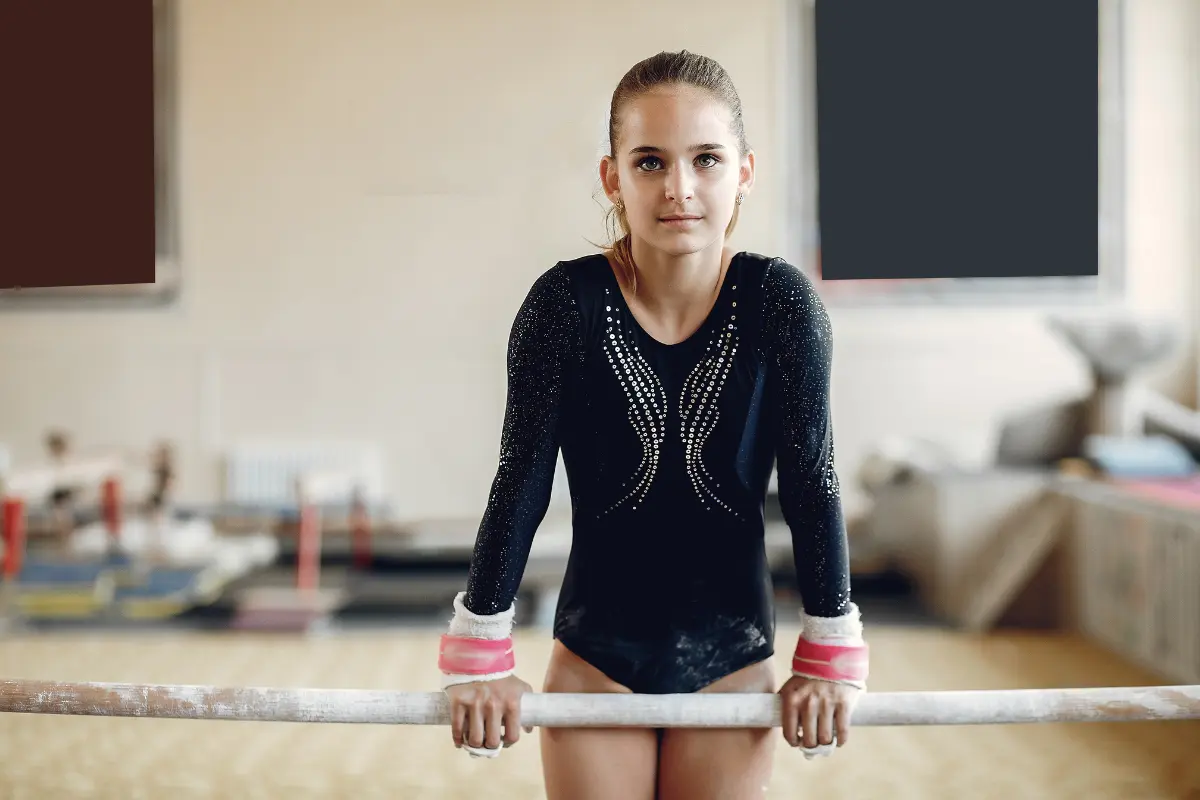
You may have heard someone say, “She’s too tall for gymnastics,” or “Once you grow past 5’2″, it’s over.” Height myths are deeply ingrained in gymnastics culture, passed down through gyms, parents’ conversations, and social media.
- Myth #1: “You Have to Be Under 5’2” (or a Certain Height) to Compete
- Myth #2: “Judges Deduct You for Being Tall”
- Myth #3: “Tall gymnasts can’t do bars because the equipment isn’t made for them”
- Myth #4: “Gymnastics stunts your growth, so tall gymnasts can’t happen”
- Why Gymnastics Often “Favors” Shorter Athletes (Without Banning Tall Ones)
- Where Height Matters Most in Practice: Event-by-Event Reality Check
- “So… Is There Any Situation Where Height Becomes a Real Barrier?”
But here’s the truth upfront:
There is no official height limit in competitive gymnastics.
No rulebook from Fédération Internationale de Gymnastique (FIG), USA Gymnastics (USAG), or NCAA sets a maximum or minimum height for athletes. What does exist is a complex mix of biomechanics, equipment standards, judging criteria, training realities, and long-standing selection bias.
So why does the belief that “you must be short” feel so real? Because gymnastics is a sport where body size changes the physics of movement, and over time, certain body types have become more common at the very top. That pattern gets mistaken for a rule, but it isn’t one.
Myth #1: “You Have to Be Under 5’2” (or a Certain Height) to Compete
Fact: There is no universal height cutoff in competitive gymnastics rules.
What does exist in official regulations includes:
- Age eligibility rules (especially strict in elite/FIG competition)
- Equipment specifications and settings (apparatus must fall within approved ranges)
- Skill requirements and scoring rules (difficulty, execution, and neutral deductions)
But no rule ever says, “If you’re taller than X, you can’t compete.”
In real competition, gymnasts range from quite short to relatively tall, even at high levels. This is especially clear in NCAA gymnastics, where athletes 5’7″ and taller regularly compete and succeed.
Myth #2: “Judges Deduct You for Being Tall”
Fact: Judges do not deduct points because of height.
Judges deduct for execution faults and missing requirements, such as:
- Bent knees
- Leg separations
- Form breaks
- Under-rotations
- Extra steps or hops on landings
A taller gymnast may face different technical challenges, such as needing more clearance on bars, but if those challenges result in visible errors, the errors are deducted, not the gymnast’s height.
Myth #3: “Tall gymnasts can’t do bars because the equipment isn’t made for them”
Fact: Gymnastics equipment is standardized, but it is also adjustable within limits to accommodate different athletes.
Uneven Bars: Adjustability and Practical Limits
In competitive gymnastics:
- FIG apparatus norms provide set measurements for uneven bars (e.g., typical high bar ~250 cm, low bar ~170 cm above the mat).
The distance between bars is adjustable to fit the gymnast’s size and skill.
At elite competitions, FIG rules allow official requests to raise bar heights in a specific situation (for example, when a gymnast’s feet touch the mat during an exercise) to maintain safety and fairness.
Bottom line: equipment is standardized, but it’s not “one-size-fits-only-one-height.”
Myth #4: “Gymnastics stunts your growth, so tall gymnasts can’t happen”
This myth blends a real observation with an oversimplified conclusion. Elite gymnasts are often shorter, but that does not mean gymnastics automatically stunts growth.
What Research Actually Says
Gymnastics does not guarantee growth stunting, but excessively high training loads combined with inadequate nutrition or recovery can impact growth during sensitive developmental periods. That’s a health and training-management issue, not a height rule.
Why Gymnastics Often “Favors” Shorter Athletes (Without Banning Tall Ones)
Much of gymnastics comes down to physics.
Rotation and Moment of Inertia
When body mass is farther from the center of rotation (as with longer limbs), moment of inertia increases, requiring more force to achieve the same rotation speed. This can make certain skills more technically demanding for taller gymnasts.
Balance and Center of Mass
A lower center of mass (more common in shorter athletes) can make balance elements feel slightly more forgiving, especially on beam. But it does not determine success.
But Physics Cuts Both Ways
Taller gymnasts can also have advantages:
- Reach and lines: Longer limbs often enhance extension and visual lines
- Power events: Height does not automatically reduce power; many taller gymnasts develop exceptional speed and explosiveness for tumbling and vault
So it’s not “short always wins.” It’s simply that different bodies excel in different ways.
Where Height Matters Most in Practice: Event-by-Event Reality Check
While no rulebook ever sets a height limit, body size can influence how skills feel, how they’re performed, and what technical adjustments are needed.
Vault: Height Isn’t a Rule Barrier, But Mechanics Matter
Vault success comes from converting run-up speed into vertical lift and rotation. The key factor is how high the gymnast’s center of mass rises at takeoff, because more airtime allows cleaner rotation and safer landings.
Height alone doesn’t determine vault success. Instead, performance depends on speed, power, and timing.
For taller gymnasts, refining these details is especially important:
- Board contact timing to preserve speed
- Shoulder angle at the block to turn speed into lift
- A tight body shape in flight for efficient rotation
With solid mechanics, taller gymnasts can achieve just as much height and rotation as shorter athletes.
Uneven Bars: Apparatus Fit and Swing Physics
Uneven bars are where height differences are most noticeable:
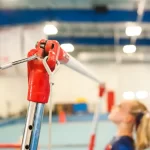
- Bar spacing can be adjusted to better fit the gymnast’s body, which is particularly helpful for taller athletes with longer reach.
- Taller gymnasts often need more clearance under the high bar during swings and release skills, affecting timing rather than competitiveness.
This is exactly why FIG and national programs allow bar spacing and height adjustments within set limits, to keep routines safe and fair.
Key reality: Bars aren’t “too short” for tall athletes, but technique must be adapted carefully.
Balance Beam: Precision and Coordination Over Height
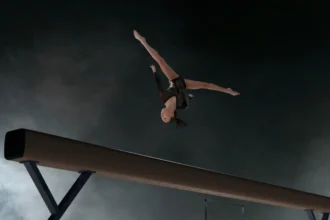
Beam rewards control, rhythm, and consistency. While a lower center of mass can make balance feel slightly easier, it does not determine success.
The beam is the same for everyone:
- 10.16 cm wide
- 125 cm high
Because of this:
- Taller gymnasts can excel with strong postural control and alignment.
- Longer limbs may make movements look bigger, but judges evaluate precision and execution, not body size.
On beam, coordination and confidence matter far more than height.
Floor Exercise: Height Can Be an Advantage
Floor routines are performed on a spring floor, designed to return energy and increase rebound.
As a result:
- Taller gymnasts who develop strong run speed and vertical power can take full advantage of the floor’s rebound.
- Longer limbs often create impressive height and extension in leaps and dance elements, boosting execution scores when performed cleanly.
While shorter gymnasts may find rotation slightly easier, taller gymnasts can use speed, rebound, and extension to produce powerful tumbling and visually striking routines.
“So… Is There Any Situation Where Height Becomes a Real Barrier?”
Not a rule-based barrier, but sometimes a practical ceiling, depending on context.
Factors that can matter include:
- Equipment constraints (even with allowed adjustments, limits exist)
- Injury risk management (impact forces, ankle/knee stress, recovery demands)
- Coaching environment (some gyms adapt technique better than others)
- Selection bias at the highest levels (elite pipelines often reinforce preferred body types, sometimes unfairly)
None of these make a gymnast ineligible. They simply influence how far and in what direction an athlete may progress.