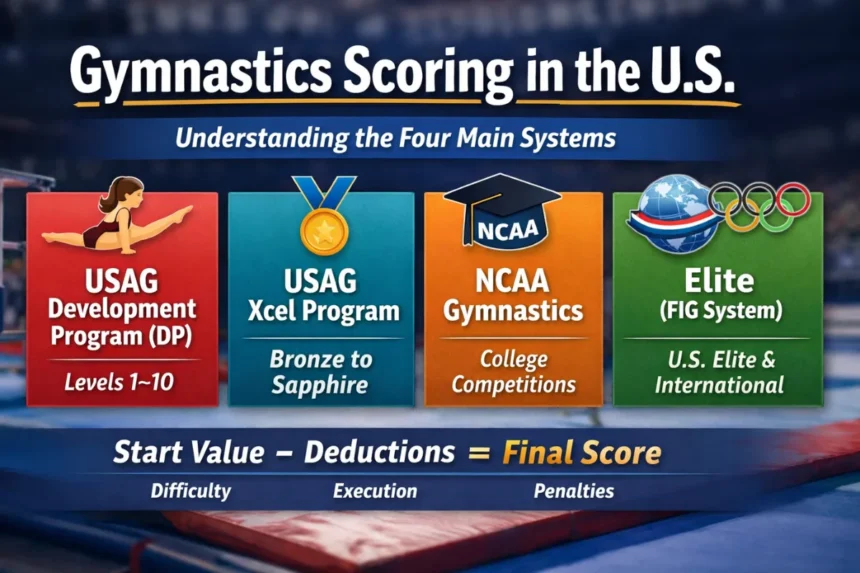
Gymnastics scoring in the United States isn’t handled by a single system. Instead, athletes compete under four main scoring frameworks, depending on their level and competition:
- USAG Development Program (DP) (Levels 1–10)
- USAG Xcel (Bronze through Sapphire)
- NCAA (college gymnastics)
- Elite (the international FIG system used at U.S. elite competitions)
USAG Club Gymnastics Scoring (DP & Xcel)
For most gymnasts in the U.S., competition begins at the club level, where scoring is governed by USA Gymnastics. This is where the majority of athletes and families first encounter how gymnastics scores are calculated.
The two primary club pathways, Development Program (DP) and Xcel, share the same scoring foundation, even though their routines are structured differently.
Both DP and Xcel use the same core formula:
Final Score = Start Value − Execution Deductions − Neutral Deductions
- Start Value (SV): The highest possible score a routine can earn before deductions
- Execution Deductions: Taken for mistakes in form, technique, and control (such as bent knees, balance checks, or landing errors)
- Neutral Deductions: Penalties for rule violations (for example, stepping out of bounds or overtime)
Execution deductions are judged the same way in both programs, which means judges apply consistent standards whether a gymnast competes in DP or Xcel.
The key difference between DP and Xcel lies in how the Start Value is earned, based on each program’s rules and expectations.
USAG Development Program (DP) Scoring
The Development Program is the traditional competitive pathway in club gymnastics, structured into Levels 1–10 with increasing complexity and skill expectations.
- Compulsory Levels (1–5): All gymnasts perform the same set routines. Judges award a preset Start Value when the routine is performed correctly, then deduct for execution faults.
- Optional Levels (6–10): Gymnasts perform customized routines. To earn a full Start Value (typically a 10.0), routines must include required skills and meet level-specific composition and difficulty requirements. Coaches balance skill selection with clean execution and control.
As gymnasts progress, routines become more individualized and strategy plays a larger role, but judges continue to reward strong fundamentals and precise execution.
DP scoring documents, including the Development Program Optional Code of Points, define the requirements, skill values, and deductions used through 2026.
Xcel Program Scoring
Xcel scoring uses the same overall scoring model as DP, but Start Value is built differently.
For most Xcel divisions (Bronze through Sapphire), routines must meet:
- Value Part (VP) requirements
- Special Requirements (SRs)
Each Special Requirement on events like bars, beam, and floor is worth a defined amount and must be fulfilled through specific skill combinations. For example, a typical Xcel Gold routine includes required “A” or higher-value skills, along with designated acrobatic and dance elements.
Gymnasts earn their Start Value by collecting the required number of VPs and satisfying all Special Requirements. The official Xcel Code of Points (updated through 2026) outlines the full VP/SR criteria and scoring expectations for each division.
DP vs Xcel: How They Compare in Scoring
| Feature | Development Program (DP) | Xcel Program |
|---|---|---|
| Governing Body | USA Gymnastics | USA Gymnastics |
| Scoring Model | Start Value − Execution − Neutral | Start Value (VP/SR) − Execution − Neutral |
| Routine Flexibility | Moderate → High from Levels 6–10 | Broad flexibility at all levels |
| Start Value Basis | Level requirements & composition | Value Parts & Special Requirements |
| Skill Progression | Standardized levels 1–10 | Tiered divisions with flexible progression |
NCAA Gymnastics Scoring (College Gymnastics)
College gymnastics in the U.S. especially NCAA women’s gymnastics uses a distinct scoring approach that’s different from club gymnastics (DP and Xcel), even though it still centers around a maximum score of 10.0.
Instead of building routines from strict level requirements, NCAA scoring uses a base value + bonus system designed to keep the scoring competitive and exciting for collegiate meets.
For most events, the logic looks like this:
Final Score = Start Value (up to 10.0) − Execution Deductions − Neutral Deductions
Unlike elite gymnastics, NCAA does not use an open-ended D-score. Difficulty is rewarded only to the extent that it helps a routine reach a 10.0 start.
The 9.4 Base Start Value (Bars, Beam & Floor)
On uneven bars, balance beam, and floor exercise, NCAA routines that meet the minimum composition requirements start from 9.4. From there, gymnasts earn bonus through two channels:
- Difficulty bonus (D/E credit)
- Connection Value (CV)
When enough bonus is earned, the routine reaches a maximum Start Value of 10.0.
Bonus: How Gymnasts Get from 9.4 → 10.0
Once a gymnast has a valid 9.4 start, she can earn up to 0.6 in bonus to reach a 10.0 maximum start value. Bonus comes from multiple sources:
Skill Difficulty Bonus
- D-value skills typically earn +0.1 bonus
- E-value skills typically earn +0.2 bonus
- Some skills like releases or tumbling elements can earn extra bonus in specific situations (e.g., final passes, release elements on bars).
Connection Value Bonus
Connection bonuses are earned when skills are linked in specific ways (e.g., acrobatic or dance connections). These can range from +0.1 to +0.3 depending on the sequence and difficulty of the skills connected.
Vault Is Scored by Published Start Values
NCAA vault scoring is a bit different from the other three events. Each vault has a specific start value assigned. This means that on vault, gymnasts don’t need bonus points to reach 10.0 if they perform a vault with a 10.0 published start value.
NCAA Scoring at a Glance
| Element | How It Works |
|---|---|
| Base Start Value (Bars/Beam/Floor) | 9.4 if all special requirements are met |
| Bonus to 10.0 | Skill difficulty + connection bonuses earned through routine design |
| Vault Start Value | Based on the specific vault performed |
| Deductions | Execution errors (form, landings, balance) and composition faults |
Why College Scores Often Look “High”
Because NCAA scoring starts from a 9.4 base and is intentionally structured so most routines that meet requirements can reach a 10.0 start value, you’ll often see scores clustered near the top (e.g., 9.8–10.0) in many college meets. This is both part of the scoring design and a reflection of high-level collegiate performance quality.
Elite Gymnastics Scoring (FIG System)
At the elite level, U.S. gymnasts are not scored under USAG DP, Xcel, or NCAA rules. Instead, they follow the international system set by the International Gymnastics Federation (FIG), the same system used at World Championships and the Olympic Games.
Unlike club and college gymnastics, elite scoring is open-ended and does not use a 10.0 cap.
The Elite Scoring Formula (At a Glance)
Final Score = D-Score (Difficulty) + E-Score (Execution) − Neutral Deductions
- D-Score: What skills are performed (difficulty, connections, requirements). No maximum.
- E-Score: How well the routine is performed. Starts at 10.0 and deductions are taken for form, balance, and landings.
- Neutral deductions: Rule penalties (e.g., out of bounds, overtime) subtracted at the end.
Elite scoring separates difficulty from execution, making risk-vs-reward clear and allowing scores above (or below) 10.0 based on the routine’s content and cleanliness.
For a deeper explanation of D-scores, E-scores, and deductions, see our full guide to gymnastics scoring.