Why does one gymnast have a 5.4 difficulty score while another has a 6.2?
- What Is the D-Score in Gymnastics?
- What Makes Up a Gymnastics D-Score?
- What Is a Difficulty Value?
- How Is the WAG D-Score Calculated?
- How Is the MAG D-Score Calculated?
- Women’s vs. Men’s D-Score
- Which Elements Count Toward the D-Score?
- How Is the Vault D-Score Calculated?
- How the 2025–2028 Code Changed the D-Score
The answer is the D-Score, short for Difficulty Score.
Under the current 2025–2028 FIG Code of Points, the D-Score measures the difficulty content of a routine. It is built from the Difficulty Values of recognized elements, plus requirements, connections and applicable bonuses.
The exact calculation differs between Women’s Artistic Gymnastics (WAG) and Men’s Artistic Gymnastics (MAG), while Vault uses a different system from the other apparatuses.
This guide explains how the FIG gymnastics D-Score is calculated step by step.
The D-Score is only one part of how FIG gymnastics scoring works. It is combined with the E-Score, with any separate penalties then subtracted to produce the final score.
Note: This article covers the international FIG scoring system. USAG Development Program Start Value, Xcel Start Value and NCAA gymnastics scoring use different rules.
What Is the D-Score in Gymnastics?
The D-Score, or Difficulty Score, represents the difficulty and required content of a gymnastics routine.
It is separate from the E-Score, which evaluates how well the routine is performed.
The final FIG score is generally:
D-Score + E-Score − Neutral Deductions = Final Score
The D-Score therefore rewards what the gymnast performs, while the E-Score measures how well it is performed.
Unlike a traditional 10.0 Start Value system, the FIG D-Score is generally open-ended. A gymnast can increase scoring potential by performing harder elements, more valuable combinations and other qualifying difficulty.
Execution mistakes are evaluated separately. For a detailed explanation of execution errors, landings, artistry and falls, see how the FIG E-Score is calculated.
What Makes Up a Gymnastics D-Score?
For most WAG events:
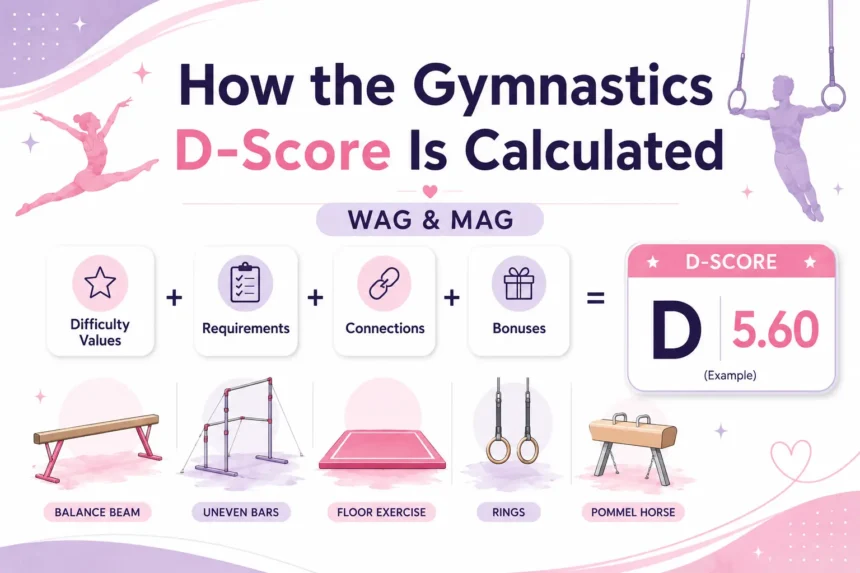
D-Score = Difficulty Values + Composition Requirements + Connection Value + Applicable Bonuses
For most MAG events:
D-Score = Difficulty Values + Element Group Credit + Event-Specific Connections and Bonuses
Vault is the major exception. Instead of building a D-Score from several elements, each recognized vault already has a predetermined Difficulty Value.
| D-Score Component | WAG | MAG |
|---|---|---|
| Counting elements | Up to 8 | 8 |
| Element Difficulty Values | Yes | Yes |
| Composition Requirements | Yes | No |
| Element Groups | No | Yes |
| Connection Value | Event-dependent | Event-dependent |
| Dismount-related credit/bonus | Yes | Yes |
| Other bonuses | Event-specific | Event-specific |
| Vault | Predetermined DV | Predetermined DV |
One of the biggest changes for the 2025–2028 cycle is that MAG routines now count eight elements instead of 10 on non-vault apparatuses.
What Is a Difficulty Value?
Before calculating the D-Score, it is important to understand Difficulty Value (DV).
A Difficulty Value is the numerical value FIG assigns to a recognized gymnastics element.
For non-vault elements, the current WAG and MAG systems use the following scale:
| Difficulty Rating | Difficulty Value |
|---|---|
| A | 0.10 |
| B | 0.20 |
| C | 0.30 |
| D | 0.40 |
| E | 0.50 |
| F | 0.60 |
| G | 0.70 |
| H | 0.80 |
| I | 0.90 |
| J | 1.00 |
For example:
C = 0.30
D = 0.40
E = 0.50
G = 0.70
The harder the recognized element, the more it contributes to the routine’s D-Score.
However, the gymnast does not simply add the value of every element performed. FIG limits which and how many elements can count.
For a deeper explanation of element ratings and the A–J system, see FIG Difficulty Values.
How Is the WAG D-Score Calculated?
For Women’s Artistic Gymnastics, Vault works differently from the other three events.
On Uneven Bars, Balance Beam and Floor Exercise, the D-Score is generally built from:
Difficulty Values + Composition Requirements + Connection Value + Bonuses
FIG counts up to the eight highest eligible Difficulty Values, including the dismount, subject to the apparatus-specific counting and composition rules.
The routine can also receive up to 2.00 points from Composition Requirements, plus applicable connection and bonus value.
1. Difficulty Values
Judges first identify the elements that are successfully recognized and determine which eligible elements count toward difficulty.
Imagine the eight counting elements in a routine are:
| Element Value | Points |
|---|---|
| E | 0.50 |
| E | 0.50 |
| D | 0.40 |
| D | 0.40 |
| D | 0.40 |
| C | 0.30 |
| C | 0.30 |
| C | 0.30 |
| Total DV | 3.10 |
The gymnast therefore earns 3.10 in element Difficulty Value.
But this is only the first part of the D-Score.
2. Composition Requirements
FIG also requires WAG routines to contain certain types of elements.
Uneven Bars, Balance Beam and Floor Exercise each have four Composition Requirements, worth up to:
0.50 each
Completing all four can therefore add:
4 × 0.50 = 2.00
The exact requirements are different on each apparatus.
On Balance Beam, for example, the requirements cover different types of dance, turning and acrobatic content.
If a gymnast fails to fulfill one 0.50 requirement, the intended D-Score can therefore drop by 0.50.
Composition Requirements are separate from the Difficulty Values of the skills themselves. An element may contribute its own DV while also helping satisfy a Composition Requirement.
For the full apparatus-by-apparatus rules, see FIG Composition Requirements.
3. Connection Value
Gymnasts can also increase their D-Score by directly connecting certain elements.
This is called Connection Value (CV).
The individual skills still receive their normal Difficulty Values, but a qualifying direct connection can earn additional difficulty credit.
Depending on the apparatus and the combination, a connection may add:
0.10, 0.20 or another amount specified by the event rules.
The connection must actually be completed according to the Code.
If a pause, extra swing, fall or other interruption breaks the connection, the gymnast may still receive the Difficulty Values of the individual elements but lose the planned Connection Value.
This is why routine construction matters. Two gymnasts can perform many of the same skills but receive different D-Scores because one uses more valuable combinations.
For a detailed look at eligible combinations and how extra credit is awarded, see how Connection Value works in gymnastics.
4. Series and Dismount Bonuses
Certain WAG events also provide additional difficulty bonuses.
On Balance Beam, qualifying sequences can receive Series Bonus in addition to applicable Connection Value.
The current WAG rules also provide a 0.20 dismount bonus on:
- Uneven Bars
- Balance Beam
- Floor Exercise
when the required conditions are met with a qualifying D-value or higher dismount.
These bonuses are added separately to the D-Score.
Other event-specific ways to increase difficulty are covered in FIG gymnastics bonuses explained.
Simple WAG D-Score Example
Imagine a Balance Beam routine receives:
| D-Score Component | Value |
|---|---|
| 8 counting elements | 3.20 |
| Composition Requirements | 2.00 |
| Connection Value | 0.30 |
| Series Bonus | 0.10 |
| Dismount Bonus | 0.20 |
| D-Score | 5.80 |
The calculation is:
3.20 + 2.00 + 0.30 + 0.10 + 0.20 = 5.80
The exact connection and bonus rules depend on the elements performed, but this example shows how the main parts of a WAG D-Score fit together.
How Is the MAG D-Score Calculated?
Men’s Artistic Gymnastics follows the same general principle, but the routine requirements are different.
On Floor Exercise, Pommel Horse, Still Rings, Parallel Bars and Horizontal Bar, the D-Score is generally built from:
Difficulty Values + Element Group Credit + Event-Specific Connections and Bonuses
Under the 2025–2028 MAG Code, eight elements are used to build the difficulty score on non-vault events.
On Floor Exercise, the eight counting elements are used.
On Pommel Horse, Still Rings, Parallel Bars and Horizontal Bar, the D-Score generally includes the best seven eligible counting elements plus the dismount.
1. Difficulty Values
As in WAG, every recognized MAG element has a Difficulty Value.
The same A–J scale applies:
A = 0.10 → B = 0.20 → C = 0.30 → D = 0.40 → E = 0.50
and continues through:
J = 1.00
Judges identify the recognized elements and determine which ones are eligible to count toward the D-Score.
Imagine a Floor Exercise with these eight counting elements:
| Element Value | Points |
|---|---|
| F | 0.60 |
| E | 0.50 |
| E | 0.50 |
| D | 0.40 |
| D | 0.40 |
| D | 0.40 |
| C | 0.30 |
| C | 0.30 |
| Total DV | 3.40 |
The gymnast earns:
3.40 in element difficulty
As in WAG, however, Difficulty Values are only one part of the complete D-Score.
2. Element Group Requirements
Instead of WAG’s Composition Requirements, MAG uses Element Group Requirements.
Element Groups encourage gymnasts to include different types of skills rather than constructing the entire routine from one movement family.
Floor Exercise has four Element Groups.
Pommel Horse, Still Rings, Parallel Bars and Horizontal Bar generally have:
Element Group I
Element Group II
Element Group III
Dismount Group IV
The exact movement families are different on each apparatus.
For example, Still Rings separates different swing and strength elements, while Horizontal Bar includes different swing and flight families.
Under the current rules, most Element Groups fulfilled by a D-value or higher element can receive:
0.50
A group fulfilled with an A-, B- or C-value element generally receives:
0.30
There are apparatus-specific exceptions. Element Group I, for example, can have its own treatment depending on the apparatus.
The Dismount Element Group also follows specific rules and is now capped at a maximum of 0.50 in Element Group credit.
Element Group credit can therefore make a large contribution to the final MAG D-Score.
3. Connection Value
Certain MAG apparatuses also reward direct combinations of difficult elements.
Connection rules are apparatus-specific and are especially important on events such as Floor Exercise and Horizontal Bar.
If two elements are directly connected in a way recognized by the Code, the gymnast can receive additional connection points on top of the individual Difficulty Values.
The elements retain their normal DVs, while the connection credit is added separately to the D-Score.
If the intended connection is interrupted or one of the required elements is not recognized, the gymnast may lose the connection credit even if the individual elements still receive DV.
4. Stick and Other Bonuses
MAG also includes event-specific bonuses that can increase the D-Score.
One important example in the 2025–2028 Code is the stick bonus.
A qualifying stuck dismount of at least C difficulty can earn:
+0.10
under the applicable conditions.
Qualifying salto vaults can also receive the bonus, while Pommel Horse is excluded.
This creates an unusual situation where the landing can sometimes influence both parts of the score.
A landing error normally affects the E-Score, but successfully sticking a qualifying MAG dismount can also add 0.10 to difficulty.
Simple MAG D-Score Example
Imagine a Floor Exercise receives:
| D-Score Component | Value |
|---|---|
| 8 counting elements | 3.40 |
| Element Group credit | 2.00 |
| Connection Value | 0.20 |
| Stick Bonus | 0.10 |
| D-Score | 5.70 |
The calculation is:
3.40 + 2.00 + 0.20 + 0.10 = 5.70
The exact Element Group, connection and bonus rules depend on the apparatus and skills performed, but the example shows how the main parts of a MAG D-Score combine.
Women’s vs. Men’s D-Score
WAG and MAG use the same general idea—rewarding the difficulty and construction of a routine—but the way they award requirement credit is different.
| D-Score Component | WAG | MAG |
|---|---|---|
| Difficulty Values | Yes | Yes |
| Counting elements | Up to 8 on UB, BB, FX | 8 on non-vault events |
| Composition Requirements | Yes | No |
| Element Group Requirements | No | Yes |
| Connection Value | Yes, depending on event | Yes, depending on event |
| Dismount-related credit/bonus | Yes | Yes |
| Other bonuses | Event-specific | Event-specific |
| Vault | Predetermined numerical DV | Predetermined numerical DV |
The easiest way to remember the difference is:
WAG → DV + Composition Requirements + Connections + Bonuses
MAG → DV + Element Groups + Connections + Bonuses
The basic final scoring system is still the same for both. For the bigger picture, see how FIG gymnastics scoring works.
Which Elements Count Toward the D-Score?
Performing an element does not automatically mean it will contribute to the D-Score.
FIG applies rules covering how many elements can count, repetition and whether an attempted skill is recognized.
Not Every Performed Element Counts
A gymnast may perform more elements than are ultimately used to calculate the Difficulty Value portion of the routine.
In WAG, up to eight eligible Difficulty Values count on Uneven Bars, Balance Beam and Floor Exercise.
MAG also uses eight counting elements on non-vault events under the current cycle, although the exact selection rules depend on the apparatus.
Extra elements can still be part of the routine without adding additional Difficulty Value to the counting total.
Repeated Elements
A gymnast generally cannot repeatedly perform the same element simply to collect its Difficulty Value several times.
In WAG, the same element normally receives DV only once.
MAG similarly restricts a repeated element with the same Code identification from contributing again to the D-Score.
There are additional apparatus-specific repetition rules, so repetition must be considered when constructing a routine.
Element Recognition
Attempting a difficult element does not automatically guarantee its intended Difficulty Value.
The gymnast must perform the element closely enough to the technical description in the Code for the D-Jury to recognize it.
If the technique does not meet the required definition, the element may:
- receive a lower recognized value,
- be recognized as another element,
- or receive no Difficulty Value.
This can also affect Composition Requirements, Element Groups, connections and bonuses that depended on the original skill.
A single poorly recognized element can therefore reduce several parts of the intended D-Score.
How Is the Vault D-Score Calculated?
Vault is the main exception to the usual FIG D-Score calculation.
Instead of combining several counting elements, requirements and connections, each recognized vault already has a predetermined Difficulty Value in the FIG Table of Vaults.
For example, if a vault has a Difficulty Value of:
5.4
its D-Score is:
5.4
The E-Score is then used to evaluate how well the vault is performed.
Because Vault uses its own difficulty scale, its numerical values should not be compared directly with the A–J values assigned to individual elements on other apparatuses.
For a complete explanation of Start Values, Difficulty Values, execution deductions and one-vault versus two-vault rules across different programs, see how gymnastics vault scoring works.
How the 2025–2028 Code Changed the D-Score
The basic D-Score concept remains the same, but the current Olympic cycle changed several rules that directly affect difficulty.
Women’s Artistic Gymnastics
WAG still counts up to eight Difficulty Values on Uneven Bars, Balance Beam and Floor Exercise.
The current cycle also includes:
- changes to the Difficulty Values of selected elements,
- updated connection and composition rules,
- continued 0.20 qualifying dismount bonuses on Uneven Bars, Balance Beam and Floor Exercise,
- and event-specific changes affecting how difficulty is constructed.
The basic WAG formula remains:
DV + Composition Requirements + Connections + Bonuses
Men’s Artistic Gymnastics
MAG received larger structural changes.
The most important was reducing the number of counting elements from:
10 → 8
on non-vault events.
Other D-Score changes include:
- revised Element Group credit,
- upgraded and downgraded element values,
- changes to apparatus-specific connection rules,
- the new 0.10 qualifying stick bonus,
- a 0.40 reduction in MAG Vault Difficulty Values at the beginning of the cycle,
- and a later 0.50 maximum for Dismount Element Group credit.
These changes place more importance on selecting valuable elements because fewer skills contribute to the final difficulty total.