When it comes to gymnastics rings, few skills look as clean and impressive as the front lever and back lever. These two static holds demand body tension, strength, and control. For athletes who are new to ring training or calisthenics, the big question usually arises: Which should you learn first?
What Is the Front Lever on Rings?
The front lever is one of the most recognizable strength holds in gymnastics and calisthenics.
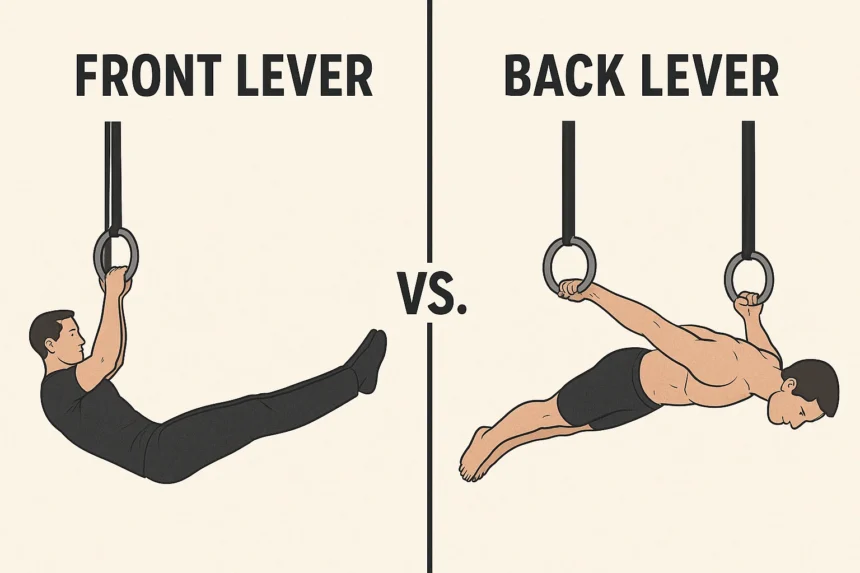
To perform it, the athlete hangs from the rings face-up, keeping the body locked in a straight line with arms extended overhead. The challenge is maintaining that horizontal position without letting the hips sag or the shoulders collapse.
On the rings, this becomes significantly harder than on a fixed bar. The instability forces the scapular stabilizers, lats, core, and rear delts to work overtime just to keep the body steady. The front lever is considered a high-level pulling strength move, and mastering it often takes many months, even years, of consistent training.
Progressions usually include: tuck lever → advanced tuck → straddle → one-leg → full front lever. Each step increases the lever arm and demands more from the lats and core.
What Is the Back Lever on Rings?
The back lever, though less flashy, is an equally respected milestone in ring training.
In this hold, the athlete rotates forward from a skin-the-cat position until the body is parallel to the ground, but this time facing downward. The arms remain straight, and the shoulders rotate to support the position.
Muscle engagement here shifts toward the chest, anterior delts, biceps (under stretch), and core. Because the back lever has a more mechanically favorable line of pull, many athletes find it comes faster than the front lever. It’s often used as an early straight-arm strength skill to condition the shoulders and build confidence with inverted positions.
Progressions mirror the front lever’s path: tuck back lever → advanced tuck → straddle → full back lever. The skin-the-cat drill is often the first step in preparing the shoulders safely.
Front Lever vs. Back Lever: At a Glance
| Feature | Front Lever | Back Lever |
|---|---|---|
| Body Position | Face-up horizontal hold | Face-down horizontal hold |
| Starting Point | Hang and lift into horizontal | Inverted hang, rotate forward into horizontal |
| Primary Muscles Worked | Lats, scapular retractors, abs, glutes, posterior chain | Chest, shoulders (anterior delts), biceps (extended position), core, lower back |
| Strength Focus | Pulling power + core tension | Straight-arm pushing strength + shoulder mobility |
| Code of Points Rating | “A” difficulty skill | “A” difficulty skill |
| Relative Difficulty | Considered harder for most athletes due to leverage demands | Usually learned sooner; slightly more forgiving mechanics |
Which Is Harder?
While difficulty varies by athlete, most coaches and gymnasts agree:
- The back lever is easier to achieve first. Its shorter learning curve makes it a common milestone within just a few months of training.
- The front lever is harder. It often requires significantly more pulling power and core control. Even strong athletes may take a year or more to master it.
On rings, both skills are tougher than on bars because of instability. The rings rotate freely, forcing stabilizing muscles in the shoulders, forearms, and core to work harder.
Why the Back Lever Feels Easier
Most athletes find the back lever more approachable. The reasons come down to biomechanics, leverage, and muscle recruitment.
1. Mechanical Advantage
In the back lever, the shoulders rotate into extension and can almost “lock” into place. This reduces the amount of active muscular effort required to hold the horizontal line. The front lever, on the other hand, demands constant pulling strength from the lats and scapular stabilizers to fight gravity, with no mechanical assistance.
2. Potential to Cheat the Position
The back lever allows small compensations that make it easier for beginners:
- Pressing the triceps into the lats for extra support.
- A slight arch in the lower back, which creates stability (though it isn’t perfect form).
The front lever is less forgiving—any sag in the hips or arch in the back quickly breaks the line and causes the hold to collapse.
3. Muscle Engagement Differences
The two skills recruit different dominant muscle groups:
- Front Lever: Primarily pulling muscles (lats, rear delts, scapular retractors), with heavy abdominal involvement to prevent the hips from dropping.
- Back Lever: More pushing-dominant muscles (chest, anterior delts) plus support from the lower back. Since these muscles are often better developed in beginners from push-ups, dips, or bench presses, athletes usually progress faster here.
Which Should You Learn First?
For most people, the back lever should come first.
- Entry is easier and safer. The skin-the-cat naturally sets up the back lever, making it less intimidating.
- Shoulder conditioning. It builds straight-arm strength and resilience, preparing the body for harder holds later.
- Confidence boost. Mastering it sooner provides a sense of progress and motivation to continue training.
The front lever should be treated as a long-term goal. It develops superior pulling power and has greater transfer to advanced skills, but it requires more patience and strength. Many coaches recommend conquering the back lever first, then working toward the front lever once the foundation is set.
Training Both for Balanced Strength
Although it’s tempting to focus on one, the truth is that the front lever and back lever complement each other beautifully:
- Front Lever: Builds pulling power and core compression.
- Back Lever: Strengthens shoulder extension, develops pushing balance, and builds confidence in inverted holds.
Together, they create balanced push–pull strength, improve straight-arm control, and pave the way for higher-level gymnastics and calisthenics elements like planches, crosses, or Maltese holds.
Conclusion
If you’re new to ring training, begin with the back lever. It’s more approachable, conditions the shoulders safely, and teaches you how to maintain body tension in a horizontal position. Once that foundation is secure, set your sights on the front lever.
Both are iconic, both are valuable, and training them side by side will give you the balanced strength that defines true mastery on the rings.