Neutral Deductions in Gymnastics: OOB, Time & Other Penalties
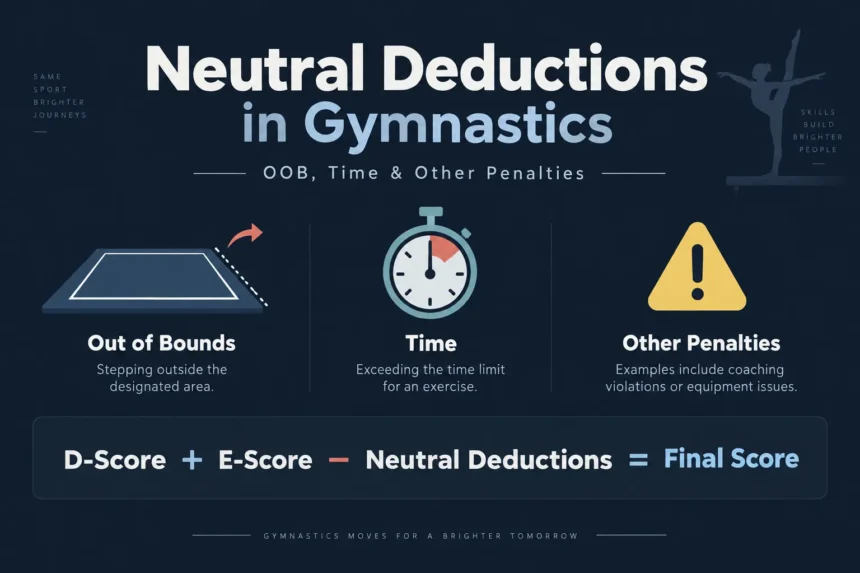
A gymnast’s difficulty and execution scores can add up to 14.200, yet the scoreboard may show 14.100. A separate penalty, often called a neutral deduction, can explain the difference.
Contents
In FIG elite artistic gymnastics, judges take certain penalties after combining difficulty and execution. Going out of bounds, exceeding a time limit and breaking particular equipment or competition rules can all reduce the final score this way.
This article covers Women’s Artistic Gymnastics (WAG) and Men’s Artistic Gymnastics (MAG) under FIG rules. USAG Development Program, Xcel and NCAA competitions use their own rules and penalty amounts.
Rules reviewed September 15, 2026, against the 2025–2028 FIG Codes, the WAG Help Desk (2nd edition, April 2026) and MAG Newsletter No. 4, whose rule clarifications took effect September 1, 2026.
What Counts as a Penalty in Gymnastics?
People sometimes use penalty to describe anything that lowers a gymnastics score. Judges, however, distinguish mistakes in performance, separate rule violations and difficulty that does not receive credit.
In FIG, difficulty is recorded in the D-Score, while performance quality is recorded in the E-Score.
| Reason for a lower score | Examples | How it affects the score |
|---|---|---|
| Execution deduction | Bent knees, a balance check, an uncontrolled landing or a fall | Reduces the FIG E-Score |
| Neutral deduction or separate penalty | Going out of bounds, exceeding a time limit or certain equipment and conduct violations | Is subtracted separately from the combined score |
| Lost difficulty or Start Value | An unrecognized skill, a broken connection or a missing requirement | Can reduce the D-Score in FIG, or the Start Value in domestic programs, under their respective rules |
For example, if a FIG gymnast breaks a planned connection, judges may withhold the connection points. That is difficulty the routine did not earn. An additional execution deduction depends on whether the gymnast also made a performance error, such as a balance check.
In USAG Development Program, Xcel and NCAA women’s gymnastics, missing required content can instead lower the Start Value—the score available before performance deductions. Those programs have their own rules; the penalty amounts below apply to FIG.
FIG documents use labels including penalty, neutral deduction and deduction from the Final Score. In this article, neutral deduction means a penalty applied separately from the D-Score and E-Score. The responsible official and procedure depend on the violation.
Where Neutral Deductions Fit in the Score
The E-Score begins from 10.0, then decreases as judges deduct for performance errors.
A neutral deduction is subtracted separately. For a routine with no separately awarded bonus, the calculation is:
D-Score + E-Score − Neutral Deductions = Final Score
| Component | Hypothetical score |
|---|---|
| D-Score | 5.800 |
| E-Score | 8.400 |
| Neutral deduction | −0.100 |
| Final score | 14.100 |
Use the gymnastics score calculator to see how a separate penalty changes the total. Enter the awarded difficulty and execution first, then put the penalty in “Separate penalties” so it is subtracted once.
The E-Score stays at 8.400. Subtracting the penalty from execution as well would count it twice. Where a separate bonus applies, such as an eligible men’s stick bonus, that credit must also be included once.
For the broader calculation, see how FIG combines difficulty, execution and penalties.
One movement can cause both an execution deduction and a separate penalty. A gymnast who takes an uncontrolled landing step beyond the Floor boundary can lose execution points for the step and receive a line penalty for going outside.
To check one situation, such as a hand or foot outside the floor boundary, by program and event, try the Deduction Finder.
How Out-of-Bounds Deductions Work
Going out of bounds, often abbreviated OOB, means touching beyond the permitted area. On Floor, the boundary line itself belongs to the competition area; touching the line is allowed, while touching beyond it can bring a penalty.
Floor Boundary Penalties
The basic amounts are the same in women’s and men’s FIG Floor Exercise:
| Contact outside the Floor boundary | Separate penalty |
|---|---|
| One foot or one hand | 0.10 |
| Both feet, both hands, a foot and hand, or another body part | 0.30 |
The penalty can apply when the gymnast lands outside or steps beyond the boundary afterward. Line judges report violations so the appropriate deduction can be taken from the final score. The rules appear in WAG Section 13 and MAG Section 10.
Separate exits can produce separate deductions. The WAG Help Desk describes a gymnast stepping out with one foot, returning inside, then stepping out again: that sequence receives two 0.10 penalties.
Touching outside with a knee falls under the 0.30 category. WAG Help Desk, Floor border examples.
To look up a line penalty, choose FIG women or FIG men, select Floor exercise and search “out of bounds.” The finder keeps separate penalties distinct from execution deductions.
Can Going Out of Bounds Also Affect Difficulty?
A boundary penalty alone does not automatically erase the difficulty of the skill just performed. However, starting the next element outside the Floor area can create another problem.
In WAG, taking off entirely outside the boundary means the element receives no Difficulty Value, Connection Value or Composition Requirement credit.
The Help Desk distinguishes this from taking off with one foot inside, or with both feet only partly outside, where difficulty can still be awarded despite a line penalty.
MAG likewise gives no difficulty value to an element initiated outside the Floor area, while execution is still evaluated.
These are two separate consequences: the line violation lowers the final score, and a skill that does not count can reduce difficulty.
Vault Landing-Corridor Penalties
FIG Vault has a marked landing corridor, the area in which the gymnast should land and establish control. Women’s and men’s rules use the same basic amounts: 0.10 for one foot or hand outside, and 0.30 for two feet/hands or another body part outside.
These line penalties are separate from deductions for an uncontrolled landing. A step can therefore affect execution and also carry the gymnast outside the corridor.
Vault also has rules for approaches, invalid attempts and two-vault competition. Those are covered in the guide to vault values, attempts and deductions.
The Men’s September 2026 Clarification
On a Floor dismount or Vault, a man may land with his feet apart and one foot outside the boundary, then bring his feet together outside while reaching his final standing position. The clarification specifies a 0.30 line deduction for that situation.
This provision took effect September 1, 2026. The same newsletter confirms that a gymnast can still receive a qualifying stick bonus on Floor or Vault while also receiving a line penalty. Landing control and boundary position are evaluated separately. MAG Newsletter No. 4.
Time Penalties: Routines, Late Starts and Falls
FIG uses several different clocks. The routine’s duration, the delay before starting and the time allowed after a fall are separate matters.
Exceeding the Routine Time Limit
Women’s Beam and Floor have a 90-second maximum. The Code specifies a 0.10 overtime deduction when the exercise reaches 91 seconds or more.
Men’s Floor has a 70-second maximum, with a larger penalty for a longer overrun:
| Event and overtime situation | Separate penalty |
|---|---|
| WAG Beam or Floor: 91 seconds or more | 0.10 |
| MAG Floor: more than 70 seconds, up to 2 seconds overtime | 0.10 |
| MAG Floor: more than 2 and up to 5 seconds overtime | 0.30 |
| MAG Floor: more than 5 seconds overtime | 0.50 |
For example, a men’s Floor routine lasting 73 seconds is three seconds over its limit and receives 0.30. The men’s time judge signals at 60 and 70 seconds. MAG Floor timing and deduction rules.
WAG elements performed after the 90-second limit can still receive difficulty credit and execution evaluation; the overtime penalty is taken separately.
On Beam, routine timing ends when the gymnast touches the landing mat after the dismount. On Floor, it ends with the final position. WAG Sections 12–13.
Starting Too Late—or Before the Signal
In both disciplines, the gymnast is expected to begin within 30 seconds of the green light or the designated judge’s signal. Exceeding the allowed starting time brings a 0.30 penalty.
There is also a 60-second cutoff, after which the right to begin is terminated. Starting without the required signal or while the red light is showing can instead result in a zero score. It is a different violation from starting late.
These procedures are specified in WAG Section 9 and MAG Article 2.4.
Taking Too Long to Continue After a Fall
A FIG fall normally costs 1.00 in execution. Exceeding the allowed recovery time can add a separate penalty.
| Situation | Recovery time without an additional penalty | Penalty for exceeding it and continuing |
|---|---|---|
| WAG Uneven Bars | 30 seconds | 0.30 |
| WAG Balance Beam | 10 seconds | 0.30 |
| MAG after a fall from the apparatus | 30 seconds | 0.30 |
The fall-time clock starts when the gymnast is back on their feet. On women’s Beam, this interruption is timed separately from the routine’s duration.
For example, a woman who falls from Beam and exceeds the permitted remount time can lose 1.00 from execution plus 0.30 separately. The 0.30 does not replace the fall deduction.
The Codes also set a 60-second limit for resuming after a fall. Waiting beyond the permitted cutoff ends the exercise; the gymnast cannot continue indefinitely by accepting another time penalty.
Other Separate Penalties: Attire, Conduct and Equipment
Boundary and time violations are only part of the picture. FIG also regulates competition clothing, conduct, music and apparatus use.
Attire and Conduct
Individual attire violations generally carry 0.30, but the permitted clothing and the procedure for applying the deduction differ between WAG and MAG. WAG examples include incorrect competition attire, jewelry or bandage color, and missing national identification.
Failing to acknowledge the judging panel before or after the exercise can also cost 0.30. MAG specifies that deduction for each failure to acknowledge the judge. Other conduct violations include returning to the podium after finishing or behaving in an undisciplined way.
These penalties are not necessarily repeated on every routine. For example, the MAG individual-attire penalty is applied once per competition session. Team clothing violations follow separate rules and may reduce the team total. The relevant procedures are set out in WAG’s general deduction table and MAG’s violation table.
Apparatus and Mat Violations
Common apparatus-related penalties include:
| Violation covered by the relevant FIG rules | Separate penalty |
|---|---|
| Using an unpermitted additional mat, or failing to use a required one | 0.50 |
| Moving an additional landing mat during the exercise contrary to the rules | 0.50 |
| Changing apparatus height without permission | 0.50 |
| Improper chalk use or damage to the apparatus | 0.50 |
| Rearranging or removing springboard springs | 0.50 |
| Presence of a spotter where one is not permitted | 0.50 |
WAG also lists 0.50 for placing the springboard on an unpermitted surface. The event rules determine which mats and arrangements are allowed.
Some violations make an attempt invalid. For example, failing to use the required safety collar correctly on a round-off-entry vault produces an invalid vault worth 0.00, rather than an ordinary half-point penalty. See WAG Sections 9–10 and MAG Articles 2.4 and 13.3.
Women’s Floor Music
WAG Floor has a 1.00 separate penalty for absence of music or music with words. Wordless use of the human voice as an instrument is permitted under the Code’s conditions.
That rule is separate from artistry and musicality deductions for how the gymnast performs to the music. WAG Floor music requirements.
Is Coach Assistance a Neutral Deduction?
The answer depends on the discipline and event. A coach helping complete a skill is also different from a coach standing nearby where spotting is permitted.
| Situation | How it is treated |
|---|---|
| WAG assistance on Bars, Beam or Floor | 1.00 separate penalty, with possible loss of difficulty and other credit |
| MAG assistance contributing to completion of a non-vault element | 1.00 execution deduction and the element is not recognized |
| Assistance during a vault | Can make the vault invalid and worth 0.00 |
The WAG Help Desk distinguishes assistance during a skill from assistance after it is completed. Help used to complete an element removes its difficulty and associated requirement, connection and bonus credit. Its Uneven Bars example of assistance after completion allows Difficulty Value and Composition Requirement credit, but awards no Connection Value or dismount bonus.
In the Help Desk’s examples of assistance used to complete an element, judges do not add an execution fall deduction for that same assisted action.
Non-permitted spotter presence can create an additional 0.50 penalty. However, permitted spotting positions and incidental contact have their own rules; simply seeing a coach near a gymnast does not establish that assistance occurred.
These distinctions appear in the WAG Help Desk’s assistance examples and MAG’s execution and vault rules.
Frequently Asked Questions
Does a Neutral Deduction Change the E-Score?
No. It is subtracted separately. The E-Score can also be lower because of a related performance error, but the neutral penalty itself is not deducted from execution again.
Is a Fall a Neutral Deduction?
An ordinary FIG fall is an execution deduction. A related violation, such as exceeding the permitted remount time or touching outside the Floor boundary, can create an additional separate penalty.
Does a Line Judge Decide the Whole Score?
No. Line judges report boundary violations. Difficulty and execution are evaluated by their respective judging panels, and the separate penalties are applied under the competition’s judging procedures.
Are These the Same Penalties Used in USAG, Xcel and NCAA?
No. This article explains FIG international artistic gymnastics. Domestic programs have different deduction tables and procedures, so these values should not be transferred automatically to a USAG, Xcel or NCAA meet.
What to Remember
A lower gymnastics score can come from execution errors, separate penalties or difficulty the routine did not earn. A neutral deduction belongs to the separate-penalty category and does not reduce the E-Score again.
Checking the event and the specific rule explains whether one mistake affects execution, difficulty, a separate penalty, or more than one part of the score.