How to Do a Back Walkover: Steps, Drills and What Coaches Look For
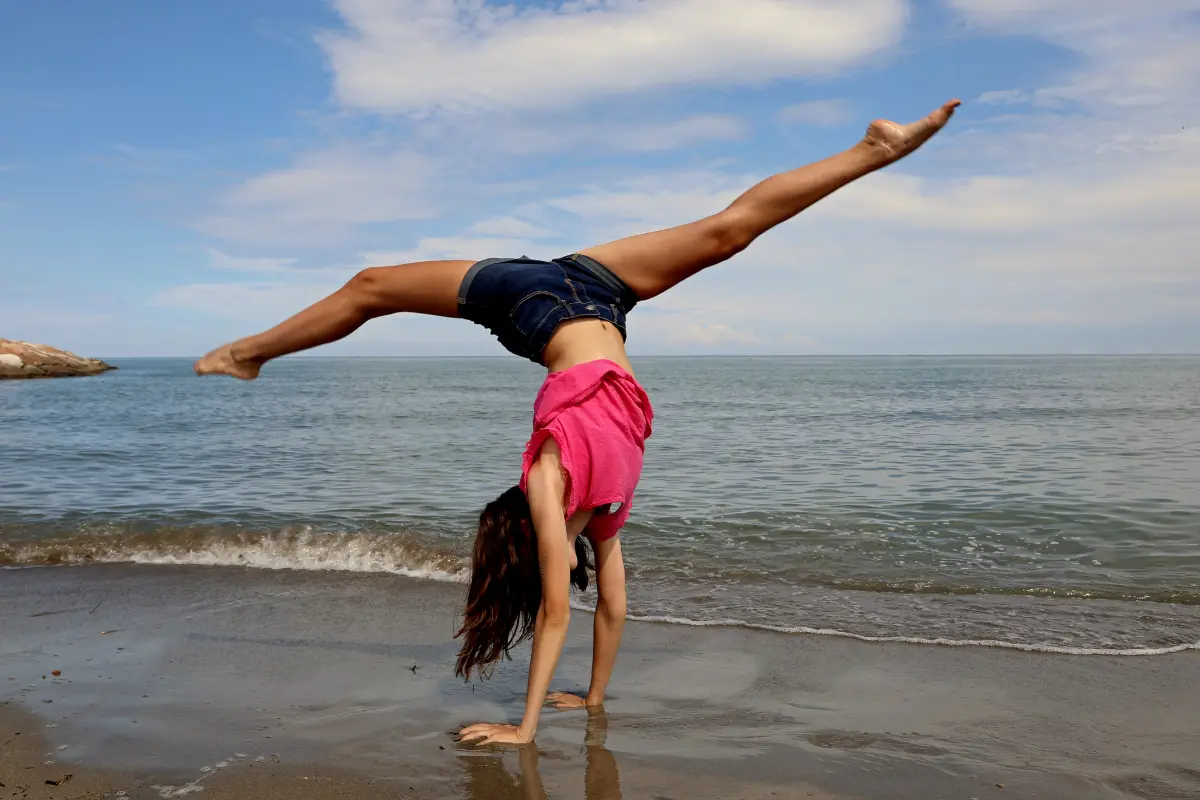
A back walkover is a slow, controlled skill that moves backward through hand support. The gymnast lifts one leg, reaches back to the floor, passes through a split handstand and steps down one foot at a time. It looks like a bridge and a kickover joined together, but in a good walkover there is no stop in the bridge: the leg lift, the reach and the step-over are one continuous movement.
Contents
- The Back Walkover at a Glance
- Back Walkover, Bridge Kickover and Back Handspring
- What a Gymnast Needs Before a Back Walkover
- How to Do a Back Walkover, Step by Step
- Drills Coaches Use
- How Judges Score a Back Walkover
- Common Mistakes and How Coaches Fix Them
- Back Pain Needs Attention
- From Floor to Beam
- Common Questions
- Final Takeaway
- Main Sources
In USA Gymnastics’ compulsory program, the back walkover is part of the Level 4 floor routine and one of the acro choices on Level 5 beam. It takes a flexible upper back and shoulders, straight-arm strength and the confidence to move backward without seeing the floor, so gymnasts learn it with a coach who can spot the first attempts.
The Back Walkover at a Glance
| Phase | What happens | What to aim for |
|---|---|---|
| Start | Stand tall, one leg pointed in front, arms straight up by the ears | Long body, tight stomach |
| Lift and reach | The front leg lifts as the arms and chest reach backward | One continuous action; the leg doesn’t drop |
| Hands | Both hands reach the floor together, shoulder-width apart | Straight arms, shoulders open |
| Split handstand | The legs pass over the top in a split | A wide split (150° or more in the compulsory routines) |
| Step-down | The lifted leg lands first, then the other | Finish standing or in a lunge, arms up |
Back Walkover, Bridge Kickover and Back Handspring
| Skill | Defining feature | Why the difference matters |
|---|---|---|
| Bridge kickover | Starts from a bridge already made on the floor | Separates the bridge from the kick over the hands; a common step toward the walkover |
| Back walkover | One continuous movement from standing, through a split handstand, to a step-down | The leg lift and the backward reach must happen together |
| Back handspring | A jump backward onto the hands, with flight, landing on two feet | Needs power and timing rather than a slow, flexible pass through the hands |
A bridge kickover is a stepping stone to the walkover, not the finished skill, and a back handspring is not a fast walkover. Our guide to walkovers, handsprings and aerials shows how to tell them apart.
What a Gymnast Needs Before a Back Walkover
- A good bridge: arms straight and shoulders pushed over the hands, not a bridge bent only at the lower back. Our back bridge guide covers it.
- A bridge kickover: from a bridge, kicking one leg over to a step-down.
- A split handstand: a handstand held with the legs split, so the middle of the walkover feels familiar.
- Wrists and shoulders that can take the weight: see our guide to wrist strengthening.
A coach judges readiness from the whole picture: flexibility alone isn’t enough, and neither is strength. A gymnast with a deep bridge may still bend her arms in the middle of the walkover; another may be strong but not yet comfortable moving backward.
How to Do a Back Walkover, Step by Step
Learn these steps with a coach spotting, on a mat, before trying them alone.
- Stand tall. Point one foot in front, weight on the back leg, arms straight up by the ears.
- Lift and reach together. Start lifting the front leg as you push the hips slightly forward and reach the arms and chest back. Keep the leg rising the whole time; don’t let it lift, drop and lift again.
- Find the floor. Keep the head between the arms and look back for the floor. Place both hands down at the same time, shoulder-width apart, fingers pointing back toward the feet.
- Pass through the split handstand. Push through straight arms and let the lifted leg carry over the top, then the other, with the legs in a wide split.
- Step down. The lifted leg lands first, close to the hands, then the other. Push the floor away and stand up with the arms by the ears, finishing in a lunge or standing.
Drills Coaches Use
Coaches choose the drills and set up the mats; the examples below show what each one trains.
- Bridge kickovers: practice the step-over part on its own.
- Walkovers down an incline mat: the slope makes the hands reach the floor sooner, so the gymnast can feel the whole movement.
- Walkovers over a barrel or rounded mat: support the back through the middle, usually with a spot.
- Stand-to-bridge with a leg lift: trains the continuous leg lift and the reach back, finishing in a bridge.
- Split handstand holds and kick-throughs: build the split and the push through the shoulders.
How Judges Score a Back Walkover
In the current compulsory routines (2021–2029, revised July 2025), the back walkover with a 150° split is worth 0.40 on Level 4 floor and 0.60 when chosen on Level 5 beam. The listed faults are the same:
| Fault | Deduction |
|---|---|
| No continuous leg lift (the leg lifts then drops, stops, or lifts after the arch has begun) | Up to 0.10 |
| Hands placed staggered or one after the other | 0.10 |
| Split less than 150° | Up to 0.20 |
Common Mistakes and How Coaches Fix Them
| Mistake | What it looks like | Usual fix |
|---|---|---|
| Leg drops before the reach | The leg lifts, falls, then kicks up again | Practice the lift and reach together in stand-to-bridge |
| Stopping in a bridge | The gymnast arrives in a bridge and kicks over separately | Incline-mat walkovers to feel the movement as one piece |
| Bent arms | Elbows give as the hands land | Straight-arm strength; more support or a spot until it holds |
| Hands land one at a time | One hand reaches the floor before the other | Reach back with both arms by the ears |
| All the bend in the lower back | Shoulders stay closed; the low back does the work | Shoulder flexibility and bridges with the shoulders over the hands |
Back Pain Needs Attention
The American Academy of Orthopaedic Surgeons explains that spondylolysis, a stress injury in the lower spine, is more likely in young athletes whose sport involves frequent overstretching (hyperextension) of the lower back, such as gymnastics. Pain while bending backward is not normal flexibility work.
Stop the painful activity and tell the coach. Back pain that persists or keeps coming back needs a medical check; new weakness, numbness or trouble walking needs prompt attention.
From Floor to Beam
A floor walkover doesn’t transfer straight to a beam. The narrow surface changes where the hands and feet land and what happens after a wobble, so coaches move the skill up gradually: a line on the floor, a floor beam, then a low beam, with mats and a spot. Don’t practice on a bench or improvised raised board at home.
Common Questions
What level is a back walkover in gymnastics?
In USA Gymnastics compulsories it is part of the Level 4 floor routine, and one of the acro choices on Level 5 beam.
Is a back walkover harder than a back handspring?
They are hard in different ways. The walkover needs more flexibility and slow control; the back handspring needs power and timing. In the USAG compulsory floor routines, the back handspring (flic-flac) appears first, at Level 3, and the back walkover at Level 4.
What is the difference between a back walkover and a bridge kickover?
A bridge kickover starts from a bridge already made on the floor. A back walkover goes from standing through the hands and over in one continuous movement.
How long does it take to learn a back walkover?
There is no set time. It depends on flexibility, strength and confidence, and on how often the gymnast trains with a coach.
Final Takeaway
A back walkover goes from standing, through a split handstand, to a step-down in one continuous movement: lift the leg as you reach back, place both hands together with straight arms, pass through a wide split and step down one foot at a time.
Learn it with a coach, after a straight-arm bridge, a bridge kickover and a split handstand. Judges look for a continuous leg lift, hands placed together and a split of at least 150°. Back pain is a reason to stop and get it checked.
Main Sources
- USA Gymnastics Women’s Development Program Compulsory Exercises, 2021–2029, revised July 2025: Level 4 floor table of penalties
- USA Gymnastics compulsory replacement pages, July 2023: Level 3 and 4 floor, Level 5 beam
- American Academy of Orthopaedic Surgeons (OrthoInfo): Spondylolysis and Spondylolisthesis