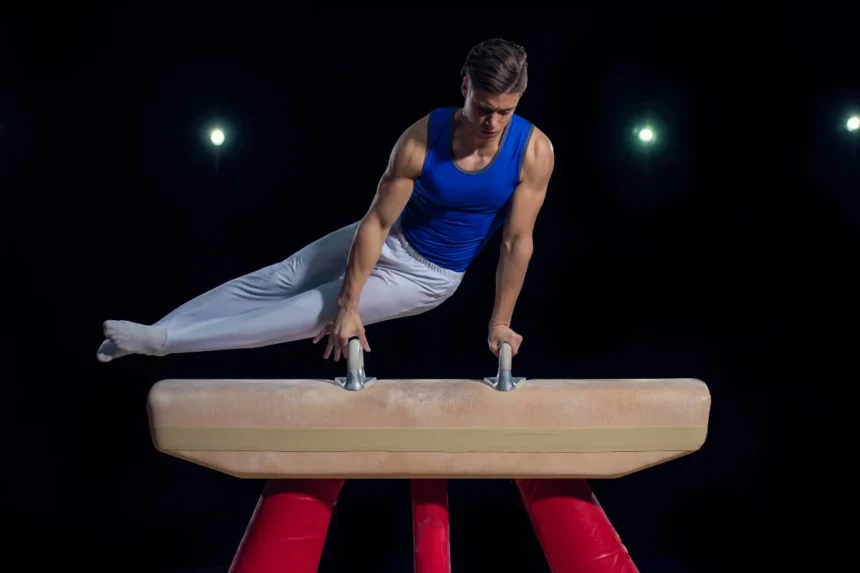
Pommel horse has a reputation for being one of the most confusing events in men’s gymnastics. The skills don’t look like flips or releases, and to beginners, it can feel like everyone is just “spinning in circles.”
- What Are Turning Skills on Pommel Horse?
- Why the Mushroom Matters in Pommel Horse Training
- 1. Spindle: The First True Turning Skill
- 2. Czech (Check): Turning While Staying Centered
- 3. Stockli: Same Direction, Different Hand Placement
- 4. Russian: Hands and Body Turn Together
- How These Four Skills Fit Together
At its core, pommel horse is built around turning skills. These turns allow the gymnast to change direction, change body position, and eventually link long, flowing combinations across the horse.
What Are Turning Skills on Pommel Horse?
Turning skills are movements where the gymnast rotates the shoulders and hips around the hands while maintaining continuous support on the apparatus. Unlike swings on bars or flips on floor, pommel horse turns stay in contact with the horse at all times.
Most turning skills are first learned on the mushroom, where gymnasts can slow things down and isolate the mechanics before transferring them to the horse.
Why the Mushroom Matters in Pommel Horse Training
On the full pommel horse, beginners often move too fast to understand what’s happening. The mushroom slows everything down.
Coaches frequently have gymnasts walk skills on the mushroom rather than swing them. This allows athletes to:
- See exactly where the hands are placed
- Feel how the shoulders rotate
- Learn how balance shifts during a turn
- Understand cause and effect instead of guessing
This is why even elite gymnasts return to the mushroom, it reinforces clean mechanics that carry over to high-level routines.
In this guide, we’ll break down four foundational mushroom skills: the spindle, the check, the Stockli, and the Russian.
1. Spindle: The First True Turning Skill
The spindle is usually the first turning skill taught on the mushroom because it introduces the single most important concept in pommel horse turning:
The direction of the circle and the direction of body rotation are opposite.
This idea, called counter-rotation, is the foundation of many advanced turns later on. Until a gymnast understands this relationship, most turning skills feel random or forced.
What That Means in Practice
During a spindle:
- If the legs circle clockwise
- The shoulders and torso rotate counterclockwise
This opposition is what actually creates rotation around the apparatus. Without it, the gymnast is just circling in place with no directional change. You can think of the spindle as teaching the body how to “steer” the circle instead of letting the circle control the body.
Breaking the Spindle Into Quarters
A full spindle consists of four quarter turns, but no coach teaches it at full speed right away. Instead, the gymnast learns it by walking around the mushroom, isolating the hand placements and shoulder direction.
Step by step:
- Start in a normal rear support position
- As the legs cross, the first hand returns to rear support
- The second hand turns 90 degrees, forcing the shoulders to rotate
- The gymnast continues walking until rear support is reached again
That completes one quarter spindle.
- Two quarters = half spindle
- Four quarters = full spindle
This breakdown allows the gymnast to feel when the turn happens rather than guessing at it during fast circles.
Key Coaching Focus
- Whatever direction the legs travel, the shoulders rotate the opposite way
- Hand placement creates the turn, not speed or leg power
- The goal is spatial awareness before amplitude
The spindle teaches gymnasts how to understand direction change instead of forcing it, an essential skill before progressing to Russians and advanced turns.
2. Czech (Check): Turning While Staying Centered
The Czech, often called the check, is a turning skill defined less by rotation size and more by control of the center of gravity.
While it can look similar to other turning elements, it feels very different when performed correctly.
How the Check Is Performed
To make the mechanics clear, coaches again teach this skill by walking:
- As the feet cross, the first hand moves slightly forward into the top quarter of the mushroom
- The body circles around the mushroom
- The second hand returns, placing the gymnast in front support at a 90-degree angle
- The feet continue walking
- The second hand moves back into rear support
- The gymnast finishes in front support, completing a half turn
The motion is smooth and continuous, with no sudden weight shifts.
Why the Check Feels Different
- The center of gravity stays directly over the mushroom at all times
- At the 90-degree front support position, the shoulders lean slightly in front of the hands
- The body swings naturally from front support to rear support and back out
This makes the check feel more controlled and compact than other turns.
Common Mistake
The most frequent error is letting the hips drift away from the mushroom. When this happens:
- The shoulders lose support
- Rotation slows or stops
- Balance disappears immediately
The Czech teaches gymnasts how to turn without sacrificing control, which is critical for clean pommel horse work later on.
3. Stockli: Same Direction, Different Hand Placement
The Stockli is often confused with the Czech because both rotate in a similar direction. The difference is not the circle—it’s the hand placement and shoulder position.
How the Stockli Works
As with the previous skills, the Stockli is introduced by walking:
- The gymnast walks around the mushroom
- The first hand stays in a normal placement
- The second hand steps backward into the back quarter of the mushroom
- On the next circle, the body completes a 90-degree turn into rear support
- The body continues circling another 90 degrees
- The gymnast returns to front support, completing the Stockli
Key Difference From the Czech
- In the Stockli, the shoulders move behind the hands when reaching rear support
- In the Czech, the shoulders stay more forward and centered
This shoulder-back position changes how momentum flows through the skill.
Coaching Cue
If the gymnast feels like they’re “sitting back” slightly into the turn, they are likely performing a Stockli, not a check.
The Stockli teaches gymnasts how to extend rotation without killing momentum, which becomes important when linking turns together on pommel horse.
4. Russian: Hands and Body Turn Together
The Russian is a major shift from the previous skills.
Unlike spindles, Czechs, and Stocklis, where hand direction and body direction may oppose each other, in the Russian, the hands and the body rotate together in the same direction.
This makes the Russian feel more continuous and rhythmic, but also more demanding on shoulder strength and precision.
Learning the Russian slowly
To teach it properly, coaches again slow the movement down and walk the gymnast around the mushroom:
- The gymnast walks in a full circle.
- When the second hand comes down, it steps into the back quarter.
- The front hand then turns 90 degrees into the front quarter.
- The second hand cycles another 90 degrees.
- The front hand follows with another 90-degree turn.
- Finally, the back hand completes the last 90-degree turn.
Those four hand turns create a full Russian circle.
What makes or breaks the Russian
Throughout the entire skill, the gymnast’s shoulders stay in front of the hands. This forward shoulder position keeps pressure on the mushroom and prevents collapsing or drifting off-center.
Again, balance rules everything. If the center of gravity moves off the top of the mushroom, the Russian falls apart immediately.
How These Four Skills Fit Together
Each mushroom turning skill develops a different piece of pommel horse mastery:
- Spindle → how to change direction
- Czech → how to turn without losing balance
- Stockli → how to keep momentum alive
- Russian → how to turn as one unified system
Together, they form the technical foundation of modern pommel horse turning.