Men and women can both finish an elite gymnastics routine with a score such as 14.200. The calculation follows the same basic formula, but the skills, routine requirements and performance standards behind that number differ.
D-Score + E-Score − Penalties = Final Score
The D-Score reflects the difficulty and required content judges count. The E-Score measures how well the gymnast performs the routine. Both women and men start the execution portion from 10.0 and lose points for mistakes.
This article compares Women’s Artistic Gymnastics (WAG) and Men’s Artistic Gymnastics (MAG) under the senior FIG rules for 2025–2028, including updates in force on September 13, 2026.
MAG vs WAG Scoring at a Glance
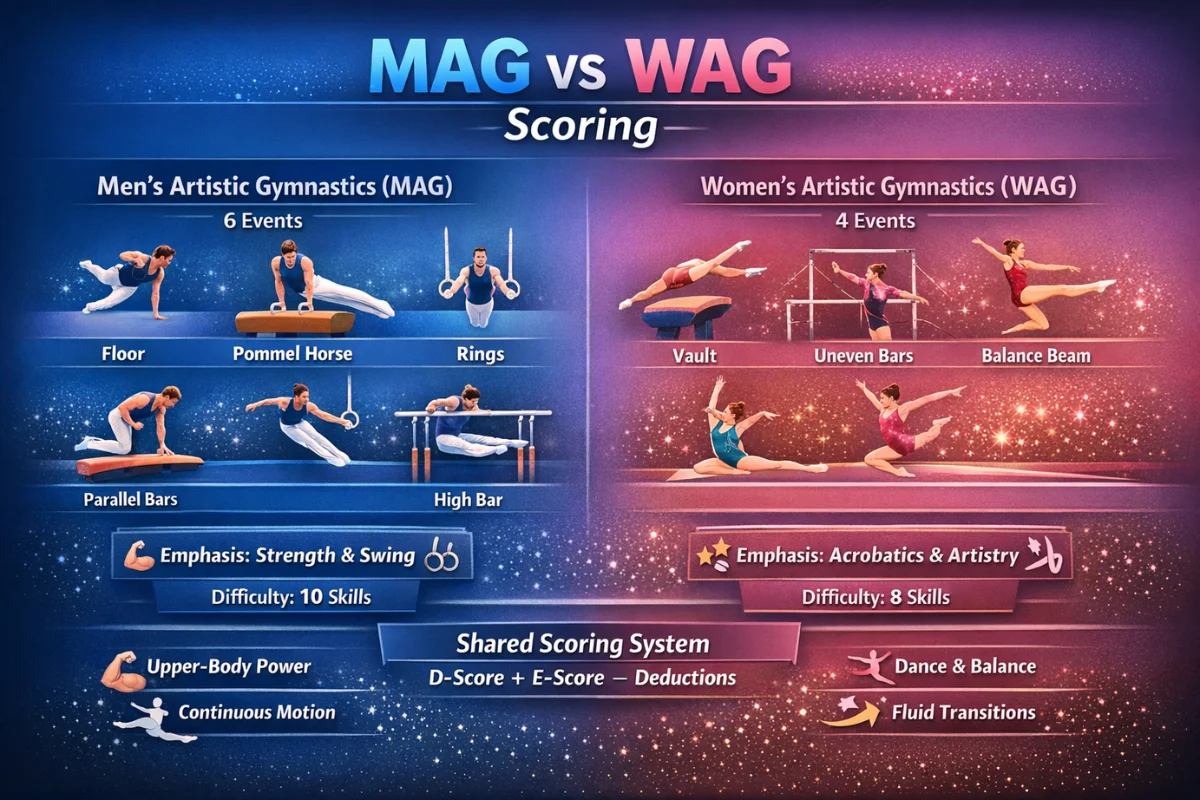
The first difference is the apparatus. Women compete on four events; men compete on six.
| Scoring feature | WAG | MAG |
|---|---|---|
| Events | Vault, uneven bars, balance beam and floor | Floor, pommel horse, still rings, vault, parallel bars and horizontal bar |
| Final-score formula | D + E − penalties | D + E − penalties |
| Difficulty score | Open-ended | Open-ended |
| Execution score | Starts from 10.0 | Starts from 10.0 |
| Counting skill values | Up to eight on bars, beam and floor, subject to apparatus rules | Eight on the five non-vault events, subject to apparatus rules |
| Required routine content | Composition Requirements | Element Groups |
| Floor music | Required | No music |
| Floor time limit | 90 seconds | 70 seconds |
| Vault difficulty | Assigned value for the vault performed | Assigned value for the vault performed |
| All-around total | Four event scores added together | Six event scores added together |
For either discipline, a hypothetical routine with a 5.80 D-Score, an 8.40 E-Score and a 0.10 separate penalty receives:
5.80 + 8.40 − 0.10 = 14.10
The gymnast does not start the whole routine from 10.0. That starting number belongs to execution; difficulty is added separately. The beginner’s explanation of FIG scoring covers how those parts fit together.
How Women and Men Build Their D-Scores
On the non-vault events, both disciplines add the values of counting skills and other difficulty credit. Judges also check whether the routine includes the required variety of movements.
The biggest difference is how that required content earns points.
Women: Four Composition Requirements
On uneven bars, beam and floor, women have four Composition Requirements (CR). Each completed requirement adds 0.50, for a maximum of 2.00.
These requirements describe the types of gymnastics that must appear in the routine. For example, a bars routine needs a flight element in which the gymnast releases and catches the same bar. Floor includes a dance passage and specified types of tumbling.
Each requirement has its own conditions. Performing several difficult skills does not automatically fulfill all four.
The simplified women’s calculation is:
Counting skill values + Composition Requirements + connections + applicable bonuses
Beam and floor also require a mix of dance and acrobatics among their eight counting elements: at least three of each. Dance elements include leaps, jumps and turns; acrobatic elements include movements such as handsprings and flips. These provisions appear in Sections 7, 12 and 13 of the WAG Code of Points.
Men: Credit for Element Groups
Men’s non-vault events organize skills into movement families called Element Groups (EG). A gymnast earns group credit by including qualifying skills from the required families.
On rings, for example, the groups distinguish swinging skills, strength holds, swings into strength holds and dismounts. A dismount is the skill used to finish the routine and leave the apparatus.
Unlike a women’s Composition Requirement, men’s group credit can depend on the difficulty of the skill used to fulfill it.
For regular groups other than Group I, a counting A, B or C earns 0.30, while a D or harder earns 0.50. Group I receives 0.50 for a recognized counting element regardless of its difficulty. The separate dismount group follows its own rules.
The simplified men’s calculation is:
Counting skill values + Element Group credit + connections + applicable bonuses
The practical effect can be larger than the skill upgrade alone. Suppose a counting C is replaced by a D, and that upgrade raises one eligible regular group’s credit from 0.30 to 0.50.
The gymnast gains 0.10 in skill value plus 0.20 in group credit, or 0.30 altogether, assuming nothing else changes. The underlying rules are in Article 7.2 of the MAG Code of Points.
The Same Difficulty Letters Do Not Make Skills Equivalent
Both disciplines use the same numerical letter scale: an A contributes 0.10, a D contributes 0.40 and an E contributes 0.50, continuing through the higher letters.
A D-rated beam skill and a D-rated rings skill therefore contribute the same individual difficulty value when counted. They still involve different techniques and physical demands, and each belongs to its own apparatus table.
The letter describes the value assigned under that event’s rules. It is not a universal measure of how difficult the movement would be for every gymnast.
Connections and Dismount Credit Also Differ
Women and men can earn extra difficulty for certain linked skills, but the combinations that qualify depend on the event. A connection worth bonus on one apparatus should not be assumed to earn the same credit elsewhere.
Women’s bars, beam and floor can also award a 0.20 bonus for a D-or-higher dismount without a fall, subject to the apparatus conditions. On floor, the routine needs more than two tumbling lines, and the final line must be completed without a fall.
Men’s pommel horse, rings, parallel bars and horizontal bar instead have separate Dismount Element Group credit. Since January 1, 2026, this credit equals the dismount’s difficulty value up to a 0.50 maximum. The dismount still receives its normal individual skill value. The change is confirmed in MTC Newsletter No. 3.
Men also have a 0.10 stick bonus for qualifying C-or-harder dismounts on floor, rings, parallel bars and horizontal bar. Pommel horse is excluded. “Sticking” means meeting the rules for a controlled landing without corrective foot movement; vault has its own eligibility provision.
The full WAG and MAG D-Score calculation explains these components without treating the two systems as interchangeable.
How Execution and Artistry Are Judged
Both disciplines calculate execution from the same starting point:
E-Score = 10.00 − execution deductions
The general deduction scale is also familiar in both:
| Error category | Typical FIG deduction |
|---|---|
| Small | 0.10 |
| Medium | 0.30 |
| Large | 0.50 |
| Fall | 1.00 |
These categories do not mean every mistake has all four possible values. Judges apply the specific rule for the error and apparatus.
Different Apparatus Create Different Technical Checks
On beam, a gymnast can lose execution points through balance checks, pauses and landing errors. On rings, judges examine the position and stability of strength elements, including whether required holds last a full two seconds.
Bars routines place considerable emphasis on handstands, swing and clean catches, but uneven bars, parallel bars and horizontal bar each have their own technical rules.
Even a familiar landing step has discipline-specific guidance. The women’s general table uses more than shoulder width as the guideline for a very large step or jump.
The men’s table defines a small step or hop as no more than one foot-length; a larger movement receives the larger deduction. The details appear in the WAG landing guidance and Section 9 of the MAG Code.
Women Have Specific Beam and Floor Artistry Deductions
Women’s beam and floor evaluation includes defined artistry and presentation criteria. Judges consider matters such as posture, rhythm, variety and how fully the gymnast uses her body in the movements. On floor, the relationship between the choreography and music also matters.
These deductions affect the E-Score. They are separate from the Composition Requirements that add points to the D-Score.
Men are also judged on body position, control, rhythm and the quality of movement. Their routines do not use the same beam and musical floor artistry checklists, but a men’s routine is still expected to look controlled and well performed throughout.
A routine without a fall can therefore lose substantial execution points in either discipline. The apparatus-by-apparatus E-Score guide explains the individual deductions.
Women’s Floor vs Men’s Floor
Floor is shared by both disciplines, but its routine requirements make the performances look different.
| Floor feature | Women | Men |
|---|---|---|
| Maximum duration | 90 seconds | 70 seconds |
| Music | Required | None |
| Difficulty content | Tumbling and dance skills | Acrobatic skills and required non-acrobatic content |
| Required-content system | Four Composition Requirements | Four Element Groups |
| Presentation | Choreography, expression, rhythm and musical connection | Control, rhythm, transitions and use of the floor |
Women’s floor combines tumbling with dance and choreography performed to music. Dance affects more than the appearance of the routine: qualifying leaps, jumps and turns can contribute difficulty, while the dance passage fulfills one of the Composition Requirements.
Men’s floor places greater emphasis on tumbling, alongside non-acrobatic elements such as balances and strength movements. It does not require the same set of counting dance elements as women’s floor.
However, men cannot treat everything between tumbling passes as unjudged preparation. Long pauses, simple repositioning steps and poorly controlled transitions can affect the score. The current rules also require variation in corner transitions, clarified in the men’s December 2025 newsletter.
The absence of music changes the presentation requirements; it does not remove the expectation of a complete, controlled routine.
How Women’s and Men’s Vault Scoring Differ
For both disciplines, each recognized vault has a predetermined Difficulty Value. Judges add its execution score and subtract any separate penalties.
Vault difficulty + E-Score − penalties = individual vault score
The women’s and men’s vault tables are separate, and their bonus provisions differ. Two vaults that look similar should not automatically be assigned the same difficulty across the two Codes.
One Vault or a Two-Vault Average
At the Olympics, the team and all-around events use one vault score per gymnast. Gymnasts seeking a place in the vault final must perform two qualifying vaults in qualification, and finalists perform two again.
The vault event result uses the average of the two scores, rather than selecting the better score. The vaults must meet the discipline’s rules for the required variety.
The Women’s Two-Vault Bonus
Women can receive 0.20 added to the two-vault average when they perform a qualifying pair with flips in opposite directions, one forward and one backward, during the flight after leaving the table. Both vaults must be completed without a fall and satisfy the different-group requirement.
For example, an average of 14.200 becomes 14.400 when the pair earns the bonus. It is added once to the average, not separately to each vault. The conditions are explained in Section 10 of the WAG Help Desk.
The Men’s Stick Bonus
Men can earn 0.10 for an eligible stuck vault containing a salto, the gymnastics term for a flip. This bonus belongs to the individual vault evaluation.
A stuck landing does not automatically mean perfect execution. Other faults, such as poor body position or insufficient preparation for landing, can still receive deductions.
The guide to vault values, averages and bonuses covers the full event calculation.
Can Men’s and Women’s Scores Be Compared Directly?
A score tells how a performance was evaluated under its own rules. A higher number on one apparatus does not establish that the routine was universally harder or better than a routine on another apparatus.
That caution applies within each discipline as well. A rings score and a pommel horse score come from different skill tables and technical expectations.
All-around totals have another obvious difference: men add six event scores, while women add four. In a hypothetical example, an average of 14.000 per event produces 84.000 for a man and 56.000 for a woman. The different totals come entirely from the number of events.
Scores from different Code cycles also need context. At the start of 2025–2028, men moved from ten counting elements to eight, floor shortened to 70 seconds, and all men’s vault difficulty values dropped by 0.40. The federation outlines those changes in its official MAG Code overview.
A lower D-Score under a new Code does not necessarily mean the gymnast performed an easier routine. The rules used to value it may have changed.
Frequently Asked Questions
Is a fall worth the same deduction for men and women?
Yes. Under FIG artistic gymnastics rules, the fall deduction is 1.00 in both disciplines. The mistake may also affect difficulty if a skill, connection or requirement does not receive its intended credit.
Are women judged on artistry while men are judged only on difficulty?
No. Both receive separate difficulty and execution scores. Women have specific beam and floor artistry criteria, while men also lose points for technical errors, poor body positions, lack of control and relevant presentation faults.
Can men include leaps or dance-like movements on floor?
Yes. Men’s floor can include jumps, leaps and other choreographed movements. Certain approved jumps or leaps can also fulfill a specific floor requirement. The routine does not use the same dance requirements or musical evaluation as women’s floor. The latest refinements appear in the July 2026 MAG newsletter.
Does this comparison apply to NCAA, USAG Development Program or Xcel meets?
This article explains FIG elite scoring. Domestic and collegiate programs can use different starting values, deductions, requirements and modifications. Their rules should be checked separately.
The Bottom Line
Women and men share the same overall scoring formula: difficulty plus execution, minus separate penalties. The differences come from the apparatus, the required types of skills, the available bonuses and the standards used to judge each performance.
To understand a score, first identify the event and discipline. Then look at what difficulty the gymnast earned and how well the routine was performed.