What Injuries Are Most Common in Female Gymnasts— and Why?
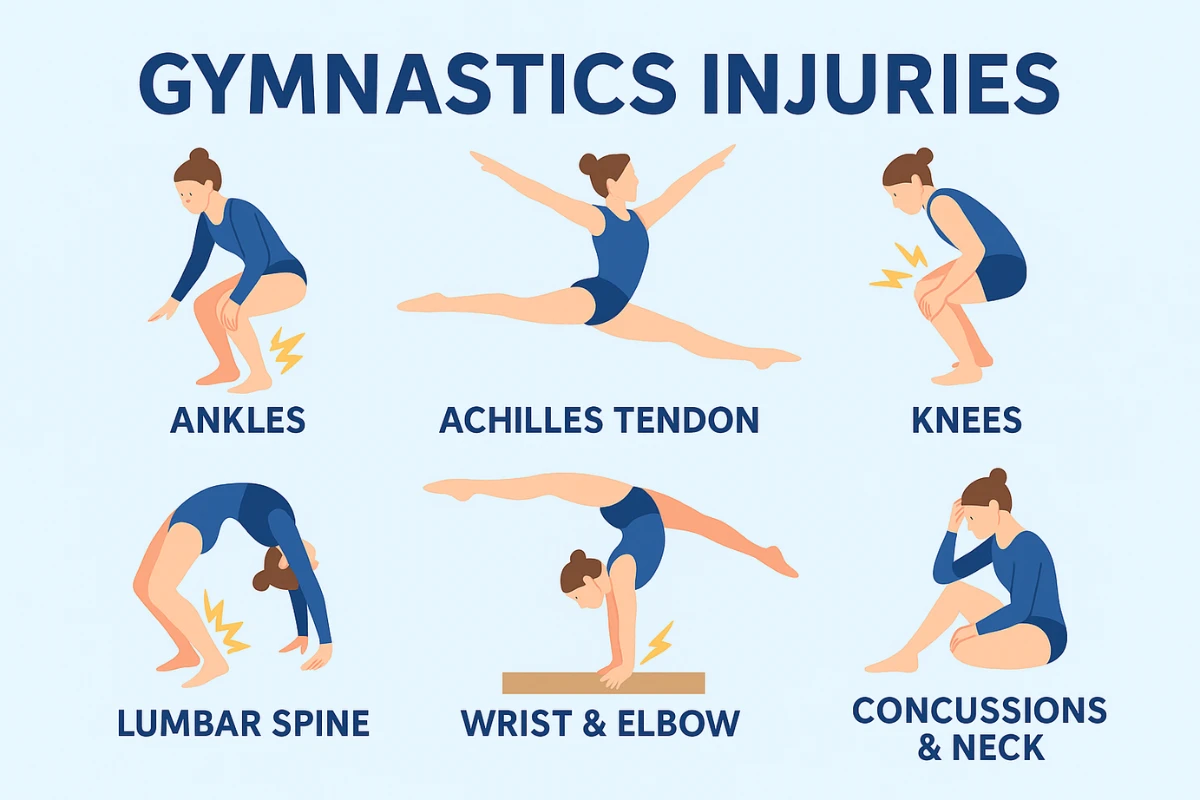
Women’s gymnastics is one of the most physically demanding sports, and the injury stats show it. NCAA injury surveillance recorded about 8 injuries per 1,000 athlete-exposures in women’s gymnastics (Chandran et al., 2021), and an earlier comparison of 15 college sports found it had the second-highest injury rate in practice (Hootman et al., 2007).
Here’s a closer look at the most frequent injuries in women’s gymnastics—and why they happen so often.
1. Ankles: Sprains, Instability, and Foot Fractures
The ankle is one of the most commonly injured areas in women’s gymnastics. In NCAA data from 2014–15 to 2018–19, the knee and ankle together made up about a quarter of injuries (Chandran et al., 2021), and in earlier seasons the ankle was the most common site (Kerr et al., 2015).
Why It Happens
Gymnasts land with great force: measured landing forces range from about 4 to 14 times body weight, and the highest come from big skills such as double back somersaults (studies reviewed by Marinšek, 2010). The ankle takes the brunt of that load in just a fraction of a second.
Gymnasts typically land barefoot or in thin slippers, which offer little support. And since the sport rewards “stuck” landings (no steps or hops), gymnasts often try to freeze their landings, which puts even more stress on the ankle joint.
Even a slight inward roll of the foot can overstretch or tear ligaments. Over time, repeated sprains are linked to chronic ankle instability. An ankle that keeps rolling, or stays painful or swollen, should be checked by a doctor or physical therapist.
Warning Signs
- Frequent ankle rolling
- Swelling or pain after landings
- Feeling of looseness or weakness in the joint
2. Achilles Tendon Rupture
The Achilles tendon is one of the most frequently torn tendons in women’s gymnastics, especially in college athletes. In NCAA data, women’s gymnastics had the highest rate of Achilles injuries of any sport, about 16.7 per 100,000 athlete-exposures, against 4.3 in men’s basketball, the next highest (Chan et al., 2020).
Why It Happens
Most tears occur during powerful takeoffs on floor: in a study of college gymnasts, 91% of ruptures happened on floor, most of them at the take-off for backward tumbling (Bonanno et al., 2021). At that moment, the Achilles is loaded very quickly, and if it can’t withstand the load, it may rupture.
In the same study, factors linked with rupture included an elite background, harder vault and floor skills, competing in the all-around, and Division I competition (Bonanno et al., 2021).
Warning Signs
- Calf tightness or soreness, especially during jumps
- A sudden “pop” or snap at takeoff
- Difficulty pushing off or pointing the toes
3. Knees: ACL & Meniscus Tears
The knee is one of the most commonly injured joints in women’s gymnastics; in recent NCAA data it was just ahead of the ankle (Chandran et al., 2021). ACL tears and meniscus damage are serious injuries that often require surgery and long rehab.
Why It Happens
Blind landings—especially during beam dismounts or twisting floor passes—are a big risk. Without seeing the floor, gymnasts may land with inward-rotated knees, the exact posture that often tears the ACL.
Female gymnasts also tend to use their quadriceps more than their hamstrings during landings. This pattern increases forward force on the shin and makes the knee more likely to collapse inward.
Gymnasts are also expected to “stick” their landings, which sends large, very fast forces through the knee.
Finally, natural factors like hip structure, joint size, and hormone changes can increase ligament looseness and injury risk.
Warning Signs
- A loud “pop” or sharp pain during landing
- Swelling and trouble straightening the knee
- Pain with pivoting or twisting
- Locking or catching in the joint
4. Lumbar Spine Stress Injuries
Back pain is common in gymnasts: studies report it in roughly 25–85% of gymnasts, depending on age, level and how back pain is defined (USA Gymnastics, 2022). A major cause is stress injury to the lower spine, especially the pars interarticularis, which can lead to stress fractures or vertebral slippage.
Why It Happens
Many gymnastics skills involve repeated arching, such as bridges, back walkovers and back handsprings. Done again and again, this can cause a stress fracture in the lower back called spondylolysis (USA Gymnastics, 2022). The American Academy of Pediatrics says gymnasts with low back pain for longer than 2 weeks should see a doctor.
Young athletes are especially vulnerable because their spine is still developing and their bones are not fully hardened.
RED-S (Relative Energy Deficiency in Sport) can make the problem worse. If a gymnast isn’t eating enough to support training, her bones may become weaker and less able to recover from stress.
Warning Signs
- Aching or sharp pain in the low back
- Pain that worsens when arching
- Muscle tightness or reduced flexibility in the back
5. Wrist & Elbow Overuse
Many gymnastics injuries involve the upper limbs, mostly the wrist and elbow. Unlike other sports, gymnastics constantly loads the arms with body weight.
Why It Happens
In a back handspring, the hands take more than twice body weight (Koh et al., 1992). Vaulting, bars, and handstands all generate strong impacts through small joints not built for repetitive high loads.
Young gymnasts are at greater risk because their growth plates (physes) are still open. These areas are softer and more vulnerable to injury from repetitive impact.
Two common overuse injuries include:
- Gymnast Wrist: A stress injury near the forearm growth plate. It causes swelling and pain and can affect bone growth if untreated.
- Capitellar OCD: A bone/cartilage injury in the elbow from repeated pressure during weight-bearing skills.
Warning Signs
- Pain during vault, bars, or handstands
- Swelling, stiffness, or clicking in the wrist or elbow
- Trouble fully extending or bending the elbow
6. Concussions & Cervical Sprain
Even though gymnastics isn’t a contact sport, concussions and neck sprains still happen—especially from falls on beam or bars. In NCAA data presented in 2023, women’s gymnastics had the highest rate of preseason concussions of any sport, about 9 per 10,000 preseason participations, against about 6 in football (University of Michigan).
Why It Happens
Beam and bars are elevated, and the margin for error is small. A missed hand or off-balance landing can send a gymnast falling onto her head or neck. Even with mats, the impact can be enough to cause a concussion or cervical injury.
In early season, gymnasts are also re-learning difficult skills after time off. Mistimed releases, short rotations, or missed landings increase head and neck risk.
Warning Signs
- Headache, nausea, or dizziness
- Trouble focusing or foggy thinking
- Neck pain or stiffness
- Poor balance or slowed reactions
Outlook
Injuries are common in women’s gymnastics, but they don’t have to be expected. With smart training, proper recovery, and early attention to warning signs, many injuries can be prevented or managed before they get worse. A strong body, a careful plan, and a supportive team can help gymnasts stay healthy and perform at their best.