Artistic gymnastics is the most well-known and widely followed type of gymnastics. It’s the one most people think of when they hear “gymnastics,” most athletes enter, and most fans follow.
In this discipline, gymnasts perform short routines on different apparatuses to show off their strength, balance, flexibility, coordination, and creativity. What sets artistic gymnastics apart is the way it combines athletic difficulty with graceful performance. Gymnasts don’t just complete skills, they connect them into flowing routines, making it as much about presentation as it is about execution.
The Events in Artistic Gymnastics
Artistic gymnastics is divided into two categories:
- Women’s Artistic Gymnastics (WAG) – 4 events
- Men’s Artistic Gymnastics (MAG) – 6 events
Each event challenges the gymnast in unique ways, from tumbling and vaulting to swinging and balancing.
Women’s Events (WAG)
- Vault (VT)
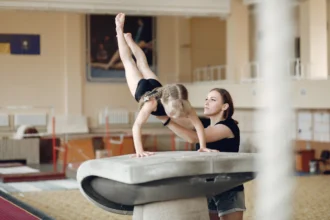
Gymnasts sprint down a runway, launch off a springboard onto the vault table, and perform a flipping and twisting motion in the air before landing. Power, precision, and form are key. - Uneven Bars (UB)
Two bars at different heights allow gymnasts to perform high-flying release moves, transitions, swings, and a final dismount. Grace and timing matter just as much as difficulty. - Balance Beam (BB)
A narrow 10 cm-wide beam tests a gymnast’s balance and nerves. Routines include acrobatic elements, leaps, turns, and a dismount—all while maintaining perfect posture and flow. - Floor Exercise (FX)
Gymnasts perform choreographed routines to music that blend tumbling passes, dance, leaps, and expressive movement. The floor is spring-loaded to help with powerful acrobatics.
Men’s Events (MAG)
- Floor Exercise (FX)
Like the women’s floor routine, but without music. It focuses more on power, strength, and tumbling difficulty, with less emphasis on artistry. - Pommel Horse (PH)
Considered one of the most challenging men’s events, this requires nonstop circular leg swings, scissors, and hand transitions without pausing. - Still Rings (SR)
Hanging rings suspended from above test a gymnast’s upper body strength and control. Athletes must perform strength holds, swings, and a powerful dismount. - Vault (VT)
Similar to the women’s vault but typically performed with greater power and a focus on more difficult twisting entries. - Parallel Bars (PB)
Gymnasts swing, press, and flip between two parallel bars in a routine that combines fluidity with upper-body strength and technical precision. - Horizontal Bar (HB)
A single high bar where gymnasts perform big release moves, twists, and dismounts. Grip strength, timing, and aerial awareness are essential.
The Skills in Artistic Gymnastics
Artistic gymnastics includes a wide range of skills across events. Each skill is assigned a difficulty value in the FIG Code of Points, ranging from easiest (A) to hardest (I or higher in elite competitions).
Here are some skill types you might see:
- Tumbling skills (e.g., back handsprings, double saltos, twisting layouts)
- Release moves on bars (e.g., Tkatchev, Jaeger, Gienger)
- Balance elements (e.g., turns, leaps, scales on beam)
- Strength holds (e.g., iron cross on rings, planche on pommel horse)
- Transitions and connections (especially on beam and bars)
- Dismounts (flipping and twisting finishes off apparatuses)
Athletes combine these skills into routines that must meet required elements and aim for maximum difficulty, all while maintaining perfect form.
How Is Artistic Gymnastics Scored?
Artistic gymnastics uses a two-part scoring system that evaluates both what gymnasts do and how well they do it. Each routine is judged using two separate scores: the Difficulty Score (D-score) and the Execution Score (E-score).
1. Difficulty Score (D-score)
This score reflects the level of difficulty in a gymnast’s routine. Judges look at:
- The hardest skills performed (up to 8 for women, 10 for men)
- Bonus points from skill combinations
- Whether all required elements are included
There’s no maximum D-score. The harder the routine, the higher this score can go.
2. Execution Score (E-score)
The E-score starts at a perfect 10.0. Judges subtract points for mistakes, such as:
- Bent knees or flexed feet
- Poor posture or body alignment
- Balance checks on beam or wobbles
- Extra steps or falls on landings
The goal is to perform with clean, precise technique and smooth transitions.
Final Score = D-score + E-score – Penalties
The gymnast’s total score is the sum of their D and E scores minus any neutral deductions, such as:
- Stepping out of bounds
- Exceeding time limits
- Coach interference or attire violations
Example:
Let’s say a gymnast’s routine has:
- D-score = 5.6
- E-score = 8.8
- Neutral Deduction = 0.1
Their final score would be: 5.6 + 8.8 – 0.1 = 14.3
This open-ended scoring system encourages gymnasts to push for more difficulty, while still rewarding clean and artistic execution. The best routines strike a balance between complexity and control.