Pommel Horse vs. Rings: How These Men’s Gymnastics Events Differ
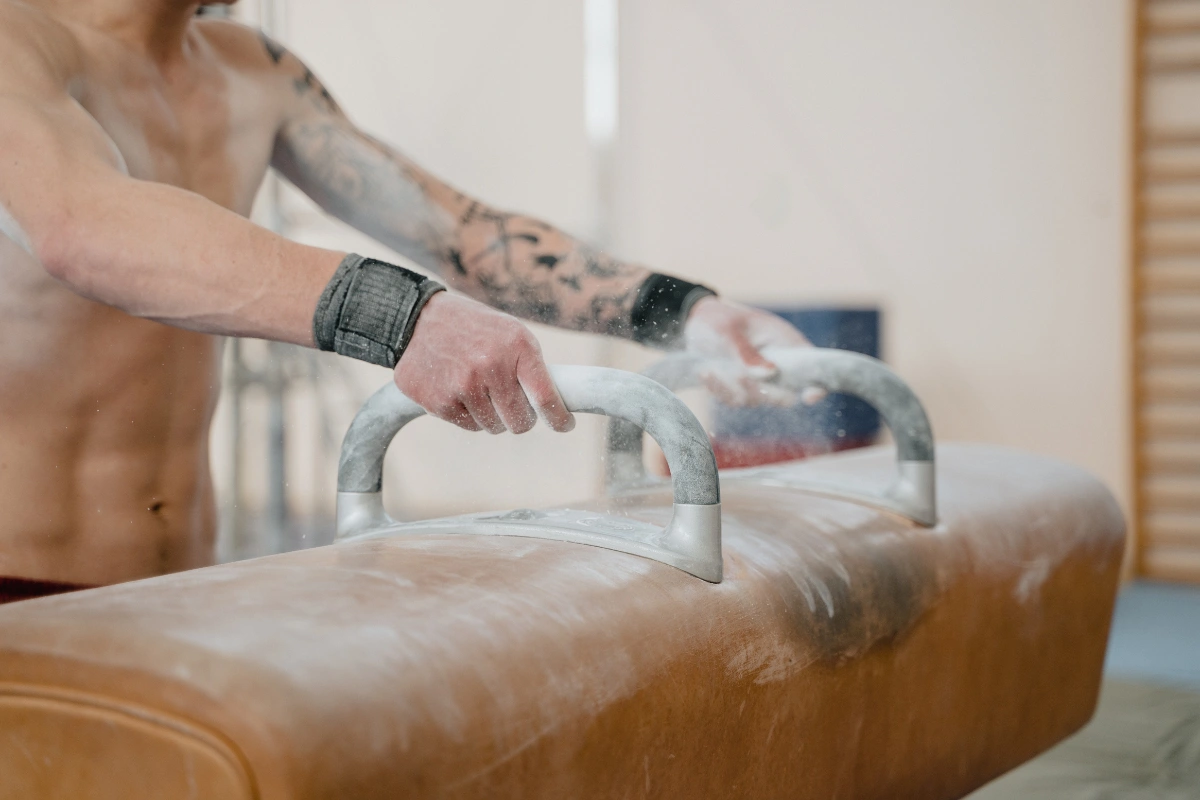
Pommel horse and still rings are both men’s artistic gymnastics events, but they reward very different performances. On pommel horse, the gymnast keeps circling, changing hand support and moving around a fixed apparatus. On rings, the gymnast combines swings with deliberately held positions while controlling two suspended handholds.
Contents
They belong to the men’s six-event international program because that is how the competition is organized. Their absence from the women’s four-event program does not mean women are incapable of learning ring or pommel skills. For a spectator, the more useful question is what makes each event difficult—and what to watch beyond the athlete’s upper-body strength.
Pommel horse and rings at a glance
| Feature | Pommel horse | Still rings |
|---|---|---|
| Main equipment | A padded horse with two raised handles, called pommels | Two rings suspended from a supporting structure |
| Most recognizable action | Continuous circles, scissors and travel along the horse | Swings linked with controlled strength positions |
| Relationship to the support | The hands move between fixed support points | The athlete must control handholds that can move |
| What a pause can mean | An interruption of the intended flow | An essential part of a recognized hold |
| Common viewing mistake | Watching only the feet and missing the hand changes | Watching only a famous strength hold and missing the transitions |
The contrast between continuous movement and controlled stillness is a useful starting point. It is not an absolute division between “skill” and “strength.” Both athletes need substantial physical preparation, and both routines involve precise technique.
Pommel horse: watch the hands as well as the legs
A circle takes the gymnast’s joined legs around the apparatus while the hands alternately support the body. A flair uses a visibly separated-leg action. Scissors have a different, alternating single-leg pattern. Once you recognize those broad shapes, an apparently repetitive routine starts to reveal changes in direction, support and position.
Travel adds another layer. The gymnast moves along the horse while maintaining the exercise, rather than circling indefinitely in one place. Turns can change the body’s orientation relative to the apparatus. The feet attract attention because they trace a large path, but the timing of each hand placement is what makes that path possible.
Try watching one sequence twice. On the first viewing, follow the legs. On the second, follow the hands and notice where the gymnast is supporting their weight. A move that initially looked like “more circles” may include a change from two pommels to one, a turn or movement toward the end of the horse.
The men’s 2025–2028 Code of Points describes pommel horse as a swinging exercise without visible interruption; strength and hold elements are not permitted. That explains why a handstand here is part of a flowing action, rather than an invitation to stop and display a balance. Our circles-versus-flairs guide looks more closely at the two recognizable leg patterns.
Still rings: the transitions matter as much as the holds
On rings, a gymnast may move from a hanging position into support, through a handstand or into a strength position. An iron cross is an easy example to recognize: the body is upright and the arms extend outward. Other elements place the body horizontally or inverted, changing what the athlete must control.
The apparatus is called still rings, but the gymnast does not remain motionless throughout the routine. Swings are part of the event. The challenge includes moving into a position cleanly, establishing the required shape and leaving it under control. A strong-looking final pose does not erase an untidy entry.
For required holds, the FIG Code specifies a minimum of two seconds, counted from a complete stop. A slow transition is therefore not the same thing as a completed hold. Viewers can ask two separate questions: did the gymnast reach the intended position, and was that position actually held?
The equipment itself also deserves attention. A competition ring frame is an engineered system, not simply two loops hanging from any convenient ceiling. For example, SPIETH’s Berlin frame incorporates shock absorption, adjustable suspension and cable tensioning. Those features help explain why playground rings or a home fitness setup should not be treated as equivalent competition apparatus.
Why the strongest athlete does not automatically win
Physical strength is necessary, but a gymnastics result measures a performance under event-specific rules. A gymnast has to select a suitable routine, complete its elements and connect them with control. More difficult work can create opportunities for a higher difficulty score, while errors reduce execution.
Consider two hypothetical pommel routines. One contains ambitious travel and turning work but several interruptions. Another has less difficulty and moves cleanly from beginning to end. Knowing only which routine “looked harder” is insufficient to predict the result; both difficulty and execution matter.
The same applies to rings. A spectacular strength element can draw applause, yet the rest of the exercise still counts. Body position, the way holds are established, swing control and the dismount all contribute to the overall performance. Looking only at the most recognizable pose misses much of the event.
Nor can body size tell you who will perform best. A spectator cannot read an athlete’s coordination, preparation or consistency from appearance. Describing pommel horse as “just balance” or rings as “just muscles” hides the technical work that makes both events compelling.
Why are they in the men’s program?
At FIG international level, men compete on floor exercise, pommel horse, rings, vault, parallel bars and horizontal bar. Women compete on vault, uneven bars, balance beam and floor exercise. These are established competitive programs with separate rules; they are not tests of everything any individual man or woman could learn.
The broader history belongs in our guide to why men’s and women’s gymnastics have different events. For this comparison, the important distinction is between an event’s place in a rulebook and a person’s opportunity to train.
Some competition frameworks explicitly cross the traditional event lists. United Club Gymnastics’ Unified Artistic rules, formerly under NAIGC, allow participation across men’s and women’s apparatus regardless of gender. That is a specific alternative format, not a change to the FIG international all-around.
What beginners should expect to learn first
A first lesson need not resemble an elite routine. A coach may use lower equipment, basic support or hanging activities, and separate preparation stations. A mushroom trainer, for example, offers a different learning environment from a full pommel horse with two handles.
Ask what the activity is teaching. Is the gymnast learning where to place the hands, how to maintain a body shape or how to move between support positions? Understanding the immediate goal is more helpful than asking how soon a child will perform an iron cross or a complete traveling sequence.
The next time you watch these events, give yourself one task on each: follow the hand changes on pommel horse, then follow the transitions into and out of holds on rings. You will see two distinct forms of control—and much more than a demonstration of arm strength.