Artistic gymnastics is one of the most watched sports in the Olympics, captivating audiences with its blend of strength, elegance, and daring acrobatics. But if you’ve ever paid close attention, you might have noticed something interesting: men and women don’t compete on the same events.
How Many Events Are in Artistic Gymnastics?
- Men compete in 6 events.
- Women compete in 4 events.
These events are performed in individual and team competitions, as well as all-around finals, where gymnasts are judged on their performance across all apparatuses.
Women’s Gymnastics Events (4 Apparatuses)
WAG (Women’s Artistic Gymnastics) has four events designed to blend dance, acrobatics, and elegant execution.
1. Vault (VT)
Theme: Power, speed, and precise landings.
Women sprint down a 25-meter runway, hit the springboard, block off the vault table, and complete flips or twists before landing. The scoring focuses heavily on height, form, and landing stability. Because it’s over so quickly, even tiny execution errors matter.
Skills involve:
- Front handsprings
- Tsukaharas
- Yurchenkos
- Round-off entry vaults
- Multiple twisting layouts at elite levels
2. Uneven Bars (UB)
Theme: Swinging, transitioning, and flight.
The bars are set at two different heights, which creates transitions unique to women’s gymnastics. Athletes swing, release, regrasp, and move between bars with fluid rhythm.
Skills involve:
- Kips
- Cast to handstands
- Release moves like Tkatchevs, Jaegers, and Giengers
- Pirouettes
- High-flying dismounts like double layouts
The event rewards seamless flow, clean body lines, and high-flying release moves.
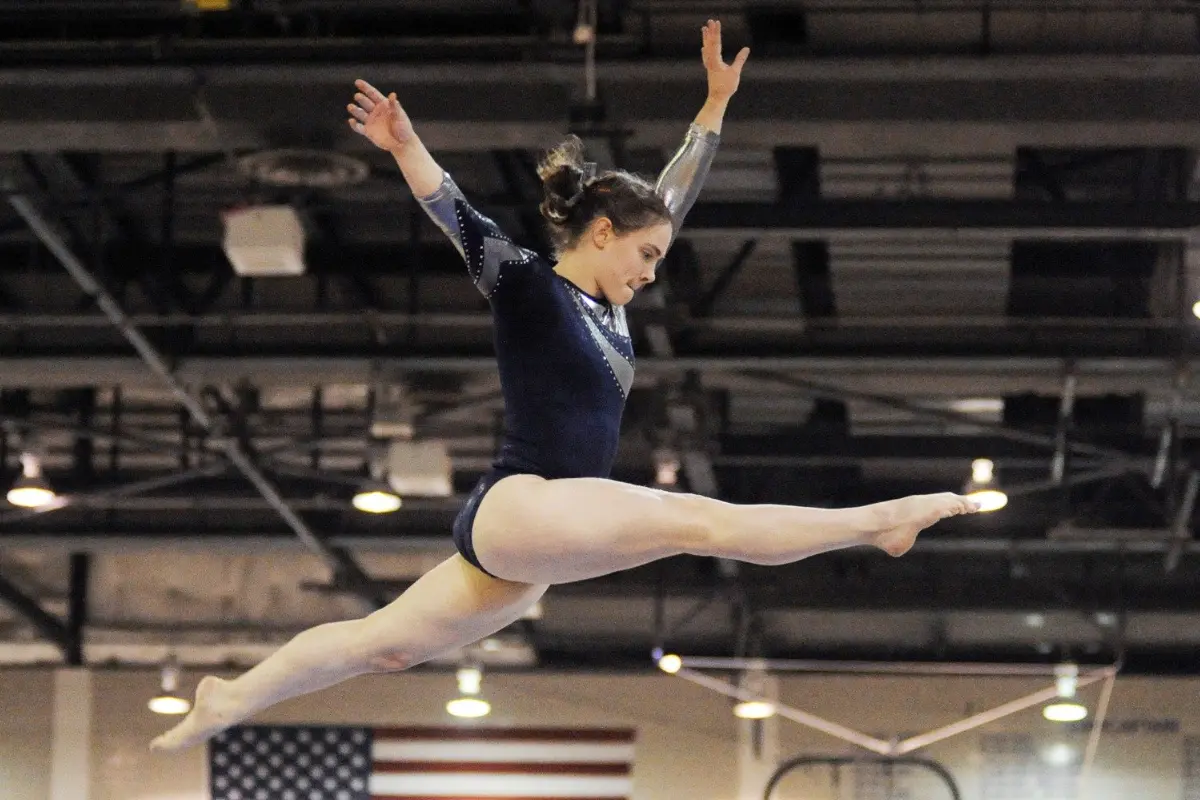
3. Balance Beam (BB)
Theme: Precision, balance, and artistry.
At just 10 cm (about 4 inches) wide, the beam demands intense focus. Routines combine dance elements with leaps, turns, acrobatics, and a powerful dismount.
Skills involve:
- Back handsprings
- Layout step-outs
- Split leaps and switch leaps
- Side aerials
- Full turns and double turns
- Salto dismounts
Even the smallest wobble is judged, so confidence and control are everything.
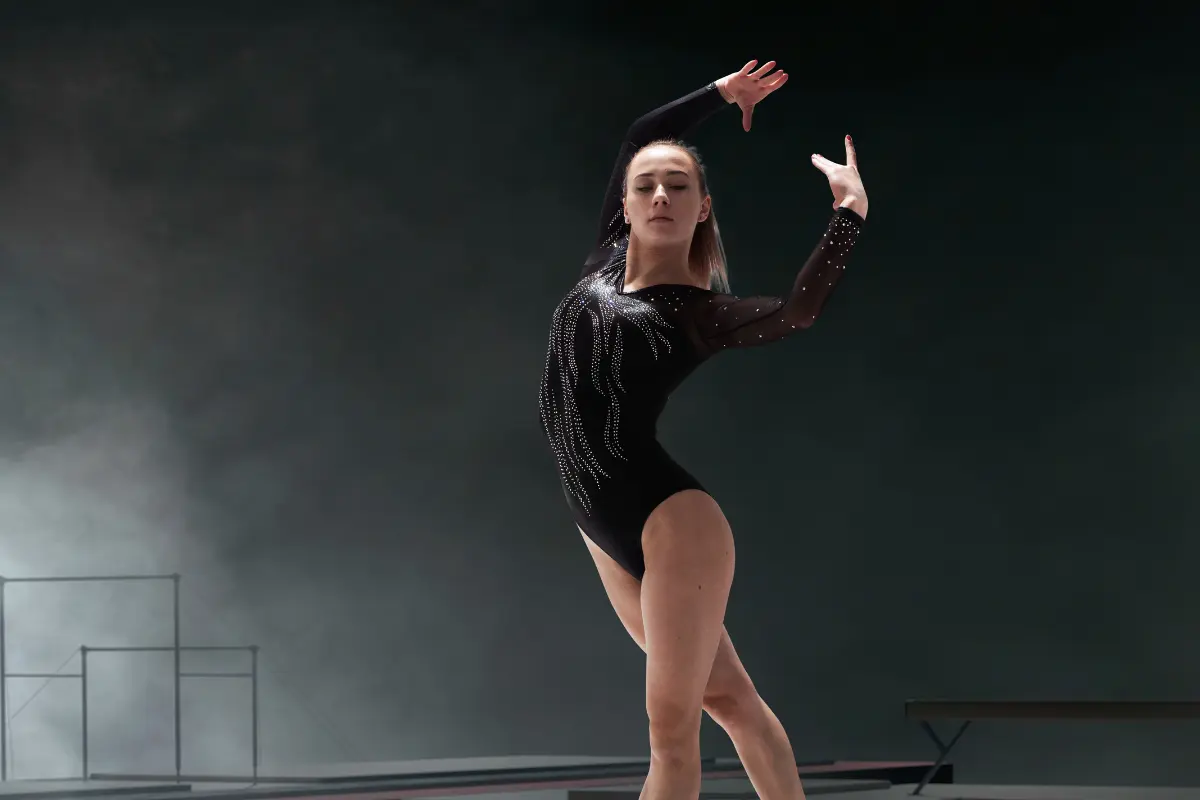
4. Floor Exercise (FX)
Theme: Dance + tumbling with music and choreography.
Women perform to music and incorporate expressive choreography between tumbling passes. Routines blend artistry, acrobatics, and musical interpretation.
Skills involve:
- Round-off back handspring double back tucks
- Twisting layouts
- Leap series
- Dance turns
- Choreography that connects movements
Unlike men, women’s floor is heavily performance-based.
Men’s Gymnastics Events (6 Apparatuses)
MAG (Men’s Artistic Gymnastics) emphasizes strength, power, swing elements, and body control. Men do not perform with music, and choreography is not part of scoring.
1. Floor Exercise (FX)
Theme: Power, tumbling, and control.
Men’s floor does not include dance or music. Instead, routines focus on tumbling difficulty, strength holds, balance control, and clean landings.
Skills involve:
- Multiple twisting layouts
- Double backs and triple twists
- Strength holds (planche, press handstand)
- Controlled landings
The routine must cover the entire floor area and show different directions of movement.
2. Pommel Horse (PH)
Theme: Continuous swing and rhythm.
Pommel horse is one of the hardest events in men’s gymnastics. Athletes swing their legs in circles, travel across the horse, and perform flairs without stopping.
Skills involve:
- Circles
- Flairs
- Travels
- Russians
- Handstand dismounts
It’s entirely based on rhythm, precision, and upper-body endurance.
3. Still Rings (SR)
Theme: Extreme strength and stability.
Rings require enormous strength because the apparatus moves freely. Gymnasts must eliminate any swing while holding difficult positions.
Skills involve:
- Iron cross
- Maltese
- Planche
- Inverted cross
- High-level dismounts
Rings are the purest test of strength in artistic gymnastics.
4. Vault (VT)
Theme: Power and explosive speed.
Men vault using the same table as women but often perform more difficult twisting vaults due to greater upper-body strength.
Skills involve:
- Handspring vaults
- Kasamatsu vaults
- Dragulescu (handspring double front with half twist)
- Tsukahara variations
Men compete one vault in team and all-around, but two vaults in event finals.
5. Parallel Bars (PB)
Theme: Swinging, upper-body strength, and clean lines.
The event mixes strength holds with powerful flight skills between the bars.
Skills involve:
- Moy to handstand
- Giant swings
- Peach baskets
- Double pike dismounts
- Diamidov and Healy turns
It requires both grace and force.
6. Horizontal Bar (HB or High Bar)
Theme: High-flying release moves and giant swings.
The high bar allows for the biggest release skills in men’s gymnastics. Routines include large swings, big releases, and dynamic dismounts.
Skills involve:
- Kovacs, Kolman, and Cassina
- Multiple giant swings
- Pirouettes
- Triple twist dismounts
This is one of the most exciting events to watch because of the height and risk.
Quick Comparison Table
| Event | Men ✅ | Women ✅ |
|---|---|---|
| Floor Exercise | ✅ | ✅ |
| Vault | ✅ | ✅ |
| Pommel Horse | ✅ | ❌ |
| Still Rings | ✅ | ❌ |
| Parallel Bars | ✅ | ❌ |
| Horizontal Bar | ✅ | ❌ |
| Uneven Bars | ❌ | ✅ |
| Balance Beam | ❌ | ✅ |
Shared Events but Completely Different Styles
Vault: Nearly the Same Event
Both men and women perform vault, but women’s vault is usually more explosive and tight in form, while men sometimes perform higher-difficulty skills due to greater upper-body strength and power.
Floor: The Biggest Difference of All
- Men’s floor: pure power, no music
- Women’s floor: dance + tumbling to music
This contrast makes the two divisions feel like entirely different sports even on the “same” event.
Why Do Men and Women Have Different Events in Gymnastics?
Men and women don’t compete on the same events in artistic gymnastics not because one group can’t do what the other does, but because the sport was designed to show off different strengths and movement styles.
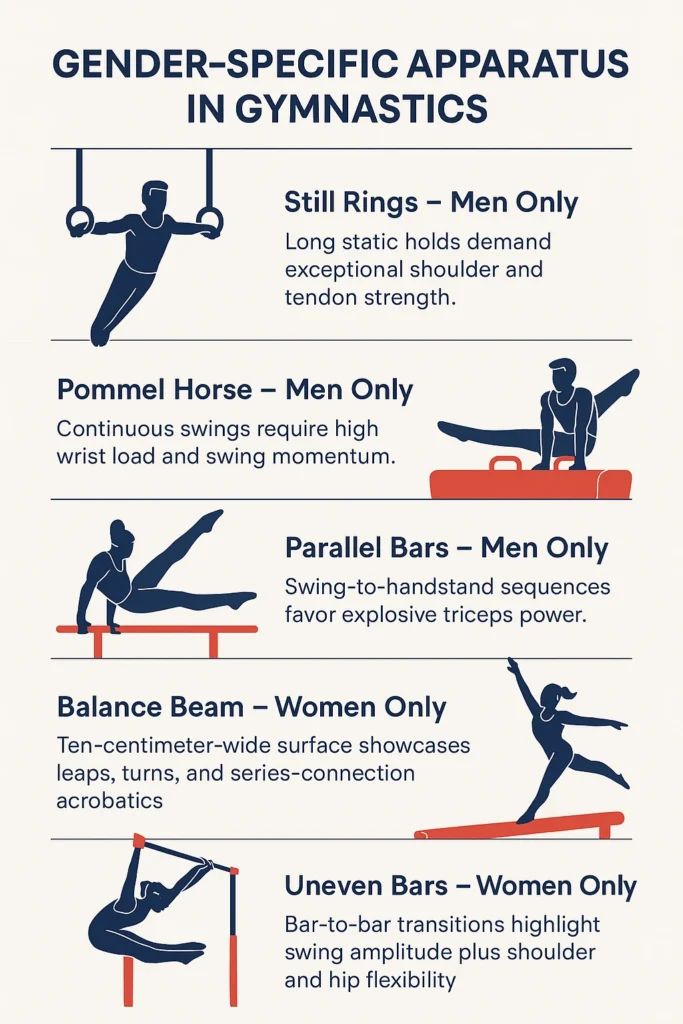
- Men’s events focus on power, strength, and control
- Women’s events highlight balance, flexibility, and grace
Do These Differences Limit Athletes?
Not at all. Both men and women perform incredibly demanding routines tailored to their apparatuses. While the events differ, the training, discipline, and athleticism required are equally elite.
Some gymnasts (especially in exhibition or adult classes) cross-train on both sets of apparatus for fun or personal challenge, but in official competition, each gender sticks to their defined events.