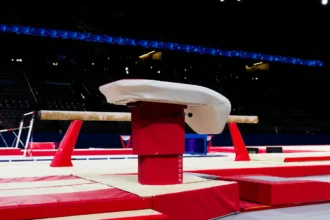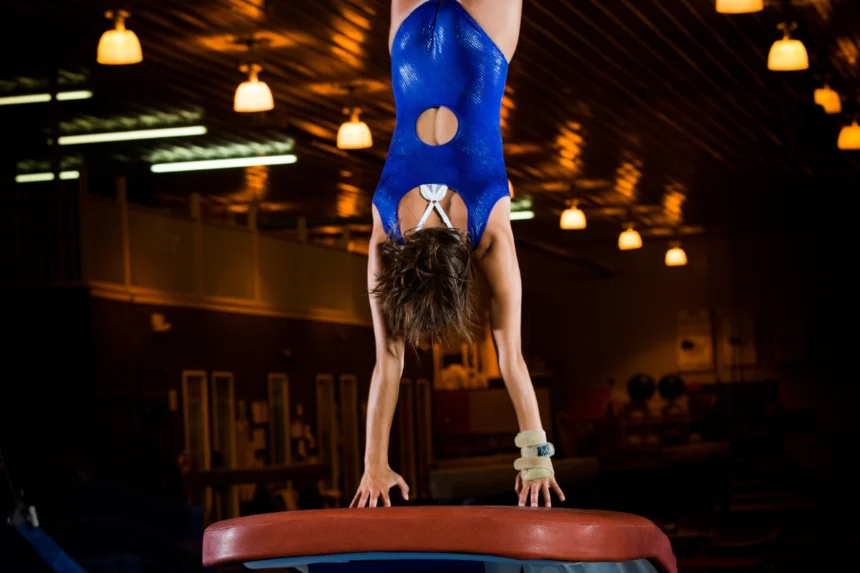
In gymnastics, few skills carry a reputation as fearsome as the Produnova vault. Officially classified as a handspring double front tuck (Family 2 in the FIG Code of Points), it demands a front handspring entry onto the vaulting table, followed by two consecutive forward flips in the tucked position.
It was first performed by Russian gymnast Yelena Produnova in 1999, and since then, only a handful of athletes have dared to attempt it in international competition. Because of its catastrophic risk factor, it earned the chilling nickname: the “Vault of Death.”
Why the Produnova Is So Dangerous
The Produnova is not just difficult—it’s inherently high-risk, pushing the boundaries of human control, timing, and landing mechanics. Four key factors explain why it is considered one of the most dangerous vaults in gymnastics:
1. High Velocity and Power
To perform the Produnova, the gymnast must sprint at maximum speed and explode into a powerful handspring. This combination generates the height and momentum needed to fit in two forward flips. But if the block off the table is even slightly mistimed, the gymnast may not reach the vertical clearance required—leading to under-rotation and potential disaster.
2. Complex Aerial Movements
The vault requires completing two forward saltos while maintaining a tucked shape and tight body control. Some gymnasts also add a half-twist, which increases aerial complexity. Managing this many rotations in such a short time while moving forward creates a razor-thin margin of error.
3. Limited Time to Correct Mistakes
Unlike some twisting vaults that allow gymnasts to make small mid-air adjustments, the Produnova gives the athlete almost no time to correct errors. Any mistake in the run, hand placement, or block carries through the entire skill. A miscalculation at the start can result in landing on the knees, back, or head.
4. High-Impact Landing
Landing a Produnova safely requires extreme precision. The gymnast must absorb tremendous force while coming out of two flips with little visibility of the ground. Even when landed successfully, the impact puts major strain on the ankles, knees, and spine. If the gymnast comes up short or over-rotates, the landing can result in fractures, ligament tears, or spinal injuries.
Difficulty Rating Through the Years
When the Produnova first appeared in the FIG Code of Points, it was given an astonishingly high value, reflecting its near-unmatched complexity. Over time, however, its difficulty score has been adjusted downward, both to balance the scoring system and to discourage unsafe attempts.
- 2013–2016: Assigned a difficulty value of 7.0, making it the highest-rated vault of the period.
- 2017–2020: Reduced to 6.4, acknowledging both the vault’s extreme risk and the evolving scoring system.
- 2022–2024: Lowered again to 6.0, where it remains in the current Code (2025–2028 cycle).
These changes don’t mean the vault has become any easier, it’s still one of the most technically demanding in gymnastics. Instead, the reductions reflect a broader effort by the FIG to balance risk and reward, ensuring gymnasts aren’t pressured into attempting skills beyond safe limits.
Who Has Attempted the Vault of Death?
Only a small group of gymnasts has competed the Produnova at the elite level. Among the most notable:
- Yelena Produnova (Russia): The originator, who gave the vault its name in 1999.
- Yamilet Peña (Dominican Republic): Attempted it frequently in the early 2010s, sometimes with inconsistent landings.
- Dipa Karmakar (India): Gained international recognition for competing the vault at the 2016 Rio Olympics, becoming a national icon for her courage.
- Oksana Chusovitina (Uzbekistan): Trained the vault in later stages of her career but opted for safer alternatives in competition.
Each attempt drew headlines, not just for the athleticism required but for the palpable sense of danger every time the vault was performed.
Produnova vs. Biles II: Danger vs. Difficulty
The Produnova is often compared to the Yurchenko double pike (Biles II), currently the hardest vault in the Code with a 6.4 D-score.
- The Biles II is considered the most difficult vault because of the sheer power and technique needed to complete two back flips in a piked shape.
- The Produnova is considered the most dangerous vault because of its blind forward landing and the catastrophic consequences of even small errors.
This distinction is why the Produnova continues to be feared, while the Biles II is celebrated as the peak of women’s vaulting evolution.
Bottom Line: A Vault Few Dare Attempt
The Produnova’s legacy is one of awe and alarm. While its 6.0 difficulty value still places it among the top vaults in the world, the risks are so severe that most gymnasts and coaches avoid it entirely. Today, safer yet still difficult vaults like the Cheng (5.6) and Amanar (5.4) dominate elite competitions.
Yet the Produnova’s nickname, the “Vault of Death,” ensures it will always be remembered as a daring skill that tested the very limits of women’s gymnastics. For those who have attempted it, the vault is both a badge of honor and a reminder of just how thin the line between glory and danger can be in this sport.